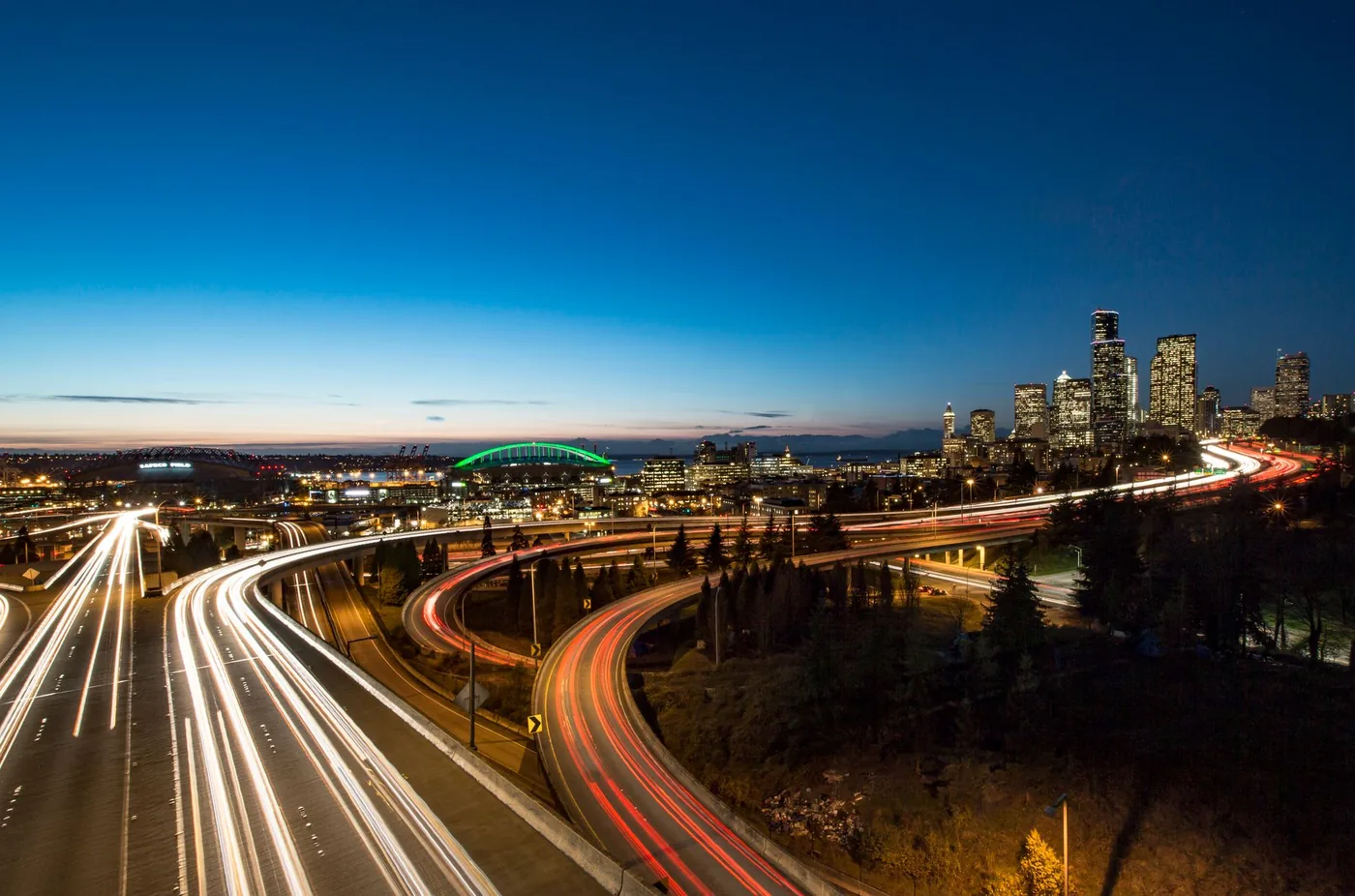
Seattle rush hour times
| Day | Morning peak | Evening peak | Worst 30 min | Best time to leave |
|---|---|---|---|---|
| Mon–Thu | 6:30–9:30 a.m. | 3:00–6:30 p.m. | Core of each peak window | Before 6:30 a.m. or after 9:30 a.m.; evening outside 3:00–6:30 p.m. |
| Friday | 6:30–9:30 a.m. | 3:00–6:30 p.m. (often stretches) | Friday evening outbound | Shift earlier than Mon–Thu when you can |
| Weekend | Lighter commute peaks | Bridge and event surges vary | No fixed weekend commute clock on this page | Outside weekday peaks; still check I-5 and your bridges |
When does Seattle traffic die down?
Morning traffic dies down after about 9:30 a.m.; evening traffic after about 6:30 p.m.; Seattle’s evening peak starts early.
If you work 12-hour nights on a rotation such as the DuPont work schedule, the early evening peak helps: a 7 p.m. start usually means leaving after the worst of it has eased, while the 7 a.m. drive home meets the morning peak as it builds.
Seattle's geography is the traffic story: a city pinched between water on both sides, with two floating bridges and one interstate carrying nearly everything. South on I-5, Portland's shorter but sharper peaks are a different problem. Here's what the data says, when I-5 and the bridges actually peak, and how to find the best time to leave for your route.
Seattle drivers lose about 68 hours a year to traffic
In the 2025 INRIX Global Traffic Scorecard data, Seattle-area drivers lost roughly 68 hours to congestion, keeping the metro among the ten most congested in the US — and the trend is up: Inrix measured a 9% jump the year before as return-to-office commutes rebuilt the peaks. That's a week and a half of work time a year spent in traffic.
When is Seattle traffic worst?
Mornings run roughly 6:30–9:30 a.m. and evenings roughly 3:00–6:30 p.m. — Seattle's evening peak starts notably early. By corridor:
- I-5 through downtown — the spine, slow in both peaks; the convergence with I-90 and the express-lane reversals shape the day.
- The floating bridges — SR-520 and I-90 — everything crossing Lake Washington funnels onto two bridges; when one has trouble, the other absorbs it and both crawl. SR-520's tolling shifts some demand by time of day.
- I-405 on the Eastside — Bellevue-Kirkland-Renton commutes stack up at both peaks; the express toll lanes change the calculus hour to hour.
- The Mercer corridor — the "Mercer Mess" into South Lake Union backs up whenever tech commutes surge.
- SR-99 and the tunnel — a useful I-5 relief valve, but its portals jam in the peaks too.
The simple move: shift off the peak
Leaving just before or just after the busiest window clears a large share of the delay — Seattle's corridors genuinely thin out on either side of the peak. Against 68 hours a year and rising, a consistent 15–30 minute shift is the cheapest time you'll buy back — work out which side of the peak to aim for before you set the alarm.
Three Seattle-specific things that move the peak
- Rain. It rains often enough that drivers cope, but heavy rain and the dark months measurably slow the peaks — a wet November evening is a different commute from a dry July one. See how weather affects traffic.
- Tech schedules. Return-to-office waves at the big employers visibly rebuild the Mercer and 520 peaks — Tuesday-through-Thursday runs heavier than Monday and Friday.
- Game days. Seahawks, Mariners or Kraken games load I-5, SR-99 and the stadium exits; the evening peak stretches hours later those days.
Why your best time is route-specific
I-5 doesn't peak like 520, a wet Thursday isn't a dry Monday, and a game day rewrites SoDo. Citywide advice smooths over exactly the differences that decide your drive. (Nationally, the worst day of the week varies by city too.)
Find the best time to leave for your Seattle route
Google Maps and Waze show live traffic and turn-by-turn once you are already on the road. BoardSpy is the leave-time app: it checks your saved Seattle before you leave route before you leave, recommends when to go, sends traffic and weather alerts, tracks delay and on-time stats (including best and worst days), and factors in weather along the way. When you set off, it opens your map app for turn-by-turn. For how routing apps differ from departure-timing tools, see best app to avoid traffic and Google Maps commute alternatives. See also how to find alternate routes — and where to eat driving through Seattle.
Just passing through?
This page is for commuters leaving Seattle. If you are a road tripper crossing the metro on the interstate, see best time to drive through Seattle instead.
Nearby cities
Every metro is listed on Best time to leave by city.
Frequently asked questions
When does Seattle traffic die down?
Morning traffic dies down after about 9:30 a.m.; evening traffic after about 6:30 p.m.; Seattle’s evening peak starts early.
What is the best time to leave to avoid traffic in Seattle?
Generally before 6:30 a.m. or after 9:30 a.m. in the morning, and outside 3:00–6:30 p.m. in the evening — Seattle's evening peak starts early. The exact best time depends on your corridor and day.
When is Seattle rush hour?
Roughly 6:30–9:30 a.m. and 3:00–6:30 p.m., with I-5 and the Lake Washington bridges slow beyond the nominal windows.
How bad is Seattle traffic compared to other cities?
Seattle sits among the ten most congested US metros in the 2025 INRIX data, with drivers losing about 68 hours a year — and congestion has been climbing as office commutes return.
What is the worst road in Seattle?
I-5 through downtown is the signature bottleneck, with the SR-520 and I-90 floating bridges close behind — everything crossing Lake Washington funnels onto those two spans.
Why is Seattle traffic so bad?
Geography: water on both sides squeezes the region onto one interstate and two floating bridges, so there's little spare capacity — and rain, dark winters, and rebounding tech commutes stretch the peaks.
How do I find the best time to leave for my Seattle commute?
Use a leave-time commute app that reads your actual route — not only a live map. BoardSpy recommends when to leave for your Seattle commute route, sends pre-departure traffic and weather alerts, and tracks on-time performance and best and worst traffic days. Download it at https://boardspy.site/apps/.