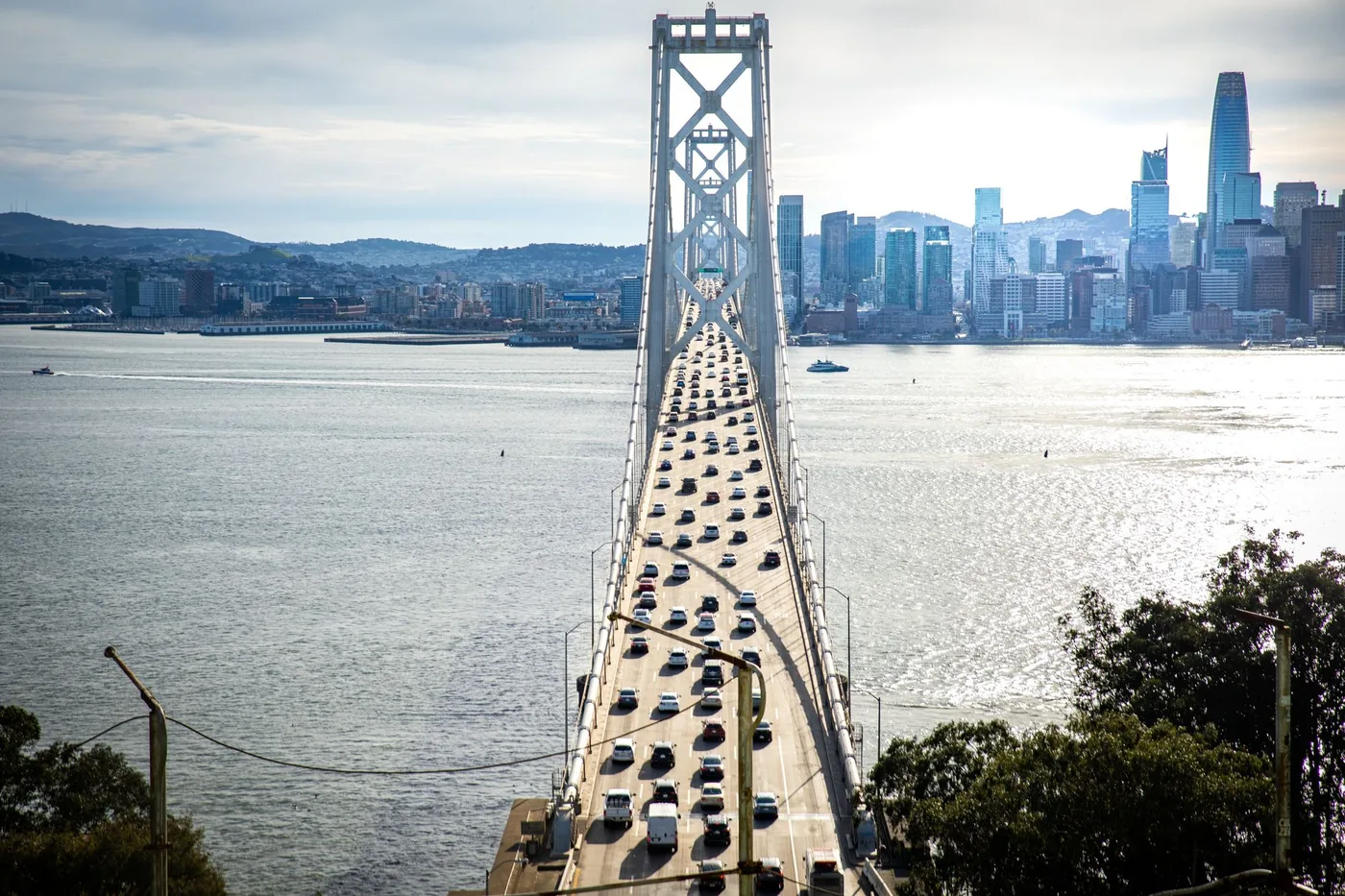
San Francisco rush hour times
| Day | Morning peak | Evening peak | Worst 30 min | Best time to leave |
|---|---|---|---|---|
| Mon–Thu | 6:30–9:30 a.m. | 3:30–7:00 p.m. | Bay Bridge corridor peak | Before 6:30 a.m. or after 9:30 a.m.; evening outside 3:30–7:00 p.m. |
| Friday | 6:30–9:30 a.m. | 3:30–7:00 p.m. (often stretches) | Friday evening bridge outbound | Leave earlier than Mon–Thu when you can |
| Weekend | Lighter commute peaks | Bridge recreational surges vary | No fixed weekend commute clock on this page | Outside weekday peaks; on a bridge commute, 15 minutes earlier still matters |
When does San Francisco traffic die down?
Morning traffic dies down after about 9:30 a.m.; evening traffic after about 7:00 p.m.; Bay Bridge delay concentrates the metro’s worst minutes.
San Francisco traffic is a story of chokepoints: the metro's overall numbers look milder than LA's or Chicago's, but the Bay Bridge corridor at the wrong hour is as brutal as anything in America. Here's what the data says, when the bridges and 101 actually peak, and how to find the best time to leave for your route.
What the data says about Bay Area traffic
In the 2025 INRIX Global Traffic Scorecard data, San Francisco drivers lost roughly 49 hours a year to congestion — notably lower than the biggest metros, but the trend is up (Inrix measured 45 hours in 2023 and rising), and INRIX's analysis names San Francisco among the nation's major congestion bottlenecks. The honest picture: fewer total hours than LA — Honolulu loses nearly the same 49 hours — but savage concentration — the delay lives on a handful of corridors at a handful of hours, which makes timing matter even more.
When is San Francisco traffic worst?
Mornings run roughly 6:30–9:30 a.m. and evenings roughly 3:30–7:00 p.m. By corridor:
- The Bay Bridge (I-80) approaches — the metering lights and the MacArthur Maze on the Oakland side are the region's signature jam; the morning westbound backup starts before 6:30 and the evening eastbound crawl can run past 7.
- US-101 — heavy both directions through the city and down the Peninsula; the 101/80 interchange backs up early.
- I-280 — the gentler Peninsula alternative, but its downtown end jams with everything else at peak.
- I-680 and I-580 — the East Bay commutes over the Altamont and through the Tri-Valley are among the longest-distance crawls in the region.
- The Golden Gate (US-101 north) — Marin commutes stack southbound in the morning and northbound in the evening.
The simple move: shift off the peak
Because Bay Area delay is so concentrated, shifting matters more here than the raw hours suggest: crossing the Bay Bridge at 6:15 versus 7:30 can be a completely different trip — time a bridge crossing to the minute from the arrival you need. A consistent 15–30 minute shift on a bridge commute routinely saves more time than any route change.
Three Bay Area-specific things that move the peak
- Bridge chokepoints. With the bay funneling everything onto a few spans, one incident at the Maze or the toll plaza rewrites the whole morning — incident days behave nothing like normal days.
- Tech schedules. Hybrid patterns make Tuesday–Thursday visibly heavier than Monday and Friday on 101 and the bridges.
- Fog and rain. Marine-layer mornings and the first real rain of the season slow the bridges and 101 well beyond normal. See how weather affects traffic.
Why your best time is route-specific
The Bay Bridge doesn't peak like 280, a foggy Tuesday isn't a clear Friday, and an incident at the Maze rewrites the East Bay. Regional advice smooths over exactly the differences that decide your drive. (Nationally, the worst day of the week varies by city too.)
Find the best time to leave for your Bay Area route
Google Maps and Waze show live traffic and turn-by-turn once you are already on the road. BoardSpy is the leave-time app: it checks your saved route before you leave route before you leave, recommends when to go, sends traffic and weather alerts, tracks delay and on-time stats (including best and worst days), and factors in weather along the way. When you set off, it opens your map app for turn-by-turn. For how routing apps differ from departure-timing tools, see best app to avoid traffic and Google Maps commute alternatives. See also how to find alternate routes — and where to eat driving through San Francisco.
Corridor detail: how far Oakland to San Francisco is.
Just passing through?
This page is for commuters driving in and around San Francisco. If you are crossing the city on the interstate rather than commuting within it, the timing question is different — see the best time to drive through San Francisco.
Nearby cities
Every metro is listed on Best time to leave by city.
Frequently asked questions
When does San Francisco traffic die down?
Morning traffic dies down after about 9:30 a.m.; evening traffic after about 7:00 p.m.; Bay Bridge delay concentrates the metro’s worst minutes.
What is the best time to leave to avoid traffic in San Francisco?
Generally before 6:30 a.m. or after 9:30 a.m. in the morning, and outside 3:30–7:00 p.m. in the evening — and on a bridge commute, even 15 minutes earlier makes an outsized difference.
When is San Francisco rush hour?
Roughly 6:30–9:30 a.m. and 3:30–7:00 p.m., with the Bay Bridge approaches backing up before and beyond those windows.
How bad is Bay Area traffic compared to other cities?
San Francisco drivers lost roughly 49 hours a year in the 2025 INRIX data — fewer total hours than LA or Chicago, but INRIX names SF among the nation's major bottlenecks: the delay is concentrated on a few corridors at peak hours.
What is the worst road in the Bay Area?
The Bay Bridge corridor — the toll plaza, metering lights and the MacArthur Maze — is the signature chokepoint, with 101 through the city and the 580/680 East Bay commutes close behind.
Why is Bay Bridge traffic so bad?
The bay funnels an enormous share of regional travel onto one span with metering lights and a complex interchange feeding it — so demand outstrips the bridge every peak, and any incident multiplies the backup.
How do I find the best time to leave for my Bay Area commute?
Use a leave-time commute app that reads your actual route — not only a live map. BoardSpy recommends when to leave for your Bay Area commute route, sends pre-departure traffic and weather alerts, and tracks on-time performance and best and worst traffic days. Download it at https://boardspy.site/apps/.