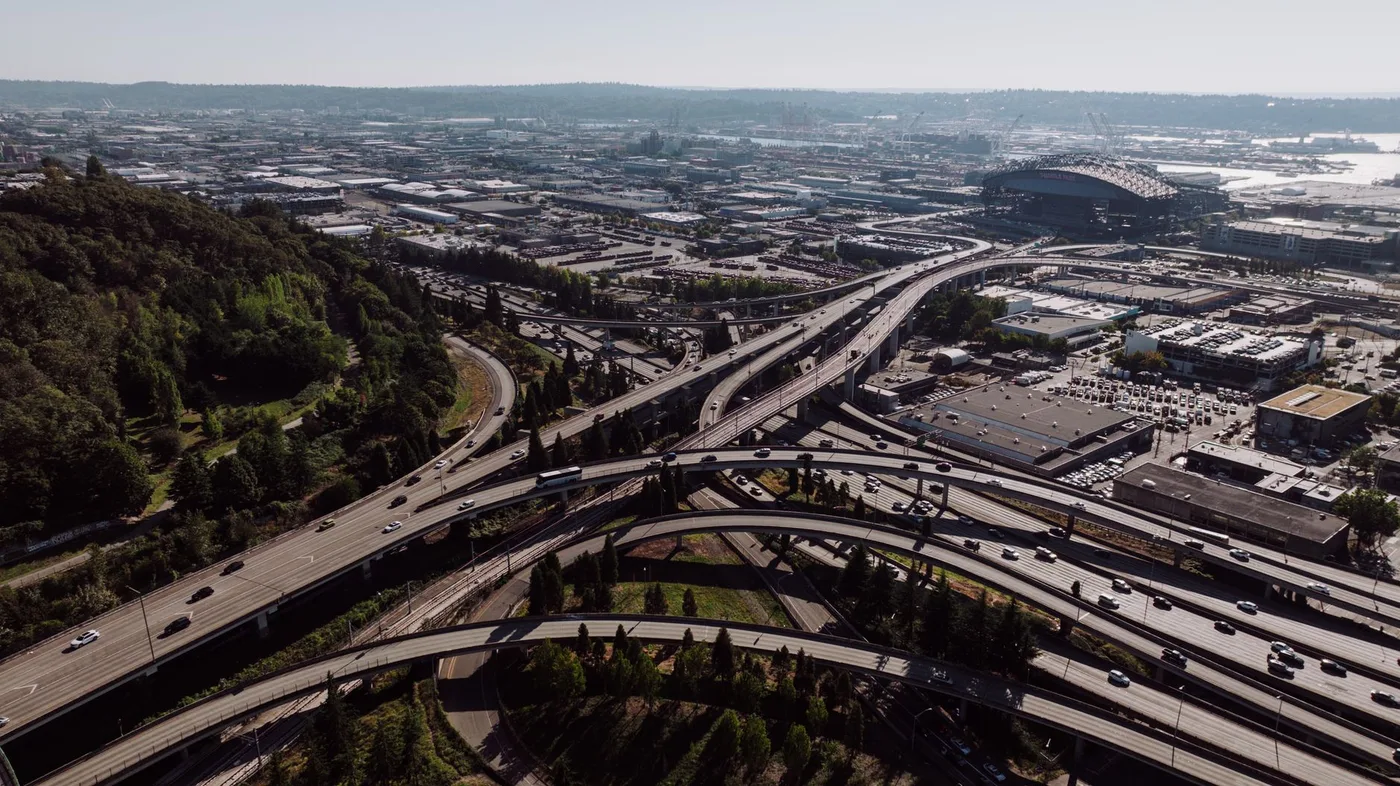
Seattle has a problem most major cities do not: there is no ring road.
If you are driving I-5 north or south, you go through. Timing is not one option among several — it is the only lever you have.
The short answer
Cross between 10:00 a.m. and 2:30 p.m., or after 7:00 p.m.
Avoid 6:00–9:30 a.m. and 3:00–7:00 p.m.
Why there is no way around
Seattle sits on a narrow strip between Puget Sound and Lake Washington. The geography that makes it beautiful also means there is nowhere to put a bypass.
I-405 runs east of the city through Bellevue and Renton, rejoining I-5 north and south. It helps for some trips — particularly if your route touches the Eastside — but it carries heavy commuter traffic of its own and is not a reliable escape.
For pure north–south through-travel, you are on I-5.
The specific pinch points
The Ship Canal Bridge, north of downtown, carries I-5 over the water. No shoulder to speak of, and when it backs up there is no way off.
The downtown section, where I-5 runs below street level through the city centre with frequent entrances and exits.
The I-90 junction, where the interstate from the east joins.
The Sea-Tac stretch south of the city, where airport traffic joins the through-flow and does not follow commuter patterns.
The express lanes
I-5 has a reversible express carriageway through the city centre. It runs southbound in the morning and northbound in the afternoon.
When it is running your way, it is significantly faster than the general lanes. When it is not, it is not available at all.
Opening times and direction vary, so check the current status before planning on them rather than assuming.
Timing
| Crossing time | What to expect |
|---|---|
| Before 5:30 a.m. | Clear |
| 6:00 – 9:30 a.m. | Morning peak, heaviest northbound into the city |
| 10:00 a.m. – 2:30 p.m. | Best window |
| 3:00 – 7:00 p.m. | Worst window |
| After 7:00 p.m. | Clearing |
Puget Sound has some of the worst congestion per capita in the country, and with no bypass it concentrates on one road.
Weather
Rain is the constant. Rarely dramatic, but I-5 at capacity degrades disproportionately when the surface is wet — and it is wet a lot.
Winter ice and snow are infrequent and disruptive out of all proportion. The region has limited equipment and drivers have limited practice. A snow event on I-5 through Seattle is a serious problem rather than an inconvenience.
Fog in the low-lying areas near the water is common on autumn mornings.
Mountain passes matter if you are continuing east on I-90 — Snoqualmie Pass closes for weather and requires chains through much of the winter. Check its status separately.
If you are stopping
Services are limited inside the city — leaving I-5 downtown and rejoining it is slow at any hour.
North of Everett and south of Olympia are the practical stopping points on the through-route. Tacoma and Federal Way have services closer to the metro.
Continuing north or south?
North: Everett, then Bellingham, then the Canadian border at Blaine. Border wait times vary enormously and are worth checking separately.
South: Tacoma, Olympia, then the long run down to Portland — about 175 miles, with its own metro crossing at the far end.
East: I-90 over Snoqualmie Pass toward Spokane. Winter conditions on the pass are a different planning problem entirely.
Commuting rather than passing through?
Different timing, different advice. See our best time to leave Seattle to avoid traffic.
Before you drive
With no bypass, Seattle punishes bad timing harder than cities where you can route around the problem.
BoardSpy watches I-5 and I-405 in real time and tells you before you reach the metro whether to push on or wait — with express lane direction and live weather on the road ahead.
For tools that help you avoid traffic before you leave, see best app to avoid traffic.
Related drive-through guides
Along shared corridors: best time to drive through Portland.
Frequently asked questions
What is the best time to drive through Seattle?
Between 10:00 a.m. and 2:30 p.m., or after 7:00 p.m. Avoid 6:00 to 9:30 a.m. and 3:00 to 7:00 p.m. Seattle has no ring road, so unlike most major metros there is no practical bypass.
Is there a way to bypass Seattle?
Not really. I-405 runs east of the city through Bellevue and rejoins I-5 north and south, which helps for some trips, but it carries heavy traffic of its own. For north-south through-travel there is no genuine bypass — timing matters more here than in cities with a ring road.
What are the I-5 express lanes in Seattle?
A reversible carriageway on I-5 through the city centre that runs southbound in the morning and northbound in the afternoon. Direction and opening times vary, so check the current status before planning on them.