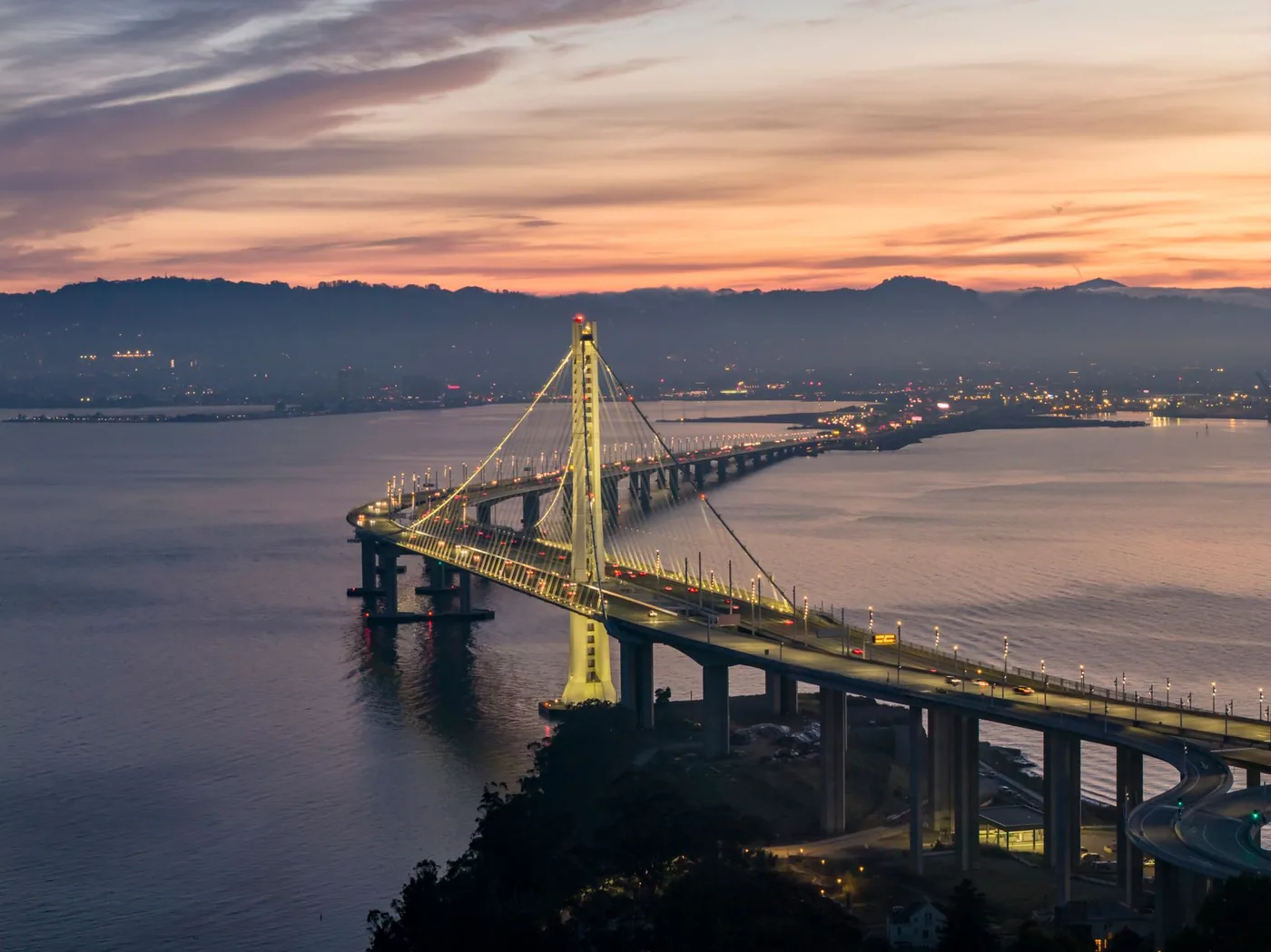
About 12 miles across the bay. Twenty minutes clear, an hour at peak.
Twelve miles is nothing. The Bay Bridge is everything.
The numbers
| Feature | |
|---|---|
| Distance | ~12 miles downtown to downtown |
| Drive time, free-flow | ~20 min |
| Weekday peak | 45 min – 1 hr 15 |
| Route | I-80 west across the Bay Bridge |
| BART | ~12 min |
| Ferry | ~25 min |
Look at those three numbers again. BART does the trip in twelve minutes. Driving at peak takes up to seventy-five. That is not a close comparison, and it explains why so many people on this corridor do not own a car.
The Bay Bridge is the whole problem
The San Francisco–Oakland Bay Bridge is one of the busiest bridges in the United States, and it is the only direct road crossing between the two cities.
There is no alternative that helps. The San Mateo and Dumbarton bridges are far south and add substantial distance. The Richmond–San Rafael is far north. For an Oakland-to-San Francisco trip, it is the Bay Bridge or it is not a drive.
Westbound into San Francisco is tolled, and metering lights at the approach control the flow. The morning peak backup is the corridor's worst regular condition.
Eastbound toward Oakland is free and generally faster, though the evening peak is real.
Parking in San Francisco is expensive enough to change the calculation on its own for anything beyond a short visit.
BART — the obvious answer
BART runs under the bay through the Transbay Tube between Oakland and San Francisco.
Journey time: roughly 12 minutes downtown to downtown. Frequent service. Multiple stations at both ends — Embarcadero, Montgomery, Powell and Civic Center in San Francisco; 12th Street and 19th Street in Oakland.
Why this dominates: it is faster than driving at every hour of every day, it is immune to the bridge entirely, and it costs a fraction of bridge toll plus San Francisco parking.
The limitation: BART does not run 24 hours, and weekend service starts later. For a late night out, check the last train — it is the one thing that regularly catches people.
The ferry — slower and better
The San Francisco Bay Ferry runs between Oakland's Jack London Square and the San Francisco Ferry Building in roughly 25 minutes.
It is slower than BART and more expensive. It is also, by a wide margin, the most pleasant way to make this trip — open deck, bay views, and it lands you at the Ferry Building.
When to take it: when the journey is part of the point, when you are travelling on a nice day, or when Jack London Square and the Embarcadero are actually your endpoints.
When not to: commuting on a schedule, bad weather, or when you need to be somewhere BART serves better.
When to drive
| Departure | Typical duration | Notes |
|---|---|---|
| Before 6:00 a.m. | ~20 min | Free-flow |
| 6:30 – 9:30 a.m. | 45 min – 1 hr 15 | Peak westbound into SF. The worst window. |
| 10:00 a.m. – 3:00 p.m. | 25–35 min | Best window |
| 3:30 – 7:00 p.m. | 40 min – 1 hr | Peak eastbound toward Oakland |
| After 7:30 p.m. | ~20 min | Clear |
Direction matters. Employment concentrates in San Francisco, so mornings load westbound and evenings eastbound. For metro leave windows, see the best time to leave San Francisco to avoid traffic. Peninsula: how far is San Jose to San Francisco.
Events change everything. Oracle Park and Chase Center in San Francisco both generate substantial bridge traffic, and a game or concert loads the crossing in a two-to-three-hour window. On event days, BART is not a preference — it is the plan.
Do you need a car for this trip?
Almost certainly not, and it is worth saying plainly.
Both downtowns are dense, walkable and well served by transit. Twelve miles with a twelve-minute train under it is precisely the trip that does not need a car.
Where you do need one: destinations in the wider East Bay away from BART, anything involving cargo, or trips continuing north or east beyond the transit network.
Weather
Marine layer fog is the signature Bay Area condition. It affects the ferry more than BART and the bridge more than the tube. On a heavy fog morning, the ferry may be less pleasant than advertised.
High winds on the Bay Bridge affect high-profile vehicles and occasionally produce advisories.
Winter rain, particularly the first after a dry spell, produces a sharp spike in incidents on the bridge approaches.
BART is unaffected by all three, which is the practical case for it whenever the weather is doing anything at all.
The airport version
Oakland International (OAK) has a dedicated BART connector, and SFO has its own BART station. Airport trips across the bay use different numbers than this city-to-city run.
Before you leave
Twelve miles, one bridge, and a train that does it in twelve minutes. This is the easiest transit decision in the Bay Area.
BoardSpy tells you before you leave what the Bay Bridge approach actually looks like right now — with live weather and wind on the crossing, so you know whether today is a driving day at all.
Related BoardSpy guides
- How far is San Jose to San Francisco
- Oakland to Sacramento I-80 commute
- Best time to leave in San Francisco
Frequently asked questions
How far is Oakland to San Francisco?
About 12 miles downtown to downtown. Free-flow driving is about 20 minutes. Weekday peaks run 45 minutes to 1 hour 15 on the Bay Bridge. Pattern estimates, not live times.
How long is BART from Oakland to San Francisco?
About 12 minutes downtown to downtown through the Transbay Tube. It is faster than driving at every hour and is immune to the bridge. Check last-train times; BART is not 24 hours.
Is the ferry worth it?
The San Francisco Bay Ferry is about 25 minutes from Jack London Square to the Ferry Building. Slower and costlier than BART, and the most pleasant option when the journey is part of the point.
When is the worst time to drive the Bay Bridge?
Westbound into San Francisco 6:30–9:30 a.m. is the worst regular window. Eastbound evenings 3:30–7:00 p.m. are also heavy. Oracle Park and Chase Center event days load the crossing.
Do you need a car for this trip?
Almost never for downtown-to-downtown. Both cores are walkable and transit-served. You need a car for wider East Bay destinations away from BART, cargo, or trips continuing beyond the transit network.
References
Posted signs and operator timetables override this guide. Drive-time windows are pattern estimates, not measured figures for today.
- BART — Transbay Tube service between Oakland and San Francisco stations.
- San Francisco Bay Ferry — Oakland Jack London Square to San Francisco Ferry Building.
- BoardSpy data sources — How leave-time recommendations use a saved route (limits disclosed).