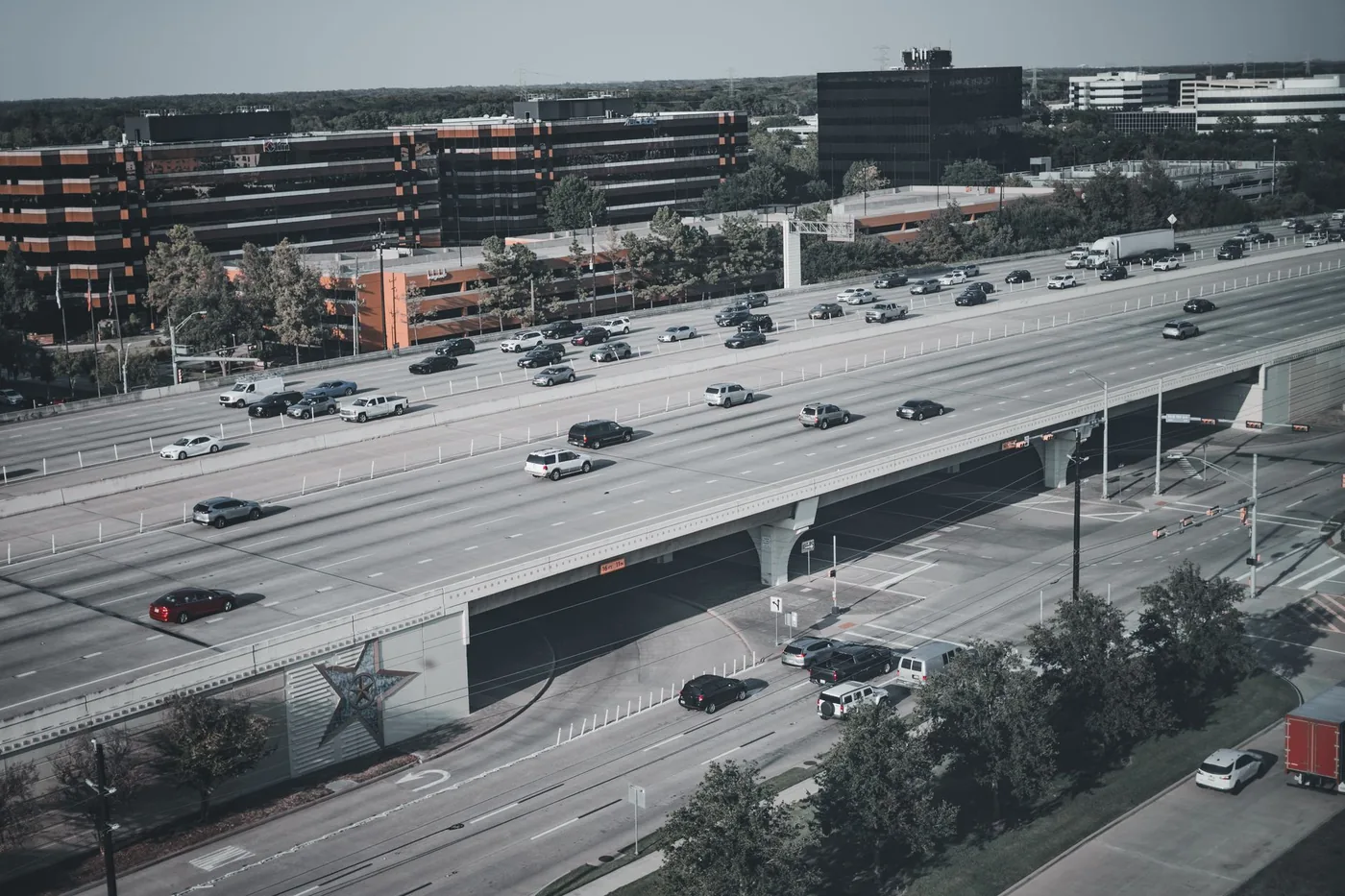
About 95 miles straight up I-35 — an hour and a half in clean conditions. It is short enough to be a day trip and long enough that the arrival timing into Dallas decides how the drive goes. Almost all the variability is in the last twenty miles. Longer haul from Austin: Austin to Dallas–Fort Worth I-35. Metroplex hub: Dallas to Fort Worth.
The short answer
- Distance: ~95 miles
- Free-flow drive time: ~1 hr 30 min
- Typical with Dallas traffic: 1 hr 45 min – 2 hr 20 min. Pattern estimates, not measured figures for today.
- Best departure: before 6:00 a.m., or 9:30 a.m.–2:00 p.m.
- Worst departure: 5:30–7:00 a.m. (arrives into peak) and Friday afternoon
The route
I-35 north from Waco through Hillsboro, where I-35 splits. This split is the one route decision on the drive and it matters:
- I-35E continues north through Waxahachie into Dallas
- I-35W branches north through Alvarado into Fort Worth
Take I-35E for Dallas. The split is signed well in advance, but it is the classic mistake on this corridor and it costs 30–40 minutes to correct. There is no serious alternative route. US 77 runs parallel and slower; SH 6 heads the wrong way. This is an I-35E drive.
Timing: work backwards from arrival
The middle 70 miles of this route are rural interstate and run at highway speed nearly all the time. What varies is Dallas.
| Leave Waco | Arrive Dallas | Verdict |
|---|---|---|
| Before 5:30 a.m. | before 7:00 a.m. | Best. Clean run, beats the peak. |
| 5:30–7:00 a.m. | 7:00–8:45 a.m. | Worst. Good drive, then straight into the morning peak. |
| 7:00–8:00 a.m. | 8:45–10:00 a.m. | Poor, easing at the end. |
| 9:30 a.m.–2:00 p.m. | 11:00 a.m.–3:45 p.m. | Good. Midday arrival. |
| 2:00–3:00 p.m. | 3:45–5:00 p.m. | Marginal — you arrive as the evening peak starts. |
| After 6:30 p.m. | after 8:00 p.m. | Clean. |
The counterintuitive result: leaving at 5:30 a.m. is worse than leaving at 5:00 a.m. or 9:30 a.m. A 5:30 departure gives you a fast rural run that deposits you into Dallas at exactly the wrong moment. This is the most common planning error on the route.
Where the Dallas end costs you
The Texas A&M Transportation Institute and TxDOT rank Dallas–Fort Worth as containing 41 of the state's 100 most congested road segments — more than any other Texas metro (Dallas Morning News; TxDOT Top 100). Several of the relevant ones are on your approach:
- I-35E into downtown Dallas appears on the congested list. The last ten miles frequently take longer than the preceding fifty.
- The I-30 Canyon near downtown Dallas is an active long-term construction zone with ongoing lane shifts, closures and detours. If your destination is central Dallas, this is on your path.
- Lower Stemmons past the Design District and medical centre is the most reliably congested stretch in Dallas, and it is slow by default from mid-morning through early evening rather than respecting rush-hour boundaries. If your destination is northwest of downtown, expect this regardless of when you arrive.
TxDOT names congestion outside the traditional peak period as one of the factors that puts a segment on the congested list. On the Dallas end of this route, "off-peak" is not the same as "clear." City windows: best time to leave in Dallas.
Stops along the way
Ninety-five miles rarely needs a stop, but the corridor has decent options if you want one. Hillsboro — ~35 miles, at the I-35 split. Full services and the natural break point. Also a useful decision point: if you are unsure whether you want Dallas or Fort Worth, this is where you commit. Waxahachie — ~70 miles, on the I-35E branch. Good sit-down options a short way off the interstate.
A stop at Waxahachie can be a scheduling tool rather than a break. If you left Waco at 5:30 a.m. and are on track to hit Dallas at 7:15, a 30-minute stop at Waxahachie converts a bad arrival into a mediocre one.
Going the other way
Southbound from Dallas to Waco, the constraint flips to your departure rather than your arrival.
- Before 3:30 p.m. — clean run out of the metro
- 4:00–6:30 p.m. — the evening peak costs you 30–40 minutes before you even reach Waxahachie
- After 7:00 p.m. — clear
Southbound is the easier direction overall. Once you clear the metro, the remaining 70 miles are rural interstate and rarely a problem.
Weather
Spring convective storms (March–June) are the main risk. North and Central Texas get fast-moving thunderstorm lines, often in the late afternoon, which lands them on the evening peak at the Dallas end. Flash flooding — the corridor crosses several creek systems and Texas drainage struggles with high-intensity rainfall. Underpasses on the approach roads flood quickly. Crosswinds on the open rural sections between Hillsboro and Waxahachie affect high-profile vehicles. Ice (December–February) is rare and disproportionately severe. Elevated sections on the Dallas approach freeze first. See does rain make traffic worse and DFW rain delays.
Before you leave
The Waco–Dallas drive is unusual in that the drive itself is easy and the arrival is the whole problem. Getting the departure right is worth 45 minutes and requires knowing what Dallas looks like an hour and a half from now. BoardSpy models your arrival rather than just your departure — it tells you when to leave Waco so you reach Dallas outside the peak, with live weather across the rural stretch where you have the fewest options.
Frequently asked questions
How long does it take to drive from Waco to Dallas?
About 95 miles. Free-flow is roughly 1 hour 30 minutes. With Dallas traffic, plan on 1 hour 45 minutes to 2 hours 20 minutes.
What is the best time to leave Waco for Dallas?
Before 5:30 a.m., or 9:30 a.m. to 2:00 p.m. Avoid 5:30–7:00 a.m. — that start deposits you into the Dallas morning peak.
Do I take I-35E or I-35W?
I-35E for Dallas, I-35W for Fort Worth. The split is at Hillsboro. Correcting after the split costs 30–40 minutes.
Why is a 5:30 a.m. departure a bad idea?
The rural 70 miles are fast at that hour, so you arrive downtown right as the morning peak starts. Leave at 5:00 a.m. or wait until 9:30 a.m.
When should I leave Dallas for Waco?
Before 3:30 p.m. or after 7:00 p.m. The 4:00–6:30 p.m. evening peak can cost 30–40 minutes before Waxahachie.
References
DFW congestion rankings come from TxDOT/TTI. Timing tables are pattern estimates, not measured figures for today.
- Texas Top 100 Congested Road Segments — TxDOT / TTI annual ranking.
- These Dallas-Fort Worth roads are among the most traffic-plagued in Texas — Dallas Morning News (Dec 2025). DFW holds 41 of the Top 100.
- 2025 Texas Top 100 Congested Road Segments (PDF) — Texas A&M Transportation Institute.
- Data sources and privacy — How leave-time recommendations use your saved route (limits disclosed).