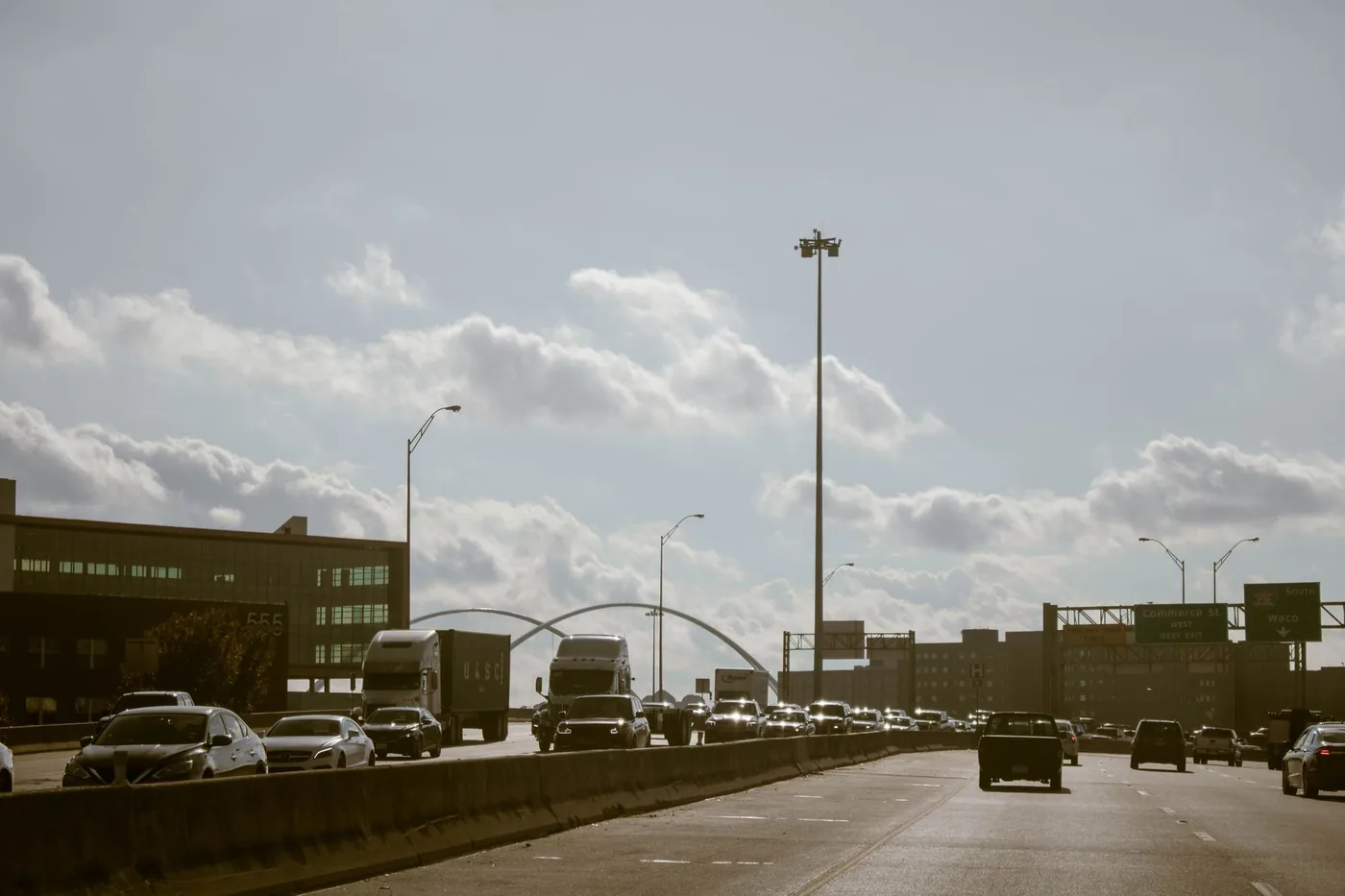
Thirty-two miles separate downtown Dallas from downtown Fort Worth. The distance never changes. The departure time is the entire variable. This guide covers every realistic route between the two downtowns, what each one costs you in time, and when to leave.
The short answer
- Distance: roughly 32 miles downtown to downtown.
- Free-flow drive time: about 30 minutes on I-30.
- Weekday peak: typically 45–60 minutes, longer with an incident. These are pattern estimates, not measured figures for today.
- Cheapest window: mid-morning into early afternoon, roughly 10:00 a.m. to 2:00 p.m.
- Worst window: weekday evening, roughly 4:00 to 6:30 p.m. westbound.
If you only take one thing from this page: the gap between your best and worst departure on this corridor is around thirty minutes each way. That is roughly five hours a week for a daily commuter, and it is entirely under your control.
Why this corridor shows up on the state's worst-roads list
The Texas A&M Transportation Institute and TxDOT publish an annual ranking of the state's 100 most congested road segments, a report the Texas Legislature has mandated since 2009. Dallas–Fort Worth accounts for 41 of those 100 segments, more than any other metro in Texas, according to Dallas Morning News coverage of the 2025 Top 100.
Named segments that sit on or feed this corridor include I-30 from the Jefferson Viaduct to East Grand and from East Loop 820 to SH 360, I-35W from SH 183 to I-30 in Fort Worth, I-35E (Stemmons) from SH 183 to I-30, I-635 from I-35E to US 75, and SH 121 / SH 183 through the mid-cities. TxDOT lists economic vitality, land use, construction, congestion outside the traditional peak, and weather as the factors that put a segment on the list.
A meaningful share of delay here happens outside rush hour. The 2025 Urban Mobility Report, cited in TxDOT's Top 100 press release, found Dallas–Fort Worth and Houston had about 39% less delay per mile than similarly sized U.S. metros. Congestion is severe in absolute terms because the region is huge and growing.
Your route options
I-30, the default
The direct line through Grand Prairie and Arlington.
- Distance: ~32 miles
- Free-flow: ~30 minutes
- Peak: 45–60 minutes
- Best for: almost everyone, almost always, when there is no event and no incident
The catch is geography. I-30 runs past the Arlington entertainment district. AT&T Stadium, Globe Life Field, and Six Flags sit within a couple of miles of the freeway. On event days the Collins Street (exit 28A) and Ballpark Way (exit 27) ramps back up, and that spill hits the mainlanes in both directions.
I-20, the southern bypass
Runs south of I-30 through south Arlington and Grand Prairie before rejoining near Fort Worth.
- Distance: ~40 miles
- Free-flow: ~40 minutes
- Peak: often faster than I-30 despite being longer
- Best for: event days, I-30 incidents, and trips that start or end south of downtown
Because of how the Metroplex developed, I-30 and the corridors north of it carry the heaviest daytime loads, while I-20 tends to move with more spare capacity. If your origin or destination is in the southern half of either city, I-20 is frequently the better default rather than the backup. See the full I-30 vs I-20 vs SH 183 comparison.
SH 183 / SH 121, the northern arc
Runs north through Irving and along the DFW Airport corridor.
- Distance: ~35 miles
- Free-flow: 40–50 minutes
- Peak: an hour or more
- Best for: trips that already touch Irving, Las Colinas, or the airport highway, not a pure downtown-to-downtown run
Managed lanes
I-30 TEXpress buys consistency, not magic speed. Verify HOV rules before relying on a discount. Sharing the ride: carpooling Dallas to Fort Worth.
When to leave
| Period | Window | Typical impact |
|---|---|---|
| Morning peak | 6:30–9:00 a.m. | Heaviest eastbound (Fort Worth → Dallas) |
| Midday lull | 10:00 a.m.–2:00 p.m. | Near free-flow, most predictable |
| Evening peak | 4:00–6:30 p.m. | Heaviest westbound (Dallas → Fort Worth) |
| Evening clear | after 7:00 p.m. | Generally free-flowing absent events |
| Weekend morning | before noon Sat/Sun | Lightest of the whole week, unless Arlington has an event |
Direction matters as much as the hour. Morning traffic loads eastbound into Dallas. Evening traffic loads westbound toward Fort Worth. Traveling against the dominant flow at peak is far cheaper than traveling with it. Hour-by-hour breakdowns: Dallas → Fort Worth and Fort Worth → Dallas.
Not driving? The TRE
The Trinity Railway Express, run by Trinity Metro and DART, connects Union Station in downtown Dallas with T&P Station in downtown Fort Worth. It is a genuine downtown-to-downtown alternative, not a token one.
- Line: 34 miles, 10 stations
- Scheduled end-to-end: just over an hour, typically about 60–70 minutes depending on the timetable (not the 30-minute free-flow drive)
- Days: Monday through Saturday. No Sunday service except during the State Fair of Texas
- Ridership: DART reported about 4,400 weekday riders in FY2025 Q4 and about 4,700 in FY2026 Q1. Annual TRE volume sits above 1.3 million trips.
- Fares: two zones, Tarrant County and Dallas County, divided at CentrePort/DFW Airport Station. Crossing both requires a regional ticket. DART's regional day pass is $9.
Sixty to seventy minutes on rails against a variable 30-65 minute drive is roughly the same peak journey time and a different planning problem. The train wins on variance. TRE serves downtowns; suburban ends usually tip back to driving.
As of 3 August 2026, TRE riders connecting at CentrePort board TRE LINK at Bus Bay A to DFW Terminal B (lower level). TRE LINK runs every 30 minutes at weekday peaks and every 60 minutes off-peak and on Saturdays, with no Sunday service.
Things that break the pattern
- Events in Arlington. Cowboys, Rangers, and peak Six Flags days load onto I-30 in a two-to-three-hour window before start time. There is no clever local routing around a stadium crowd. Leave earlier or take I-20. For a midpoint break, see where to stop between Dallas and Fort Worth.
- Weather. North Texas convective storms arrive fast, often in the late afternoon. I-30 handles them poorly. See Dallas–Fort Worth rain and weather delays and the general does rain make traffic worse explainer.
- Construction. TxDOT lists construction as a primary Top 100 factor, and this corridor has near-continuous work somewhere along its length.
Dallas-end timing: best time to leave in Dallas. Passing through hungry: where to eat driving through Dallas.
Before you leave
The corridor pattern is stable. Your Tuesday is not. BoardSpy checks live traffic and weather on this specific Dallas–Fort Worth route and tells you when to leave today, including when a fifteen-minute earlier departure would save you the peak.
Frequently asked questions
How far is Dallas from Fort Worth?
About 32 miles downtown to downtown on I-30. Free-flow is about 30 minutes; weekday peaks commonly run 45–60 minutes, longer with an incident or an Arlington event.
What is the best time to drive from Dallas to Fort Worth?
Midday, roughly 10:00 a.m. to 2:00 p.m., or after 7:00 p.m. when there is no event. The worst westbound window is about 4:00–6:30 p.m. on weekdays.
Is I-30 or I-20 faster?
I-30 is shorter and usually faster off-peak. I-20 often wins on Cowboys, Rangers, or Six Flags days, and whenever I-30 has an incident. Timing still beats routing on this corridor.
Does the Trinity Railway Express run on Sunday?
No. TRE runs Monday through Saturday, with no scheduled Sunday service except during the State Fair of Texas. Downtown-to-downtown scheduled trips take just over an hour, typically about 60–70 minutes.
Why is Dallas–Fort Worth traffic so bad?
The Texas A&M Transportation Institute and TxDOT put 41 of the state's 100 most congested segments in DFW. Several sit on I-30, I-35E, I-35W, I-635, and SH 121/183. Delay is severe in absolute terms because the metro is huge and growing.
References
Figures and service facts below come from named agencies and local reporting. Timing tables are pattern estimates, not measured figures for today.
- Texas Top 100 Congested Road Segments — TxDOT / TTI annual ranking mandated by the Texas Legislature since 2009.
- These Dallas-Fort Worth roads are among the most traffic-plagued in Texas — Dallas Morning News (Dec 2025). Confirms DFW holds 41 of the Top 100, with named I-30 and I-35W segments.
- State transportation investments continue to save Texas commuters millions — TxDOT / TTI 2025 press: DFW delay per mile about 39% lower than similarly sized U.S. metros.
- 2025 Urban Mobility Report (PDF) — Texas A&M Transportation Institute national congestion context.
- Trinity Railway Express — Operator page: Mon–Sat service, no Sunday except State Fair; TRE LINK Terminal B change.
- TRE LINK to DFW Terminal B — Pickup/drop-off moved to Terminal B lower level as of 3 August 2026; 30 min weekday peaks, 60 min off-peak and Saturday; no Sunday.
- TRE tickets and fare zones — Two zones (Tarrant and Dallas). Regional ticket required to cross CentrePort.
- Data sources and privacy - How leave-time recommendations use your saved route (limits disclosed).