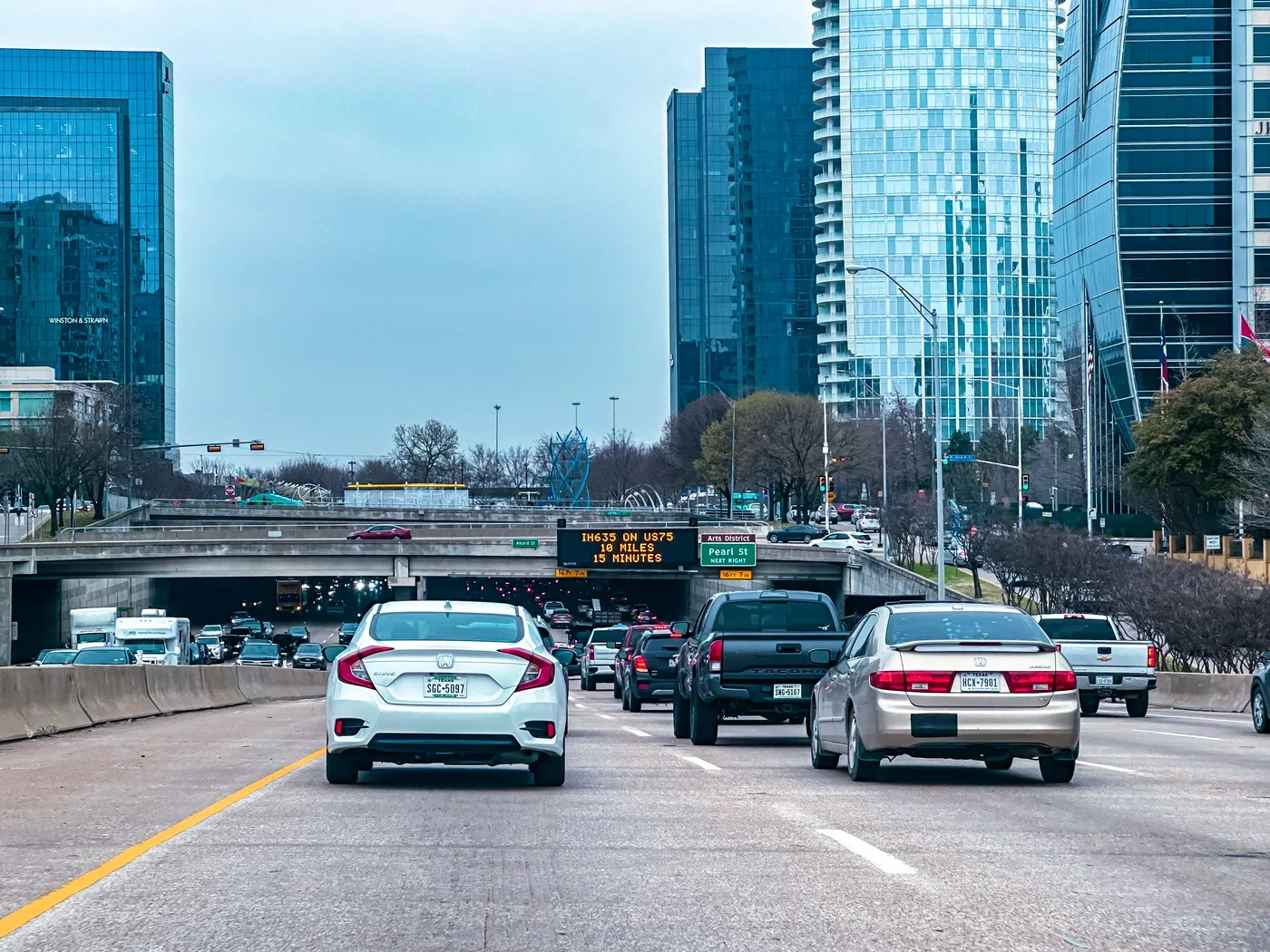
Dallas has an unusual traffic profile. The metro-wide numbers look moderate; the individual corridors do not. Here is what the data says, when Central and the LBJ actually peak, and how to find the best time to leave for your route.
The average understates it. The corridors do not.
The INRIX 2025 Global Traffic Scorecard puts the average Dallas driver at 44 hours lost to congestion, ranking the metro 19th worst in the United States — up from 41 hours the year before.
Set against Texas, that looks mild. Houston sits at 70 hours, Austin at 46, San Antonio at 43. Dallas is not the worst metro in its own state.
But the TxDOT and Texas A&M Transportation Institute rankings tell a different story: DFW holds 41 of Texas's 100 most congested road segments — more than any other metro in the state. And the standout is Woodall Rodgers Freeway, which generates about 1.4 million hours of delay a year across 1.44 miles between downtown and Uptown (US 75 to North Beckley Avenue).
That gap between the metro average and the corridor reality is the thing to understand about driving here. Dallas congestion is not spread thinly across the region; it is concentrated in specific places. If your commute touches one of them, your experience is far worse than 44 hours a year suggests. If it does not, it is far better.
Which means the question that matters here is not what time to leave Dallas. It is what time to leave your corridor.
When is Dallas traffic worst?
Mornings run roughly 6:30–9:00 a.m. and evenings roughly 3:30–6:30 p.m. By corridor:
- Woodall Rodgers — the 1.44-mile downtown–Uptown connector (US 75 to North Beckley); the worst concentration of delay in the metro, and among the worst stretches anywhere in Texas relative to its length.
- US-75, Central Expressway — the north–south spine toward Richardson and Plano; heaviest southbound in the morning and northbound in the evening.
- I-635, the LBJ Freeway — the northern loop, with the managed lanes changing the calculation by time of day.
- I-35E (Stemmons) — heavy through the Design District and the downtown Mixmaster with I-30.
- I-345 and I-30 — the aging downtown connectors, where a single incident propagates across the whole grid.
- The Dallas North Tollway and SH-121 — the Plano, Frisco and Legacy / mid-cities commutes; mornings southbound, evenings northbound, peaking in their own direction rather than toward downtown.
- The High Five interchange — where Central meets the LBJ, and a chokepoint by design rather than by accident.
Prefer a leave-by time to a set of windows? Put your arrival time into the departure time calculator and it will work out when to go.
The simple move: shift off the peak
Leaving just before or just after the busiest window clears a large share of the delay. In Dallas the payoff is uneven, though — on a lightly-used corridor a 15-minute shift may barely register, while on Woodall Rodgers or Central it can be the difference between a normal drive and a bad one.
That is the practical consequence of concentrated congestion: the timing lever is worth much more to some commuters than others, and it is worth most to exactly the people who need it.
Three Dallas-specific things that move the peak
- Managed lanes change the maths. The LBJ and several other corridors carry tolled managed lanes whose price moves with demand. The best time to leave can also be the cheapest time to leave, and the two are not always the same decision.
- The metroplex has no single centre. Downtown Dallas, Uptown, Las Colinas, Legacy in Plano, Fort Worth and DFW Airport all pull commuters in different directions at the same hour. Your corridor's peak depends on which pair it connects — see Dallas to Fort Worth if that is your run.
- Growth and construction. North Texas keeps adding population faster than lane capacity, and the rebuilds that follow move the slow spots year to year. A route that worked last year may not be the right one now.
Why your best time is route-specific
Central does not peak like the Tollway, an inbound trip is not an outbound one, and a corridor on the worst-100 list behaves nothing like one that is not. Citywide advice smooths over exactly the differences that decide your drive — and in Dallas those differences are unusually large. Nationally, the worst day of the week varies by city too.
Driving Texas more broadly? See Houston and Austin.
Find the best time to leave for your Dallas route
Google Maps and Waze show live traffic and turn-by-turn once you are already on the road. BoardSpy is the leave-time app: it checks your saved Dallas route before you leave, recommends when to go, sends traffic and weather alerts, and tracks delay and on-time stats including your best and worst days. When you set off, it opens your map app for turn-by-turn. For how routing apps differ from departure-timing tools, see best app to avoid traffic and Google Maps commute alternatives.
Just passing through?
This page is for commuters driving in and around Dallas. If you are crossing the metroplex rather than commuting within it, see the best time to drive through Dallas–Fort Worth.
Frequently asked questions
What is the best time to leave to avoid traffic in Dallas?
Generally before 6:30 a.m. or after 9:00 a.m. in the morning, and outside 3:30–6:30 p.m. in the evening. The exact best time depends heavily on your corridor — Dallas congestion is concentrated rather than spread, so a corridor on the state's worst-100 list behaves very differently from one that is not.
When is Dallas rush hour?
Roughly 6:30–9:00 a.m. and 3:30–6:30 p.m. on weekdays, with the worst delays concentrated on Woodall Rodgers, Central Expressway and the LBJ rather than spread evenly across the metroplex.
What is the worst road in Dallas?
Woodall Rodgers Freeway, which generates about 1.4 million hours of annual delay across 1.44 miles between downtown and Uptown — the highest concentration in the metro, per TxDOT and Texas A&M Transportation Institute data.
How bad is Dallas traffic compared to other cities?
INRIX ranks Dallas 19th worst in the United States for 2025 at 44 hours lost per driver, behind Houston at 70 and slightly behind Austin at 46. But that metro average understates the corridor picture: DFW holds 41 of Texas's 100 most congested road segments, more than any other Texas metro.
Why is Dallas traffic so bad on some roads and fine on others?
Because the congestion is concentrated rather than regional. Multiple job centres pull commuters in different directions at the same hour, so a handful of connectors carry disproportionate load while other corridors move freely. That is why DFW can hold 41 of the state's worst segments while its metro-wide hours-lost figure stays moderate.
How do I find the best time to leave for my Dallas commute?
Use a leave-time commute app that reads your actual route rather than only a live map. BoardSpy recommends when to leave for your Dallas route, sends pre-departure traffic and weather alerts, and tracks on-time performance and your best and worst traffic days. Download it here.