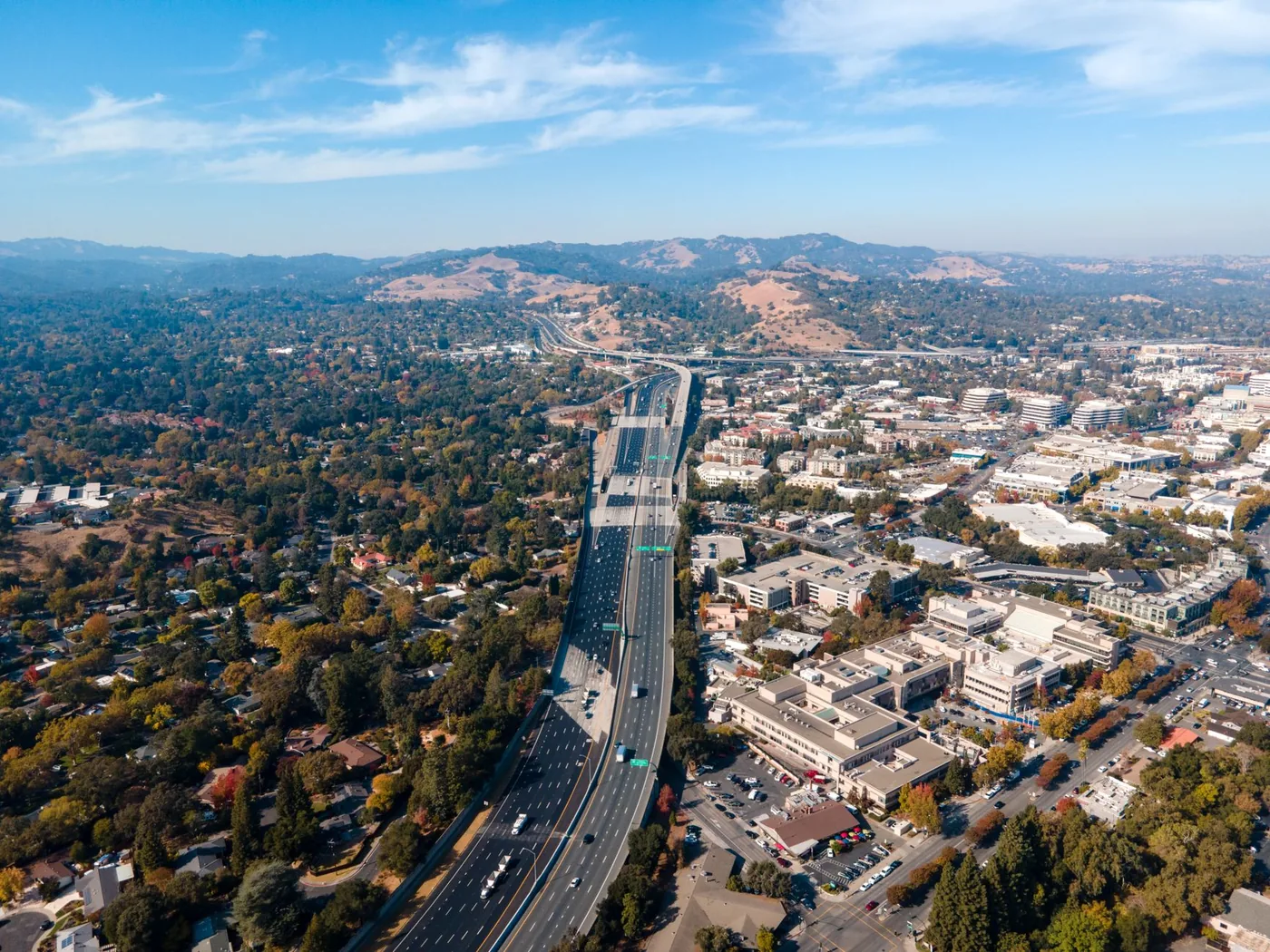
About 80 miles of I-80 — roughly an hour and twenty minutes clean, over two hours at peak. This is the same corridor as the Sacramento–San Francisco run minus the Bay Bridge, which makes it both shorter and considerably more predictable at the western end. Full corridor: Sacramento to San Francisco. Eastbound evenings from the city: SF to Sacramento timing.
The short answer
- Distance: ~80 miles
- Free-flow drive time: ~1 hr 20 min
- Typical weekday peak: 1 hr 50 min – 2 hr 30 min. Pattern estimates, not measured figures for today.
- Best departure: 9:30 a.m.–1:30 p.m.
- Worst departure: 2:00–6:00 p.m. eastbound
- The one bottleneck: the Yolo Causeway, in the final fifteen miles
The Yolo Causeway decides this drive
Without the Bay Bridge in the picture, this corridor has exactly one serious problem, and it sits at the Sacramento end. More than 10,000 vehicles per hour cross I-80 in Yolo County at peak, against a design capacity of about 2,000 vehicles per lane per hour. Caltrans figures put around 150,000 commuters across the causeway daily.
The structure compounds the volume. The causeway is elevated above the Yolo Bypass with narrow lanes and no shoulders — there is no room for a disabled vehicle and no escape from a queue. Caltrans District 3 and the Yolo Transportation District identify short weaving and merging areas, lane drops, limited sight distances, and incomplete carpool and ramp-metering networks as contributing causes.
Local commuters describe it as bumper-to-bumper every day between roughly 2:00 and 6:00 p.m. A single crash there has produced delays exceeding an hour.
The bypass: when the causeway breaks, take Highway 113 north from Davis to Woodland, then I-5 south into Sacramento. Local authorities advise exactly this, and many regular commuters use Highway 113 routinely rather than only in emergencies.
Active work: the Yolo 80 Managed Lanes Project is adding a dynamically tolled express lane along 17 miles between Davis and Sacramento, without widening the causeway itself. Tolling is operated by the Capital Area Regional Tolling Authority. A separate $280 million pavement rehabilitation project has brought lane shifts, temporary barriers and a 55 mph work-zone limit to the same stretch.
When to leave
| Departure | Typical duration | Notes |
|---|---|---|
| Before 6:00 a.m. | ~1 hr 20 min | Free-flow. |
| 6:00–9:00 a.m. | 1 hr 35 min – 1 hr 55 min | Westbound peak is the heavier direction; eastbound is moderate. |
| 9:30 a.m.–1:30 p.m. | 1 hr 20 min – 1 hr 35 min | Best window. |
| 1:30–2:00 p.m. | 1 hr 40 min – 2 hr | The edge. Leaving thirty minutes earlier pays. |
| 2:00–6:00 p.m. | 1 hr 50 min – 2 hr 30 min | Peak eastbound. The causeway is saturated. |
| After 6:30 p.m. | ~1 hr 25 min | Clear. |
Westbound (Sacramento → Oakland) flips the pattern: the morning is the problem, roughly 6:30–9:00 a.m., and the afternoon is comparatively light. Employment concentration in the Bay Area drives the direction, and travelling against it at peak is dramatically cheaper.
Route options
I-80 — Direct through Berkeley, Richmond, Vallejo, Fairfield, Vacaville, Davis. ~80 miles, and the only route that makes sense most of the time.
Highway 113 via Woodland — Longer, and the right call whenever the causeway is broken or during the 2:00–6:00 p.m. band. Learn it before you need it.
I-680 / I-780 — For origins in the southern or eastern East Bay, joining I-80 at Fairfield. Not faster from Oakland proper, but relevant if you are starting further south.
US 50 — Caltrans notes the I-80 and US 50 corridors are both subject to high demand at peak and during recreational weekend travel. It is a second busy road, not an empty one.
The train is genuinely competitive here
This is the corridor where the Capitol Corridor makes its strongest case, because Oakland is a direct station — no bus connection required, unlike San Francisco. Modal comparison for the longer pair: how to get from Sacramento to San Francisco.
- Sacramento–Oakland: up to 30 weekday round trips in 2026, with 22 weekend round trips on the main segment
- Sacramento to Emeryville/Oakland: roughly 1 hr 45 min to 2 hours
- FY25 ridership: 1,138,753, up 10.3%
- 168-mile route, 17–18 stations, Auburn to San Jose
- Fares increase from 1 September 2026 under the operator's business plan
Against a drive that runs 1 hr 20 min free-flow and 2 hr 30 min at peak, the train is slower than a good drive and faster than a bad one — with the crucial difference that it is the same duration every day.
Where the train wins: downtown-to-downtown trips at peak, especially eastbound in the 2:00–6:00 p.m. window when the causeway is at its worst. Where it doesn't: suburban origins or destinations, group travel, or trips where you need a car on arrival.
Weather and weekends
Tule fog (November–February) is the serious hazard, and it concentrates on exactly the wrong section — the Davis-to-Sacramento stretch, including the shoulderless causeway. Dense Central Valley ground fog can reduce visibility to near zero with little warning. Winter rain on a corridor already above design capacity produces disproportionate delay. Summer heat in the Central Valley drives breakdowns, and on the causeway a stalled vehicle blocks a lane outright.
Caltrans specifically identifies recreational weekend travel as a demand driver on this corridor alongside commuting. Eastbound Friday afternoon and Saturday morning carry Tahoe-bound traffic; Sunday afternoon carries it back. Friday eastbound between 2:00 and 7:00 p.m. is the worst regular slot of the week.
Before you leave
This corridor has one bottleneck, it is entirely predictable in aggregate, and it is completely unpredictable on any given day — because whether there is a crash on a shoulderless elevated causeway is not something you can forecast. BoardSpy watches the causeway specifically, tells you whether the Highway 113 bypass is the better call today, and factors tule fog and rain into your departure window rather than leaving you to find out at mile 65.
Related BoardSpy guides
- How far is Oakland to San Francisco
- Sacramento to San Francisco I-80
- How to get from Sacramento to San Francisco
Frequently asked questions
How long does it take to drive from Oakland to Sacramento?
About 80 miles. Free-flow is roughly 1 hour 20 minutes. Weekday peaks commonly run 1 hour 50 minutes to 2 hours 30 minutes when the Yolo Causeway is saturated.
What is the best time to drive from Oakland to Sacramento?
9:30 a.m. to 1:30 p.m., or after 6:30 p.m. Avoid 2:00–6:00 p.m. eastbound. Westbound mornings (Sacramento to Oakland) are the heavier reverse direction.
Is the Capitol Corridor better than driving?
At peak, often yes — Oakland is a direct station, so you skip the San Francisco bus connection. The train is slower than a good drive and faster than a bad one, with a fixed duration.
What do I do if the Yolo Causeway is jammed?
Take Highway 113 north from Davis to Woodland, then I-5 south into Sacramento. Locals also use this bypass routinely in the 2:00–6:00 p.m. band.
Is Friday worse on this corridor?
Yes. Friday eastbound 2:00–7:00 p.m. stacks commute traffic with Tahoe-bound weekend traffic and is the worst regular slot of the week.
References
Causeway operations sit with Caltrans District 3. Rail facts come from the Capitol Corridor operator. Timing tables are pattern estimates, not measured figures for today.
- Caltrans District 3 — I-80 / Yolo Causeway corridor.
- Capitol Corridor — Direct Oakland/Emeryville service, frequencies, FY ridership, 2026 fare change.
- Capitol Corridor schedules — Weekday and weekend frequencies.
- Data sources and privacy — How leave-time recommendations use your saved route (limits disclosed).