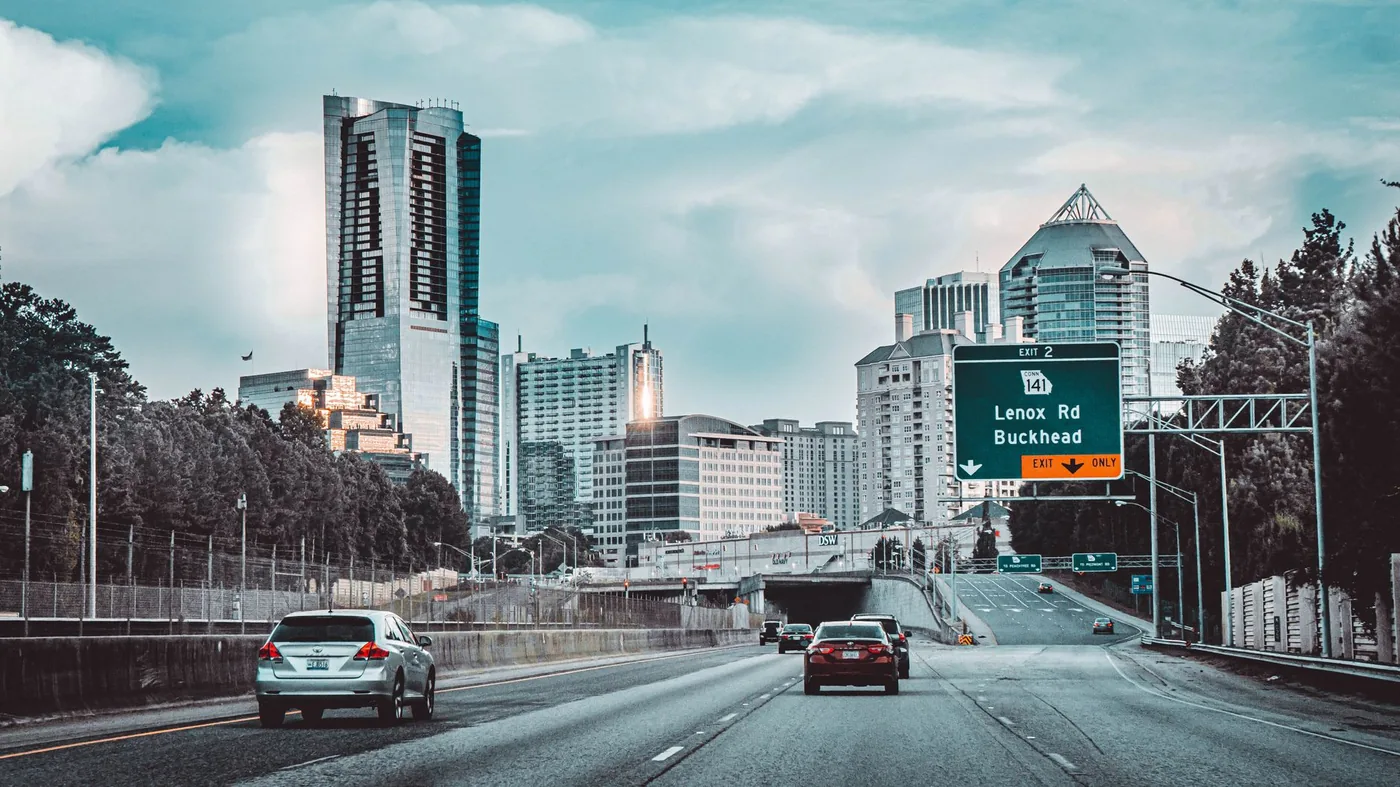
Atlanta rush hour times
| Day | Morning peak | Evening peak | Worst 30 min | Best time to leave |
|---|---|---|---|---|
| Mon–Thu | 7:00–9:30 a.m. | 3:30–7:00 p.m. | Core of each peak window | Before 7:00 a.m. or after 9:30 a.m.; evening outside 3:30–7:00 p.m. |
| Friday | 7:00–9:30 a.m. | 3:30–7:00 p.m. (often stretches) | Friday evening outbound | Leave earlier than Mon–Thu when you can |
| Weekend | Lighter commute peaks | Event and Perimeter surges vary | No fixed weekend commute clock on this page | Outside weekday peaks |
When does Atlanta traffic die down?
Morning traffic dies down after about 9:30 a.m.; evening traffic after about 7:00 p.m.
Atlanta's traffic is not just bad, it is deteriorating faster than almost anywhere else in America. Here is what the data says, when the Connector and the Perimeter actually peak, and how to find the best time to leave for your route.
Atlanta rush hour times
| Window | What to expect |
|---|---|
| Before 7:00 a.m. | Clear; best morning leave |
| 7:00–9:30 a.m. | Morning rush |
| 9:30 a.m.–3:30 p.m. | Midday lull |
| 3:30–7:00 p.m. | Evening rush; wider than most cities |
| After 7:00 p.m. | Evening peak has cleared |
Use the table above for the full weekday windows. The midday lull is the reliable clear stretch; Atlanta's evening peak runs wider than most cities, so plan a larger afternoon shift.
Atlanta traffic jumped 15% in a single year
The INRIX 2025 Global Traffic Scorecard puts the average Atlanta driver at 75 hours lost to congestion, ranking the metro 7th worst in the United States and 16th worldwide, just behind Miami and ahead of Rome. The cost: nearly $1,400 per driver a year (WSB). INRIX flags the east side of I-285 as the region's busiest corridor.
The number that matters is the direction. Atlanta was at 65 hours the year before — a 15% jump in twelve months, and one of the steepest rises among large US metros. For comparison, Los Angeles fell slightly and New York was flat over the same period.
That distinction matters for planning. In a city with stable congestion, the patterns you learned two years ago still work. In Atlanta they do not — a departure time that was reliable last year may not be now, and the gap widens each year the figure climbs.
When is Atlanta traffic worst?
Mornings run roughly 7:00–9:30 a.m. and evenings roughly 3:30–7:00 p.m. — wide windows in both directions, and the evening peak both starts early and clears late. By corridor:
- The Downtown Connector (I-75/85) — where the two interstates merge through the city centre, and the single most reliable source of delay in the metro; peak speeds regularly drop below 30 mph.
- I-285, the Perimeter — a commute corridor in its own right rather than a bypass, because so many employers sit along it. INRIX flags the east side as the region's busiest stretch.
- Spaghetti Junction (I-285 at I-85 North) — one of the most complex interchanges in the country, among the worst truck bottlenecks nationally, and a chokepoint where an incident propagates in every direction.
- I-75 through Cumberland — the northwest commute, heavy in both peaks.
- GA-400 — the north corridor from Alpharetta and Sandy Springs, which peaks toward the city in the morning and away from it in the evening.
- I-20 — the east–west line, with its own peaks on either side of downtown; its junctions with the Perimeter on both the east and west sides are nationally-ranked bottlenecks.
Prefer a leave-by time to a set of windows? Put your arrival time into the departure time calculator and it will work out when to go.
The simple move: shift off the peak
Leaving just before or just after the busiest window clears a large share of the delay. Against 75 hours a year — nearly two full working weeks — a consistent 15 to 30 minute shift is the cheapest time you will ever buy back.
Because Atlanta's evening peak runs wider than most, the afternoon shift usually needs to be larger here than the morning one to clear it properly.
Three Atlanta-specific things that move the peak
- The Connector is a single point of failure. Two interstates merging through one downtown corridor means there is no parallel route absorbing the overflow. That is why a single incident on the Connector reshapes the whole metro's traffic rather than just one road.
- Sprawl with no dominant centre. Downtown, Midtown, Buckhead, Cumberland, Perimeter Center and the airport corridor all pull commuters in different directions at the same hour. Your corridor's peak depends on which pair it connects, and they do not all peak together.
- Weather stops the city. Atlanta gets winter weather rarely enough that the region is not built for it, and even a small amount of ice has historically brought the metro to a standstill. A freeze warning is a stay-home signal here in a way it is not in northern cities. See how weather affects traffic.
Why your best time is route-specific
The Connector does not peak like GA-400, an inbound trip is not an outbound one, and the Perimeter carries its own commute rather than simply routing around the city's. Citywide advice smooths over exactly the differences that decide your drive. Nationally, the worst day of the week varies by city too.
Find the best time to leave for your Atlanta route
Google Maps and Waze show live traffic and turn-by-turn once you are already on the road. BoardSpy is the leave-time app: it checks your saved Atlanta route before you leave, recommends when to go, sends traffic and weather alerts, and tracks delay and on-time stats including your best and worst days. When you set off, it opens your map app for turn-by-turn. For how routing apps differ from departure-timing tools, see best app to avoid traffic and Google Maps commute alternatives.
Just passing through?
This page is for commuters driving in and around Atlanta. If you are crossing the metro on the interstate rather than commuting within it, the timing question is different — see the best time to drive through Atlanta, and where to eat driving through Atlanta.
Nearby cities
- Best time to leave Charlotte
- Best time to leave Nashville
- Best time to leave Orlando
- Best time to leave Tampa
- Best time to leave New Orleans
Every metro is listed on Best time to leave by city.
Frequently asked questions
When does Atlanta traffic die down?
Morning traffic dies down after about 9:30 a.m.; evening traffic after about 7:00 p.m.
What is the best time to leave to avoid traffic in Atlanta?
Generally before 7:00 a.m. or after 9:30 a.m. in the morning, and outside 3:30–7:00 p.m. in the evening. Atlanta's evening peak runs wider than most cities, so the afternoon shift needs to be larger than the morning one. The exact best time depends on your corridor and day.
When is Atlanta rush hour?
Roughly 7:00–9:30 a.m. and 3:30–7:00 p.m. on weekdays, with the evening peak starting early and clearing late.
How bad is Atlanta traffic compared to other cities?
INRIX ranks Atlanta 7th worst in the United States for 2025 at 75 hours lost per driver, and 16th worldwide. More striking than the rank is the trend: Atlanta rose 15% from 65 hours in a single year, one of the sharpest increases among large US metros, while Los Angeles fell slightly and New York was flat.
What is the worst road in Atlanta?
The Downtown Connector, where I-75 and I-85 merge through the city centre, is the most consistent source of delay and regularly drops below 30 mph at peak. INRIX flags the east side of I-285 as the region's busiest stretch, and Spaghetti Junction — I-285 at I-85 North — ranks among the worst truck bottlenecks in the country and is the interchange where incidents propagate furthest.
Why is Atlanta traffic so bad?
Two interstates merging through a single downtown corridor with no parallel route to absorb overflow, job centres scattered from Buckhead to Cumberland to Perimeter Center pulling commuters in every direction at once, sustained population growth, and a region unprepared for the rare winter weather that does arrive.
How do I find the best time to leave for my Atlanta commute?
Use a leave-time commute app that reads your actual route rather than only a live map. BoardSpy recommends when to leave for your Atlanta route, sends pre-departure traffic and weather alerts, and tracks on-time performance and your best and worst traffic days. Download it here.