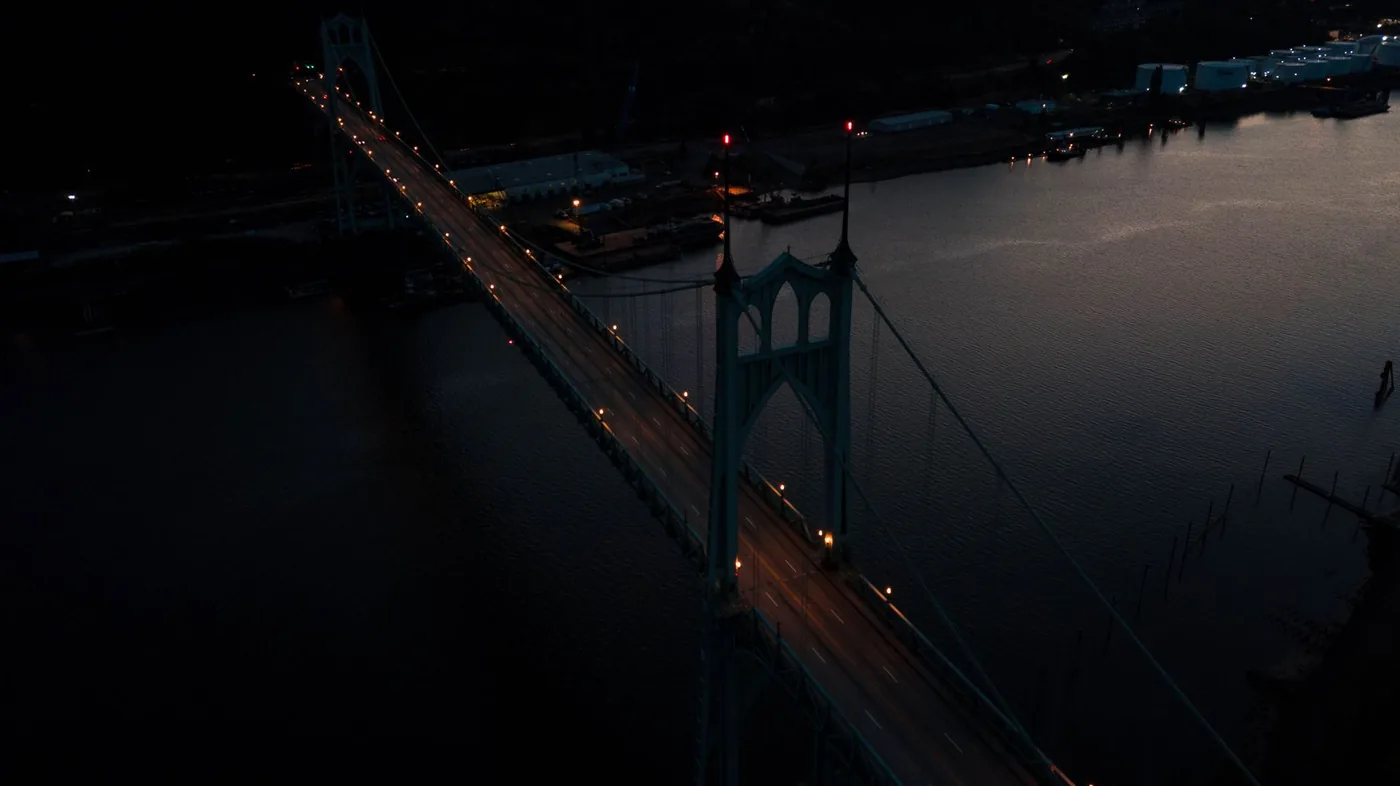
Portland is a two-river crossing with a bridge that opens. That last detail is the one people do not expect.
The routes
I-5 runs north to south through the city centre and crosses the Columbia River to Vancouver, Washington on the Interstate Bridge.
I-205 runs east of the city and crosses the Columbia on the Glenn Jackson Bridge, rejoining I-5 both north and south.
I-84 comes in from the east through the Columbia River Gorge.
I-405 loops the downtown core.
The bridge that opens
The Interstate Bridge carrying I-5 across the Columbia is a pair of steel vertical-lift truss spans. The northbound span opened in 1917; the southbound span was added in 1958. Both are on the National Register of Historic Places, which tells you something about their age.
Marine traffic has right of way by federal law. When the bridge lifts, I-5 stops completely.
How often, and when
The lift span opens an average of about 250 times a year, and in some years as many as 480. Between 2015 and 2019 the annual average was 260 lifts — roughly 153 caused by vessels and 98 by maintenance.
Lifts are prohibited during weekday peak hours: 6:30–9:00 a.m. and 2:30–6:00 p.m., except on federal holidays.
And here is the part that matters for planning: most lifts happen immediately after the morning ban lifts, between 9:00 and 11:00 a.m. That is a direct consequence of the restriction — vessels queue during the ban and go as soon as it ends.
So the window that looks best for traffic is also the window where lifts cluster. If you are on I-5 and a stoppage would wreck your schedule, that is an argument for I-205 rather than for timing.
How long
A lift normally takes six to eight minutes. During high water on the Columbia, when vessels need more caution navigating a fast, swollen river, ODOT has reported lifts lasting up to 20 minutes.
The queue takes considerably longer than the lift itself to clear.
The bridge's other problem
The Interstate Bridge has 10-foot lanes — modern standards call for 12 — and no shoulders. Its crash rate has been reported at roughly three times higher than comparable urban interstates, and any crash or stall blocks lanes completely because there is nowhere to move a vehicle to.
That is a second, independent reason the crossing backs up.
It is being replaced
In January 2026 the US Coast Guard confirmed it will allow a fixed-span replacement bridge with 116 feet of vertical navigation clearance. A fixed span eliminates lifts entirely.
That is a future fix, not a current one. Until it is built, the lift is a live variable.
Checking before you cross
WSDOT publishes live bridge lift status, and third-party monitors track it in real time. If your schedule depends on this crossing, it is worth checking rather than hoping.
The Glenn Jackson Bridge on I-205 is a fixed segmental structure that opened in December 1982, with four lanes each direction. It does not lift.
The I-5 versus I-205 decision
Take I-205 when you are passing through north–south, especially at peak, and above all if a bridge lift would wreck your schedule.
Take I-5 when it is off-peak, or your destination is central Portland.
I-205 carries real suburban traffic of its own, so it is not empty — but it avoids the downtown section and the lift bridge, which are the two things that go wrong.
Timing
| Crossing time | What to expect |
|---|---|
| Before 6:00 a.m. | Clear |
| 6:30 – 9:30 a.m. | Morning peak, heaviest southbound into the city |
| 10:00 a.m. – 2:30 p.m. | Best window |
| 3:00 – 6:30 p.m. | Worst window |
| After 7:00 p.m. | Clearing |
Portland's congestion is heavy for the metro's size, largely because the river crossings concentrate everything through a few points.
Weather
Rain is the constant, and I-5 at capacity degrades disproportionately when wet.
Winter ice and snow are infrequent and severely disruptive. The region has limited equipment and drivers have limited practice — a snow event on I-5 through Portland is a serious problem.
The Columbia River Gorge on I-84 east is its own weather system: strong east winds in winter, freezing rain, and occasional closures. If you are continuing east, check the Gorge separately.
Fog in the low areas near both rivers is common in autumn.
Summer wildfire smoke has become a recurring factor and can reduce visibility significantly.
If you are stopping
Oregon caps rest area stays at 12 hours within any 24-hour period. The ODOT rule specifically prohibits setting up a tent or other structure, camping, or remaining in a rest area beyond that limit. Twelve hours is workable for a genuine overnight; it is not a place to park for a day. Also useful: best time to leave Seattle to avoid traffic · restaurants on my route.
There is one documented exception — the rest area on I-5 at Ashland has different rules due to land zoning.
Heading north, Washington limits rest area stays to eight hours within any 24-hour period. Heading south, California applies an eight-hour limit as well. Oregon is the most generous of the three on this corridor.
ODOT's TripCheck site lists rest areas with their amenities, including RV dump stations.
Oregon also has attended fuel rules in some circumstances — not a delay worth planning around, but worth knowing if you are unfamiliar.
Continuing on?
North on I-5: Vancouver, then Olympia, Tacoma and Seattle — about 175 miles, and Seattle has no bypass at all. South on I-5: Salem, Eugene, then the long run to California. East on I-84: the Columbia River Gorge, then Boise. Check Gorge conditions in winter.
Commuting rather than passing through?
Different problem, different timing — if you commute here instead, the Portland leave-time guide covers getting out of the city rather than across it.
Before you drive
The bridge lift is the thing that catches people out, and it is the strongest argument for I-205 when you are on a schedule.
BoardSpy compares I-5 against I-205 in real time and tells you before you reach the metro which is moving — with live weather on the road ahead.
Related drive-through guides
Along shared corridors: best time to drive through Seattle.
Frequently asked questions
What is the best time to drive through Portland?
For traffic, between 10:00 a.m. and 2:30 p.m. or after 7:00 p.m. But if you are crossing on I-5, note that bridge lifts on the Interstate Bridge are banned during 6:30-9:00 a.m. and 2:30-6:00 p.m. on weekdays, and most lifts happen immediately after the morning ban ends, between 9:00 and 11:00 a.m. If a lift would wreck your schedule, use I-205 instead.
Should I take I-5 or I-205 through Portland?
I-205 crosses the Columbia on the Glenn Jackson Bridge, a fixed span that does not lift, and rejoins I-5 north and south. For through-traffic on a schedule it is frequently the better choice. I-205 traffic has exceeded Interstate Bridge traffic on a daily basis since 1999, so it is not an empty road, but it removes the lift risk entirely.
Why does the Interstate Bridge cause delays?
The Interstate Bridge carrying I-5 over the Columbia is a vertical-lift structure dating to 1917, and marine traffic has right of way by federal law. The lift span opens an average of about 250 times a year, and some years as many as 480. A lift normally takes six to eight minutes, but during high water it can last up to 20 minutes, and the queue takes considerably longer to clear.