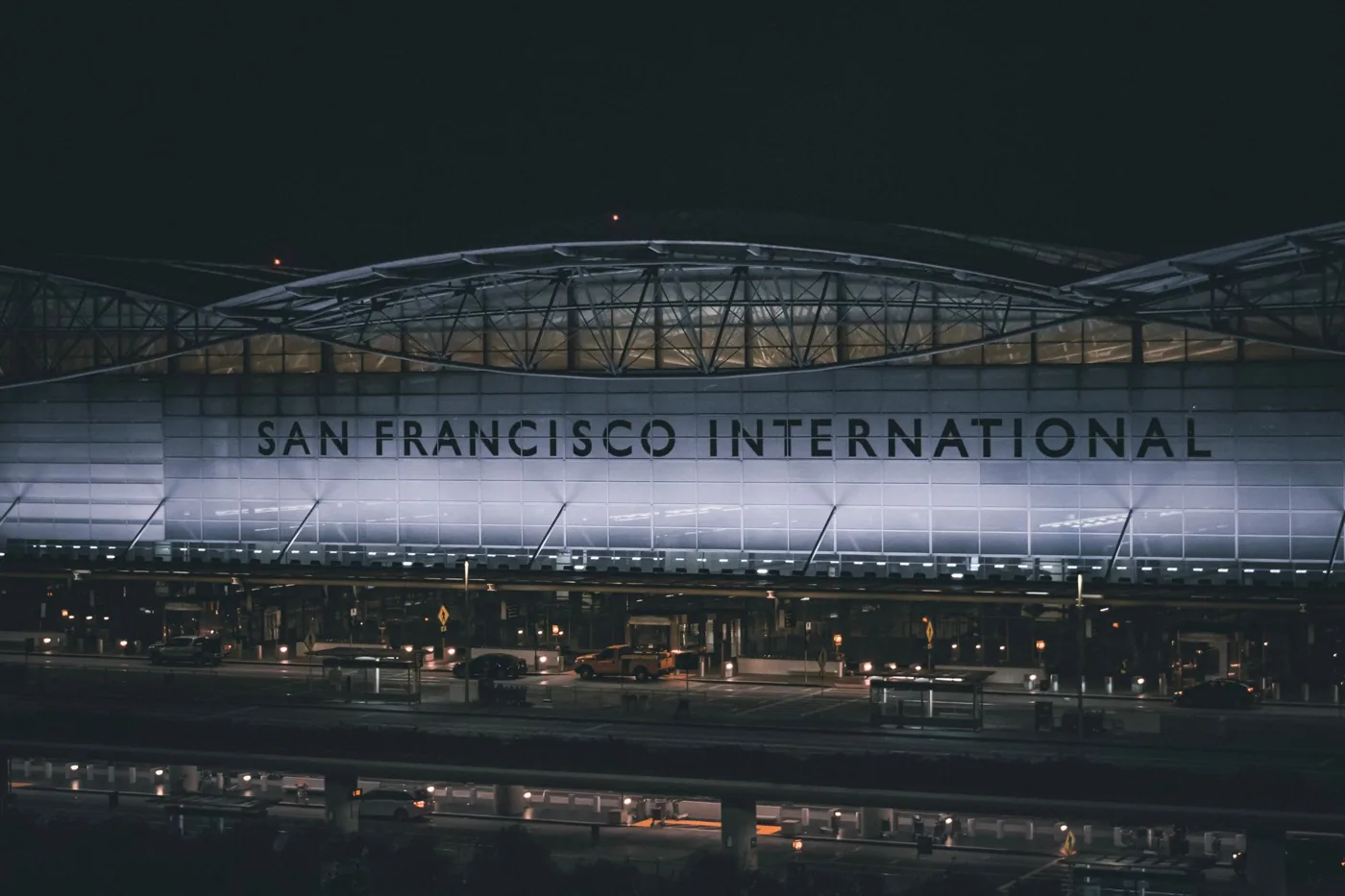
About 35 miles down the Peninsula. Forty minutes clear, well over an hour at peak, and this is the rare American airport corridor with a genuine rail connection at both ends.
There is also a question worth asking before any of this: should you have flown into San Jose instead?
The SJC question
Mineta San José International (SJC) sits at the southern end of this corridor. If your destination is San Jose or the South Bay, flying into SJC rather than SFO removes the 35-mile problem entirely.
SFO has more routes and often cheaper fares, which is why people end up making this trip. But before you book SFO for a South Bay destination, price SJC — the fare difference is frequently smaller than the cost and hassle of the transfer.
This works in reverse too. If you are heading to San Francisco proper, SFO is obviously right. The corridor exists because people book the wrong airport for their destination.
The options
| Option | Journey time | Predictable? | Best for |
|---|---|---|---|
| BART + Caltrain (via Millbrae) | ~1 hr 20 – 1 hr 40 | Yes | Light luggage, peak hours, downtown San Jose |
| Caltrain from Millbrae | ~1 hr – 1 hr 20 | Yes | Same, if you reach Millbrae directly |
| Shared shuttle | 1 hr – 1 hr 30 | Somewhat | Luggage, door to door |
| Rideshare / taxi | 40 min – 1 hr 20 | No | Speed, groups |
| Rental car | 40 min – 1 hr 20 | No | When you need a car in the South Bay |
The rail route
SFO has its own BART station, connected directly to the International Terminal. From there, BART runs south to Millbrae, where you transfer to Caltrain for the run down the Peninsula to San Jose Diridon.
That is one transfer and no traffic risk. Journey time is roughly an hour and twenty to an hour and forty depending on whether you catch a Caltrain express or a local — the difference between the two is substantial, so checking the timetable matters more here than on most rail journeys.
Caltrain has been electrified, which improved journey times and frequencies on the corridor. Check current schedules rather than relying on older figures.
The catch: Diridon Station is in downtown San Jose. If your destination is elsewhere in the South Bay — Santa Clara, Sunnyvale, Cupertino, Mountain View — you will need a further leg, and at that point the rail advantage narrows.
Driving
Distance: about 35 miles. Free-flow: ~40 minutes. Peak: 1 hour to 1 hour 20.
Route: US 101 south is the direct line. I-280 runs parallel to the west and is frequently faster and considerably more pleasant, though slightly longer.
The 101 corridor through the Peninsula carries the full weight of Bay Area tech commuting, and it is congested in both directions at peak — northbound in the morning toward San Francisco, southbound in the evening toward the South Bay. Going SFO → San Jose means the evening is your problem.
I-280 is the underrated choice. It carries less traffic, has better sightlines, and on a bad afternoon it beats the 101 comfortably.
The deadline asymmetry
Going to the airport has a deadline. Leaving it does not.
Outbound from San Jose to SFO, budget generously. The 101 northbound in the morning is heavy, and SFO is a busy international airport with the security queues to match.
For a flight before 9 a.m., leave San Jose by 5:30 a.m. and check that BART and Caltrain are running at that hour — early service is limited and Caltrain's first southbound and northbound trains differ.
Inbound, take the cheap option. A wait costs nothing but time.
First and last service
The thing most people forget: neither BART nor Caltrain runs 24 hours, and Caltrain's weekend timetable is substantially thinner than its weekday one.
For a late arrival or a very early departure, confirm service times for your specific day. If rail does not cover your hour, that is a rideshare, and knowing in advance is worth more than the fare difference.
Do you need a car?
Downtown San Jose works without one — Diridon Station, downtown and SAP Center are walkable, and VTA light rail covers more.
The wider South Bay does not. Santa Clara, Cupertino, Sunnyvale and Mountain View are spread out and transit between them is slow. If your trip touches any of that, rent.
How to choose
Downtown San Jose, light luggage → BART to Millbrae, Caltrain to Diridon. Predictable, no traffic risk.
Real luggage → Shared shuttle, or rideshare if the cost works.
Group of three or more → Rideshare or a rental; the split changes the maths.
Peak hour with a deadline → Rail. The 101 at 5 p.m. is not something to gamble a flight on.
Anywhere in the South Bay other than downtown → Rent a car.
Very early or very late → Check rail schedules first; default to rideshare if they do not cover you.
Weather
Bay Area weather rarely closes this corridor, with two exceptions.
Marine layer fog at SFO is a genuine flight-delay factor, particularly in summer mornings. It affects your flight more than your drive.
Winter rain, especially the first rain after a dry spell, lifts oil off the road and produces a spike in incidents on the 101. On a corridor already at capacity, that costs more than the rainfall suggests.
Before you leave
Thirty-five miles, two airports that are not interchangeable, and a rail option that only works if you check the timetable first.
BoardSpy compares the 101 and I-280 in real time and tells you before you leave which one is moving — with live weather on the route and an alert when today is a day to take the train instead.
Related BoardSpy guides
- Oakland Airport to San Francisco
- Best time to leave in San Francisco
- How to get from Sacramento to San Francisco
Frequently asked questions
How far is San Francisco Airport to San Jose?
About 35 miles down the Peninsula. Driving is about 40 minutes clear and 1 hour to 1 hour 20 at peak. BART plus Caltrain via Millbrae is typically 1 hour 20 to 1 hour 40. Pattern estimates, not live times.
Should you fly into SJC instead of SFO for San Jose?
If your destination is San Jose or the South Bay, SJC removes the 35-mile transfer. SFO has more routes and often cheaper fares — price both. The fare gap is frequently smaller than the transfer cost.
How do you take the train from SFO to San Jose?
SFO has a BART station at the International Terminal. Ride BART south to Millbrae, then transfer to Caltrain to San Jose Diridon. Check whether you catch an express or a local — the difference is substantial.
Is I-280 faster than US 101 from SFO to San Jose?
Often yes at peak. US 101 is the direct line and carries Peninsula tech commuting. I-280 runs parallel to the west, is frequently faster and more pleasant, though slightly longer.
Do BART and Caltrain run late enough after an SFO arrival?
Neither runs 24 hours, and Caltrain's weekend timetable is thinner. Confirm service for your specific day. If rail does not cover your hour, that is a rideshare.
References
Posted signs and operator timetables override this guide. Drive-time windows are pattern estimates, not measured figures for today.
- BART to SFO — BART station at SFO International Terminal and connections toward Millbrae.
- Caltrain — Peninsula schedules, including Millbrae to San Jose Diridon (express vs local).
- BoardSpy data sources — How leave-time recommendations use a saved route (limits disclosed).