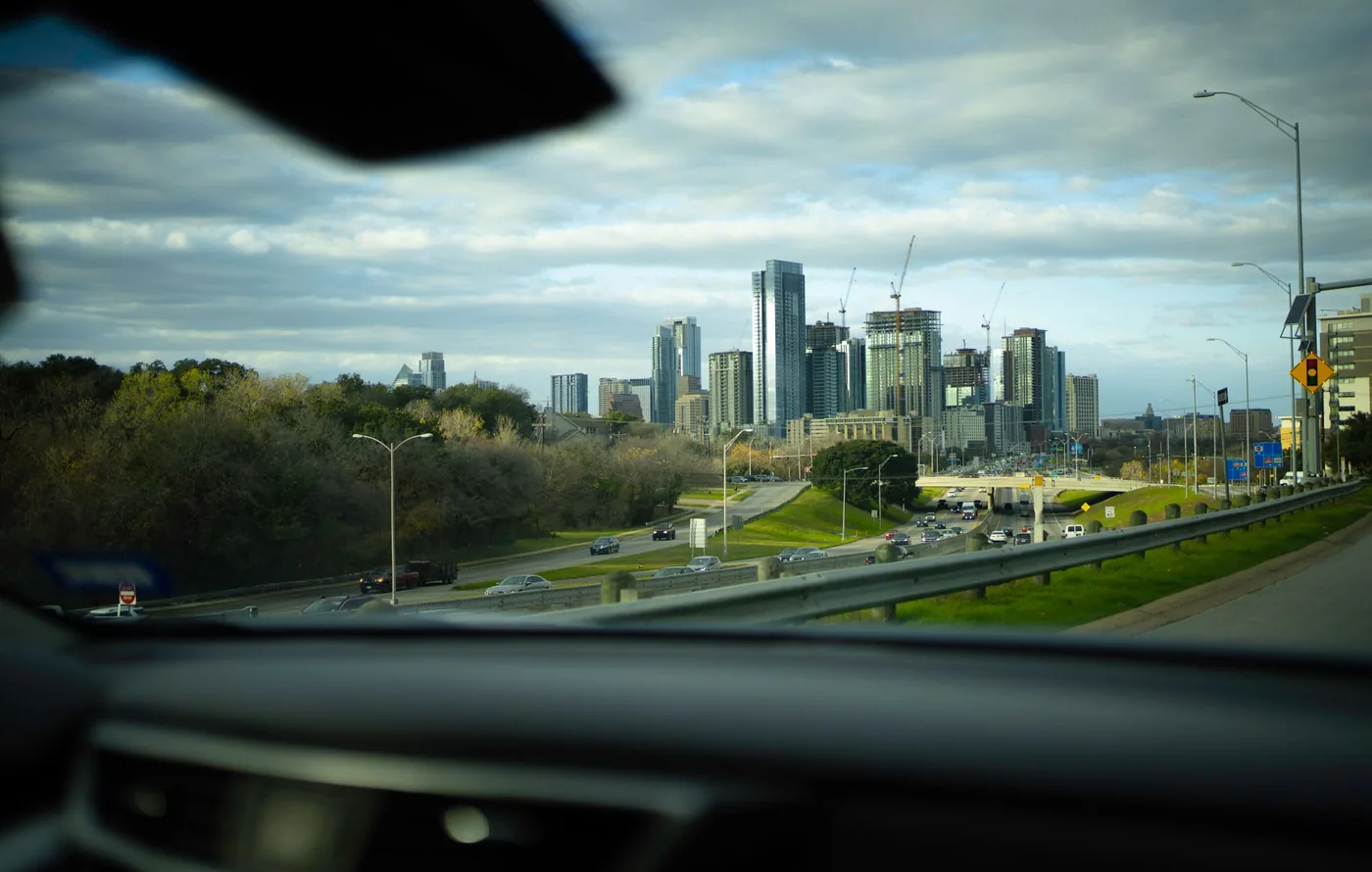
Northbound I-35 is the harder direction. Austin's job market pulls commuters up the corridor in the morning, which means the northbound morning peak is denser, starts earlier, and clears later than the southbound equivalent. If you make this drive regularly, the departure decision is worth roughly an hour. Southbound overview: Austin to San Antonio I-35 guide.
The short answer
- Distance: ~80 miles
- Free-flow: ~1 hr 20 min
- Morning peak northbound: 2 hr – 2 hr 45 min. Pattern estimates, not measured figures for today.
- Leave before 6:00 a.m. or accept the peak. There is no clever middle option.
Hour by hour, northbound
| Departure | Typical duration | Notes |
|---|---|---|
| Before 5:45 a.m. | ~1 hr 20 min | Free-flow. The only genuinely fast weekday window. |
| 5:45–6:30 a.m. | 1 hr 30 min – 1 hr 45 min | Building. Still workable. |
| 6:30–9:00 a.m. | 2 hr – 2 hr 45 min | Peak northbound. The core problem. |
| 9:00–10:00 a.m. | 1 hr 45 min – 2 hr | Easing. |
| 10:00 a.m.–2:00 p.m. | 1 hr 25 min – 1 hr 40 min | Midday window. |
| 2:00–4:00 p.m. | 1 hr 40 min – 2 hr | Southbound is worse, but this direction builds too. |
| 4:00–6:30 p.m. | 1 hr 50 min – 2 hr 15 min | Contraflow, so less severe than southbound. |
| After 7:30 p.m. | ~1 hr 25 min | Clear. |
The important asymmetry: your 6:30–9:00 a.m. northbound penalty is worse than the equivalent southbound penalty, and your 4:00–6:30 p.m. northbound penalty is better. You are with the crowd in the morning and against it in the evening.
Where the northbound delay happens
TxDOT's corridor study names the severely congested segments, and northbound they arrive in this order:
Leaving San Antonio — the southern end of the corridor. I-35 between I-10 and I-37 near Pearl carries downtown local traffic on top of corridor traffic. Add the ongoing I-35 NEX construction on the northeast side and the first fifteen miles are slower than the map suggests.
New Braunfels through San Marcos — the longest sustained problem stretch, and the one that does most of the damage. This is where the corridor narrows back to three lanes each way after the eight-mainlane section through New Braunfels.
Buda into south Austin — the final chokepoint, made worse by the active I-35 Capital Express South construction adding HOV lanes from the Travis/Hays county line north to Ben White Boulevard (MyMobility35).
That middle-of-the-drive concentration is the corridor's defining feature. A northbound trip that is going fine at San Marcos can still lose forty minutes before Austin. Austin-end windows: best time to leave in Austin.
Why the reverse commute is worth considering
If you live in Austin and work in San Antonio, you have the better arrangement on this corridor and it is worth knowing by how much. You travel southbound in the morning while the crowd goes north, and northbound in the evening while the crowd goes south. A reverse commuter's 7:30 a.m. southbound run is materially faster than a northbound commuter's — same road, same hour.
Given that TxDOT frames this stretch among the state's worst highway congestion cases — see the annual Top 100 congested road segments — being on the light side of a directional peak is a real advantage rather than a marginal one.
SH 130 northbound
The tolled eastern bypass is more valuable northbound in the morning than it is southbound in the evening, because the morning northbound peak is the sharper of the two.
Take it when you are leaving San Antonio between 6:30 and 9:00 a.m. with a hard arrival time; there is any reported incident between New Braunfels and Buda; it is a Friday; or there is a major Austin event — UT home games, ACL, SXSW. Skip it for routine off-peak trips. You are buying predictability, and off-peak I-35 is already predictable.
Where to break the drive
Eighty miles does not demand a stop, but the corridor has good options roughly at the midpoint if you want one.
- New Braunfels — the obvious choice. Full services right off the interstate, and the corridor widens to eight mainlanes here so getting on and off is easier than elsewhere. Be aware the travel-centre exits generate their own congestion, particularly at weekends.
- San Marcos — good sit-down options a short distance off the freeway, and a sensible meet-in-the-middle point for anyone splitting the drive with someone coming the other way.
A stop during the northbound morning peak costs more than the time you spend stopped, because rejoining I-35 in the San Marcos–Buda stretch is slow. Off-peak, a stop costs roughly what it looks like.
Construction reality
Both mega-projects on this corridor affect northbound travel:
- I-35 NEX on the San Antonio end — $1.5 billion, adding 9.5 miles of elevated non-tolled lanes from I-410 North to FM 3009, expected completion 2027. TxDOT projects travel time through that section falling from about 29 minutes to about 17 on the mainlanes once complete.
- I-35 Capital Express South on the Austin end — $548 million across four phases, adding two HOV lanes each direction.
Until 2027, plan around construction as a constant rather than an exception.
Before you leave
Northbound I-35 punishes a late start harder than almost any corridor in Texas, and the delay is concentrated in the middle forty miles where you have the fewest exit options. BoardSpy tells you before you leave whether the New Braunfels–San Marcos stretch is moving today, compares I-35 against SH 130 in real time, and alerts you when leaving fifteen minutes earlier is worth an hour at the other end.
Frequently asked questions
What is the best time to drive from San Antonio to Austin?
Before 6:00 a.m. on weekdays, or the 10:00 a.m.–2:00 p.m. midday window. The 6:30–9:00 a.m. northbound peak is the expensive slot.
How long is the San Antonio to Austin drive at rush hour?
About 2 hours to 2 hours 45 minutes northbound in the morning peak, versus about 1 hour 20 minutes free-flow. Evening northbound is milder because you are against the dominant flow.
Should I take SH 130 northbound in the morning?
Yes if you have a hard arrival between 6:30 and 9:00 a.m., it is Friday, there is an incident, or Austin has a major event. Off-peak, skip the toll.
Where does northbound I-35 slow down?
Leaving San Antonio near Pearl and I-35 NEX, then the long San Marcos–New Braunfels stretch, then Buda into south Austin under Capital Express South work.
Is the reverse commute faster?
Yes. Austin-to-San Antonio in the morning travels against the northbound crowd and is materially faster at the same hour than San Antonio-to-Austin.
References
Construction and congestion facts come from TxDOT and TTI. Timing tables are pattern estimates, not measured figures for today.
- Texas Top 100 Congested Road Segments — TxDOT / TTI annual ranking.
- I-35 Northeast Expansion (NEX) — TxDOT San Antonio project page.
- MyMobility35 / I-35 Capital Express — TxDOT Austin program page.
- 2025 Texas Top 100 Congested Road Segments (PDF) — Texas A&M Transportation Institute.
- Data sources and privacy — How leave-time recommendations use your saved route (limits disclosed).