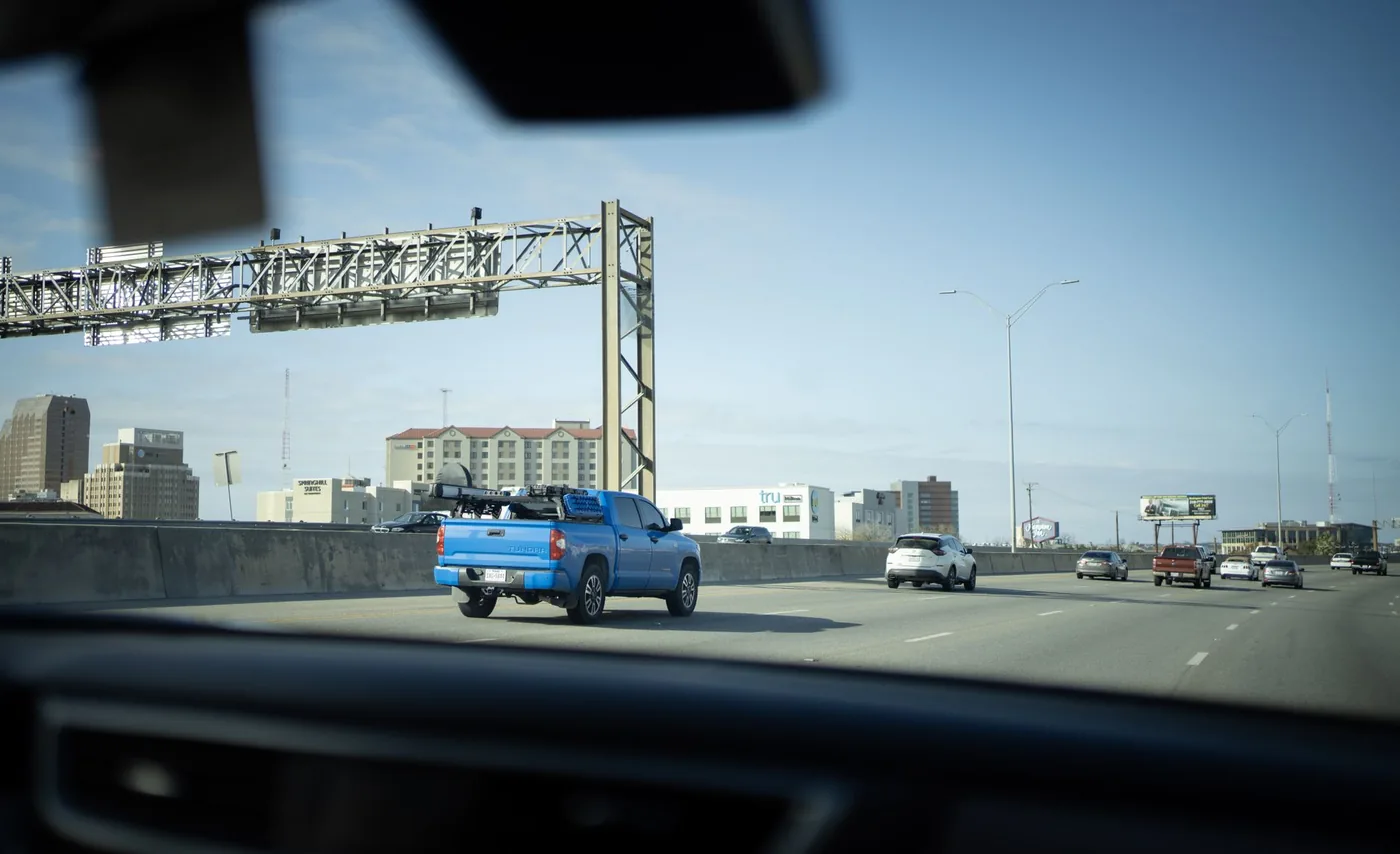
Roughly 80 miles of I-35 separate downtown Austin from downtown San Antonio. In free-flowing conditions that is about an hour and twenty minutes. On a Friday afternoon it can be three hours, and the reason is not distance — it is that you are driving one of the most congested interstate corridors in the United States.
The short answer
- Distance: ~80 miles downtown to downtown
- Free-flow drive time: ~1 hr 20 min
- Typical weekday peak: 1 hr 50 min to 2 hr 30 min. Pattern estimates, not measured figures for today.
- Best departure window: 9:30 a.m.–2:00 p.m., or after 7:30 p.m.
- Worst departure window: Friday 2:00–7:00 p.m.
- Speed limit: 70 mph for most of the run between Loop 1604 and SH 45
Why this corridor ranks so high
TxDOT's planning work on this stretch treats I-35 between Austin and San Antonio as a nationally congested interstate, and the second-most congested highway case in Texas. That is not a regional complaint; it is how the state frames the corridor. Between 100,000 and 150,000 vehicles use this section every day, and TxDOT notes that many of them are people commuting between the two cities daily. It is the busiest inter-metro interstate in Texas.
The structural problem is capacity. The corridor's typical cross-section is six mainlanes — three in each direction — carrying inter-metro commuter traffic, regional freight, and international trade traffic on the Mexico–US–Canada route all at once. Only in the New Braunfels area does it widen to eight mainlanes.
And it is getting worse rather than better. TxDOT's planning study for the corridor projects the population of the study area rising from about 309,000 in 2020 to at least 760,000, and states plainly that if nothing is done, the existing corridor will limit mobility and freight movement across the region. Statewide context: the Texas Top 100 congested road segments ranking, produced with the Texas A&M Transportation Institute, is mandated by the Legislature and updated annually.
Where it actually backs up
TxDOT's corridor study identifies specific segments as having severe congestion, and knowing them changes how you plan the drive:
- North and south of Buda — the first real chokepoint leaving Austin southbound
- Most of San Marcos, continuing south to New Braunfels — the longest sustained problem stretch
- The southern end of the corridor approaching San Antonio
The congestion is concentrated in the middle of the drive, not at the endpoints. Unlike a typical metro commute where the last few miles hurt, on I-35 the 40-mile stretch from Buda through New Braunfels is where you lose the time.
The Buc-ee's effect at New Braunfels. The New Braunfels travel-centre exits generate their own traffic independent of commute patterns, and weekend volumes there are substantial.
Downtown San Antonio. I-35 between I-10 and I-37 near Pearl carries local traffic on top of corridor traffic, and TxDOT runs periodic lane closures through that section.
Active construction
I-35 NEX (Northeast Expansion) — a $1.5 billion, three-part project adding elevated non-tolled lanes and additional mainlanes on the San Antonio end. The central portion adds 9.5 miles of elevated lanes from I-410 North to FM 3009. TxDOT's own projection: without the project, travel time through that section is about 29 minutes; with it, about 17 minutes on the mainlanes and 15 on the elevated lanes. Expected completion 2027. Project page: TxDOT I-35 NEX.
I-35 Capital Express South — a $548 million project in four phases, from Ben White Boulevard south to the Travis/Hays county line north of Buda, adding two high-occupancy-vehicle lanes in each direction. Corridor program: TxDOT MyMobility35 / Capital Express.
Until these finish, treat construction as a permanent feature of the drive rather than an occasional inconvenience. Austin-end timing: best time to leave in Austin.
Route options
I-35 — the default
The direct line. ~80 miles, ~1 hr 20 min free-flow, 70 mph limit for most of the run. It is the shortest and usually the fastest, and it is where all the congestion is.
SH 130 toll — the eastern bypass
The tolled bypass east of Austin. Longer in distance, frequently faster in practice, and dramatically more predictable — it exists specifically to route through-traffic around the I-35 corridor. The trade is money for variance. If you are travelling on a Friday afternoon, during an event, or with a hard arrival time, SH 130 is usually the correct choice. For a routine off-peak trip it is an unnecessary expense.
US 281 / I-10 — the Hill Country alternative
Slower and more scenic, through the eastern Hill Country. Not a serious contender on time, but a real option if I-35 is closed by an incident and you are not in a hurry.
When to leave
| Departure | Typical duration | Notes |
|---|---|---|
| Before 6:30 a.m. | ~1 hr 20 min | Free-flow. Fastest of the weekday. |
| 6:30–9:30 a.m. | 1 hr 45 min – 2 hr 15 min | Morning build through Buda and San Marcos. |
| 9:30 a.m.–2:00 p.m. | 1 hr 25 min – 1 hr 40 min | The midday window. Best non-dawn option. |
| 2:00–4:00 p.m. | 1 hr 50 min – 2 hr 20 min | Early build. Worse than it looks. |
| 4:00–7:00 p.m. | 2 hr – 2 hr 45 min | Peak. Avoid. |
| After 7:30 p.m. | ~1 hr 25 min | Clears quickly absent events. |
Friday is a different animal. The evening peak starts around 2:00 p.m. rather than 4:00, runs until 7:00 or later, and stacks weekend departures on top of commuters. A Friday 3:00 p.m. departure is one of the worst travel decisions available in Texas. Northbound hour-by-hour: San Antonio to Austin.
Events that break the pattern
The Texas–Texas A&M rivalry game generates significant corridor traffic between the two cities, and the standard advice — take I-35 north straight to Austin — is precisely what everyone else does. Any major Austin event (ACL, SXSW, UT home games) or San Antonio event loads this corridor in a two-to-three-hour window. On event days, SH 130 stops being a luxury and becomes the sensible route.
Is there a transit alternative?
Not a real one yet, and that is worth saying plainly. The Alamo Area Council of Governments has proposed a bidirectional bus pilot along the corridor — VIA's Randolph Park and Ride toward Austin, with stops in New Braunfels and San Marcos. AACOG has described rail as the long-term answer but one that takes many years and billions of dollars. For now, this is a driving corridor. If you commute it, your only real lever is departure time.
Before you leave
I-35 between Austin and San Antonio is a corridor where the pattern is well known and today's conditions are not. Two active mega-projects, 100,000-plus vehicles a day, and a congestion peak concentrated in the middle 40 miles rather than at either end. BoardSpy tracks the corridor live and tells you before you leave whether today is an I-35 day or an SH 130 day — with live weather along the route and an alert when shifting your departure by twenty minutes would save you an hour. Timing a similar Metroplex run: Dallas to Fort Worth.
Frequently asked questions
How long does it take to drive from Austin to San Antonio?
About 80 miles. Free-flow is roughly 1 hour 20 minutes. Weekday peaks commonly run 1 hour 50 minutes to 2 hours 30 minutes; Friday afternoon can approach three hours.
What is the best time to drive from Austin to San Antonio?
9:30 a.m. to 2:00 p.m., or after 7:30 p.m. Avoid Friday 2:00–7:00 p.m. Before 6:30 a.m. is the fastest weekday window if you can leave that early.
Is SH 130 faster than I-35?
SH 130 is longer but more predictable. Use it on Friday afternoons, event days, or whenever you have a hard arrival time. Off-peak, I-35 is usually fast enough that the toll is optional.
Where does I-35 between Austin and San Antonio actually jam?
In the middle: Buda, then San Marcos through New Braunfels, then the San Antonio approach. The 40 miles between Buda and New Braunfels are where most of the time is lost.
Is there a train or bus between Austin and San Antonio?
Not a reliable daily option yet. AACOG has discussed a corridor bus pilot; rail remains a long-term, multi-billion-dollar idea. For now this is a driving corridor.
References
Figures below come from named agencies. Timing tables are pattern estimates, not measured figures for today.
- Texas Top 100 Congested Road Segments — TxDOT / Texas A&M Transportation Institute annual ranking mandated by the Texas Legislature since 2009.
- I-35 Northeast Expansion (NEX) — TxDOT San Antonio project page for elevated lanes from I-410 North to FM 3009.
- MyMobility35 / I-35 Capital Express — TxDOT Austin program page covering Capital Express South HOV work from Ben White toward Buda.
- 2025 Texas Top 100 Congested Road Segments (PDF) — Texas A&M Transportation Institute statewide congested-segment report.
- Alamo Area Council of Governments — Regional planning agency discussing corridor transit options between San Antonio and Austin.
- Data sources and privacy — How leave-time recommendations use your saved route (limits disclosed).