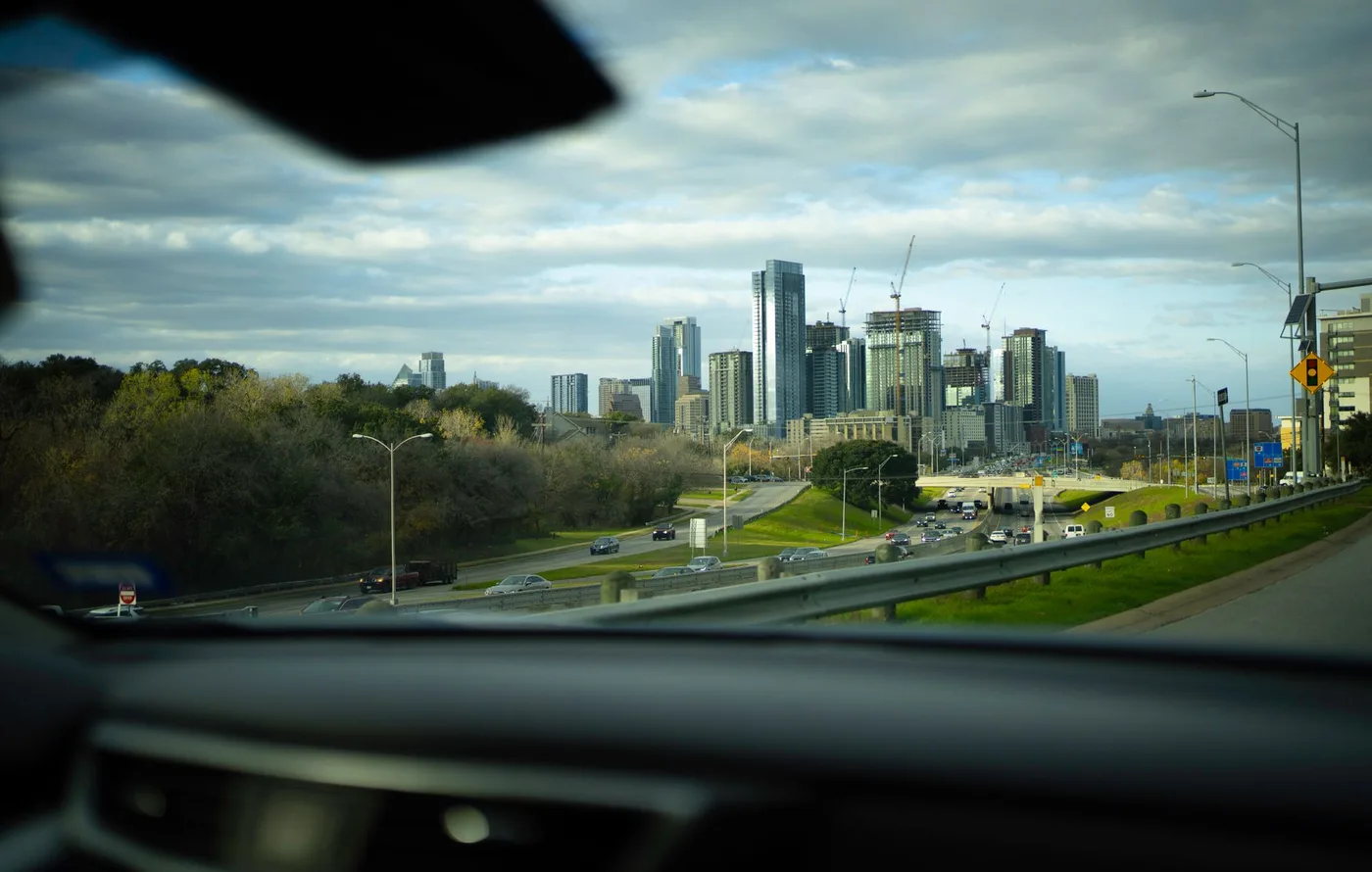
Austin's traffic problem has a street address: I-35 through the middle of town. One corridor carries the growth of the fastest-booming metro in Texas, and it is now mid-transformation by the largest highway project in state history. Here is what the data says, when I-35 and MoPac actually peak, and how to find the best time to leave for your route.
Austin traffic is climbing faster than anywhere else in Texas
The INRIX 2025 Global Traffic Scorecard puts the average Austin driver at 46 hours lost to congestion, ranking the metro 21st worst in the United States. The number that matters is the direction of travel: Austin was at 39 hours the year before, an 18% jump in twelve months.
No other big Texas metro is rising that fast. Houston came in at 70 hours but grew 6%. Dallas sits at 44 hours, up 7%. San Antonio is at 43 hours, up 10%. Austin is losing more hours per driver than either Dallas or San Antonio, and gaining them at roughly twice the rate.
The reason is concentrated in one place. Per the Texas A&M Transportation Institute's congested-roads analysis, drivers on I-35 through central Austin — the stretch from US-290 to Ben White — lost nearly 8 million hours in a single year, and TxDOT reports over 200,000 trips a day on that corridor, 80% of them starting or ending downtown. TTI's 2025 report finds 96 of Texas's 100 most congested segments sit in just four metros, and Austin is one of them.
All of it is happening inside a construction zone. The $4.5 billion I-35 Capital Express Central rebuild, the largest highway project in Texas history, is actively reshaping the corridor through at least 2028, layering closures and shifting lanes on top of the baseline crush.
When is Austin traffic worst?
Mornings run roughly 6:30–9:00 a.m. and evenings roughly 4:00–7:00 p.m. — with one Austin quirk. TTI's data shows I-35 southbound congestion running from midday onward, noon to 7 p.m., which is unusual for a metro this size. By corridor:
- I-35 through downtown — the signature crawl, worst between Lady Bird Lake and US-290. Southbound suffers from noon, northbound stacks 2–7 p.m., and construction reshuffles the pain monthly.
- MoPac (Loop 1) — the second spine, backing up hard in both directions at the afternoon peak, express lane notwithstanding.
- US-183 — heavy morning slowdowns between I-35 and Loop 360.
- SH-71 near the airport — clogs 4:00–6:30 p.m. on weekdays.
- US-290 through Oak Hill and the 2222/620 interchange — the southwest and northwest chokepoints for Cedar Park, Leander and Dripping Springs commutes.
Prefer a leave-by time to a set of windows? Put your arrival time into the departure time calculator and it will work out when to go.
The simple move: shift off the peak
Leaving just before or just after the busiest window clears a large share of the delay. Austin also has something genuinely rare among big American metros: real bypasses. SH-130 and SH-45 are tolled, but for through-trips they skip central I-35 entirely and routinely beat the interstate at peak.
Three Austin-specific things that move the peak
- The construction era. Capital Express runs to roughly 2028. A route that worked last month may be re-striped this month, which makes checking your route before leaving matter more here than almost anywhere in the country right now.
- Event surges. UT football Saturdays, SXSW, ACL and the F1 weekend rewrite the grid around downtown and every corridor feeding it.
- Growth. Central Texas keeps adding commuters faster than it adds lanes. That is the reason INRIX keeps recording double-digit annual increases here while the rest of Texas moves single digits.
Why your best time is route-specific
I-35 does not peak like MoPac, a construction week is not a normal week, and a festival weekend is its own planet. Citywide advice smooths over exactly the differences that decide your drive. Nationally, the worst day of the week varies by city too. Driving Texas more broadly? See Dallas and Houston.
Find the best time to leave for your Austin route
Google Maps and Waze show live traffic and turn-by-turn once you are already on the road. BoardSpy is the leave-time app: it checks your saved Austin route before you leave, recommends when to go, sends traffic and weather alerts, and tracks delay and on-time stats including your best and worst days. It also factors in weather along the way. When you set off, it opens your map app for turn-by-turn. For how routing apps differ from departure-timing tools, see best app to avoid traffic and Google Maps commute alternatives.
Just passing through?
If Austin is a waypoint rather than home, the timing question is different — you care about the I-35 corridor window, not the commute peak. If you are continuing south, see the I-35 run to San Antonio.
Frequently asked questions
What is the best time to leave to avoid traffic in Austin?
Generally before 6:30 a.m. or after 9:00 a.m. in the morning, and outside 4:00–7:00 p.m. in the evening. Note that I-35 southbound runs heavy from midday, so an early-afternoon departure on that corridor is not the escape it looks like. The exact best time depends on your corridor and day.
When is Austin rush hour?
Roughly 6:30–9:00 a.m. and 4:00–7:00 p.m., with I-35's southbound congestion starting around noon and construction stretching the windows further in both directions.
How bad is Austin traffic compared to other cities?
INRIX ranks Austin 21st worst in the United States for 2025, at 46 hours lost per driver. That is more hours than Dallas at 44 or San Antonio at 43, and Austin's 18% year-on-year rise is the steepest of any major Texas metro.
Why is I-35 through Austin so bad?
One interstate carries the growth of the fastest-booming metro in Texas. TTI measured nearly 8 million hours of annual delay on the US-290-to-Ben-White stretch, with over 200,000 daily trips, 80% of them starting or ending downtown — and it is mid-rebuild through at least 2028 under the largest highway project in Texas history.
How do I avoid I-35 through Austin?
For through-trips, the SH-130 and SH-45 toll bypasses skip central Austin entirely and routinely beat I-35 at peak. For local trips, MoPac is the main alternative, though it carries its own afternoon crush.
How do I find the best time to leave for my Austin commute?
Use a leave-time commute app that reads your actual route rather than only a live map. BoardSpy recommends when to leave for your Austin route, sends pre-departure traffic and weather alerts, and tracks on-time performance and your best and worst traffic days. Download it here.