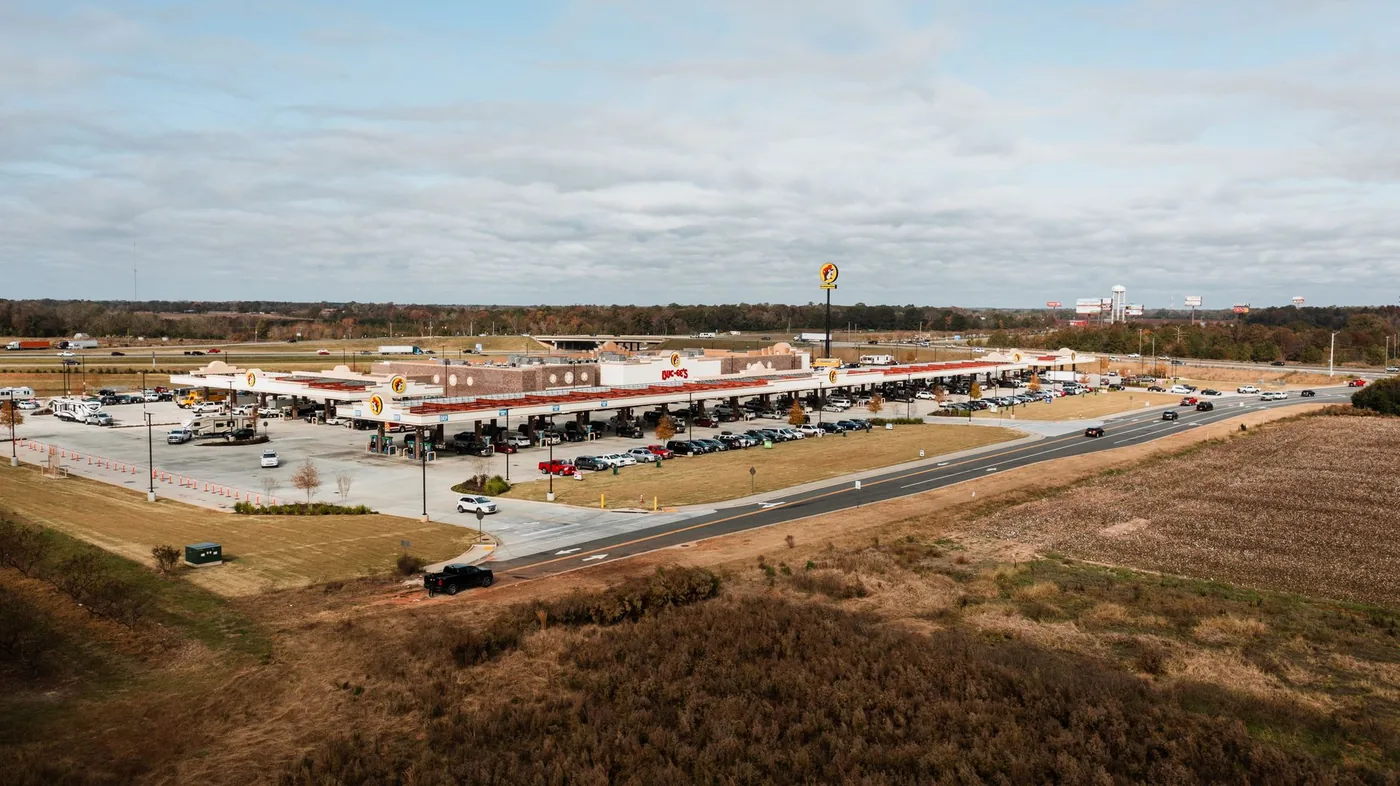
Most state rest areas do not have food. They have vending machines.
That is the honest answer, and it is worth knowing before you drive past three exits assuming the rest area ahead will feed you.
Here is where the exceptions are.
What ordinary rest areas actually have
A typical state-operated rest area offers:
- Vending machines — snacks and drinks, sometimes a hot beverage machine
- Restrooms
- Picnic tables, often covered
- Pet-walking areas
- Occasionally: WiFi, water, a dump station
No restaurants. No fuel. No shops.
There are good reasons for this. Rest areas are highway facilities built for safety, not commerce, and in many states commercial development at interstate rest areas has been restricted for decades in order to protect businesses at the exits. Federal framing: a safety rest area may have vending, but Interstate rest areas may not dispense petroleum products.
Where you can actually get a meal
Three types of facility do have real food, and knowing which is which saves you a lot of guessing.
1. Toll road service plazas
This is the main answer. Turnpike and tollway service plazas typically have full restaurants, branded outlets and fuel — and you never leave the toll road to reach them, so there is no exit-and-re-enter penalty and no second toll.
The Ohio Turnpike operates service plazas that also permit overnight stays, including RVs up to 40 feet — eight of them, which is unusual and useful. The New Jersey Turnpike, Pennsylvania Turnpike, New York Thruway and Illinois Tollway all run comparable facilities. Detail: toll road rest stops.
Expect prices above what you would pay at an exit. You are paying for not leaving the road.
2. Welcome centers
State welcome centers — usually at state lines — are typically the best-equipped facilities on any route. Staffed, with local information, and in several states better provisioned than ordinary rest areas.
Food varies. Some have cafés, many have better vending than a standard rest area, and a few have very little. Do not count on a meal without checking.
New York is the notable case: overnight parking is permitted at welcome centers where ordinary state rest areas cap at two hours.
3. Truck stops
Private businesses, not state facilities. They almost always have full food service, fuel, showers and shops.
They are also the correct choice for a long overnight in a restrictive state, since state DOT rest area rules do not govern them.
The trade is that you leave the highway to reach one, and re-entering costs a few minutes.
The practical planning rule
If you need a meal, plan for a truck stop or a service plaza, not a rest area.
If you need a break, a rest area is better — quieter, free, and you do not leave the road.
A useful pattern on a long drive: rest areas for short breaks every couple of hours, and one proper stop at a truck stop or service plaza for the meal and fuel. How to sequence those stops: rest stops along your route.
What the state DOTs publish
Several states publish interactive maps showing what each specific facility offers — truck parking, dump stations, WiFi, propane, and sometimes food service.
Arkansas does this well. Georgia and Idaho publish similar tools.
If a meal matters to your schedule, five minutes with the state map beats hoping.
A note on the "near me" version of this question
If you are searching for food at a rest stop while already driving, what you actually want is what is on your route, not what is nearest as the crow flies.
Those are different things. A restaurant half a mile away across a divided highway with no crossing is not reachable; one four miles ahead at your next exit is. Straight-line proximity is a poor guide on a freeway.
Rest area rules still apply
Whatever the facility offers, two rules do not change:
Camping is prohibited at every rest area in every state. Sleeping inside your vehicle is a different legal category.
Truck spaces are for commercial trucks. When cars and RVs take them, drivers with mandatory rest requirements end up on highway shoulders.
Time limits, briefly
If you are stopping for a meal, the time limits are unlikely to matter — but they range from two hours in Tennessee, New Jersey and Pennsylvania to no limit at all in Arizona, Arkansas and Georgia.
Our interstate rest stops guide covers the full state-by-state picture.
Before you leave
Food along a route is a live question — what is open, what is actually reachable, and what is worth the detour.
BoardSpy shows food, fuel and rest options along your actual route as you drive it, filtered by genuine detour distance rather than straight-line proximity, so you are choosing between places you can really get to.
Related BoardSpy guides
- Interstate rest stops: US overnight rules
- Toll road rest stops and service plazas
- How to plan rest stops along your route
Frequently asked questions
Do rest stops have food?
Most state rest areas do not have restaurants. They have vending machines. For a real meal, plan a truck stop or a toll-road service plaza.
Where can you get a restaurant meal without leaving the highway?
Toll road service plazas. The Ohio Turnpike, New Jersey Turnpike, Pennsylvania Turnpike, New York Thruway and Illinois Tollway all run comparable facilities with restaurants and fuel.
Do interstate rest areas sell gas?
No. Federal roadside rules do not allow Interstate safety rest areas to dispense petroleum products. For fuel, use a travel plaza or an exit cluster.
Are welcome centers better for food than ordinary rest areas?
Often better equipped, but food varies. Some have cafés, many have better vending, a few have very little. Do not count on a meal without checking.
Should you search “food rest stops near me” while driving?
That returns nearest-as-the-crow-flies. On a freeway you want what is on your route, in your direction, with a short detour — not a restaurant across a divided highway.
References
Posted signs and operator timetables override this guide. Stay limits are pattern summaries of state DOT rules, not a substitute for the sign at the facility.
- 23 CFR § 752.5 — Safety rest areas — Federal rule defining Interstate safety rest areas and limiting petroleum sales at those sites.
- Ohio Turnpike service plazas — Turnpike plazas with restaurants, fuel, and documented overnight RV parking at eight sites.
- Arkansas DOT rest areas — Arkansas interactive rest-area map with amenity detail.
- Georgia DOT rest areas — Georgia rest-area locations and amenity tools.
- NHTSA: Drowsy Driving — Why a planned meal stop is also a fatigue break.
- BoardSpy data sources — How leave-time recommendations use a saved route (limits disclosed).