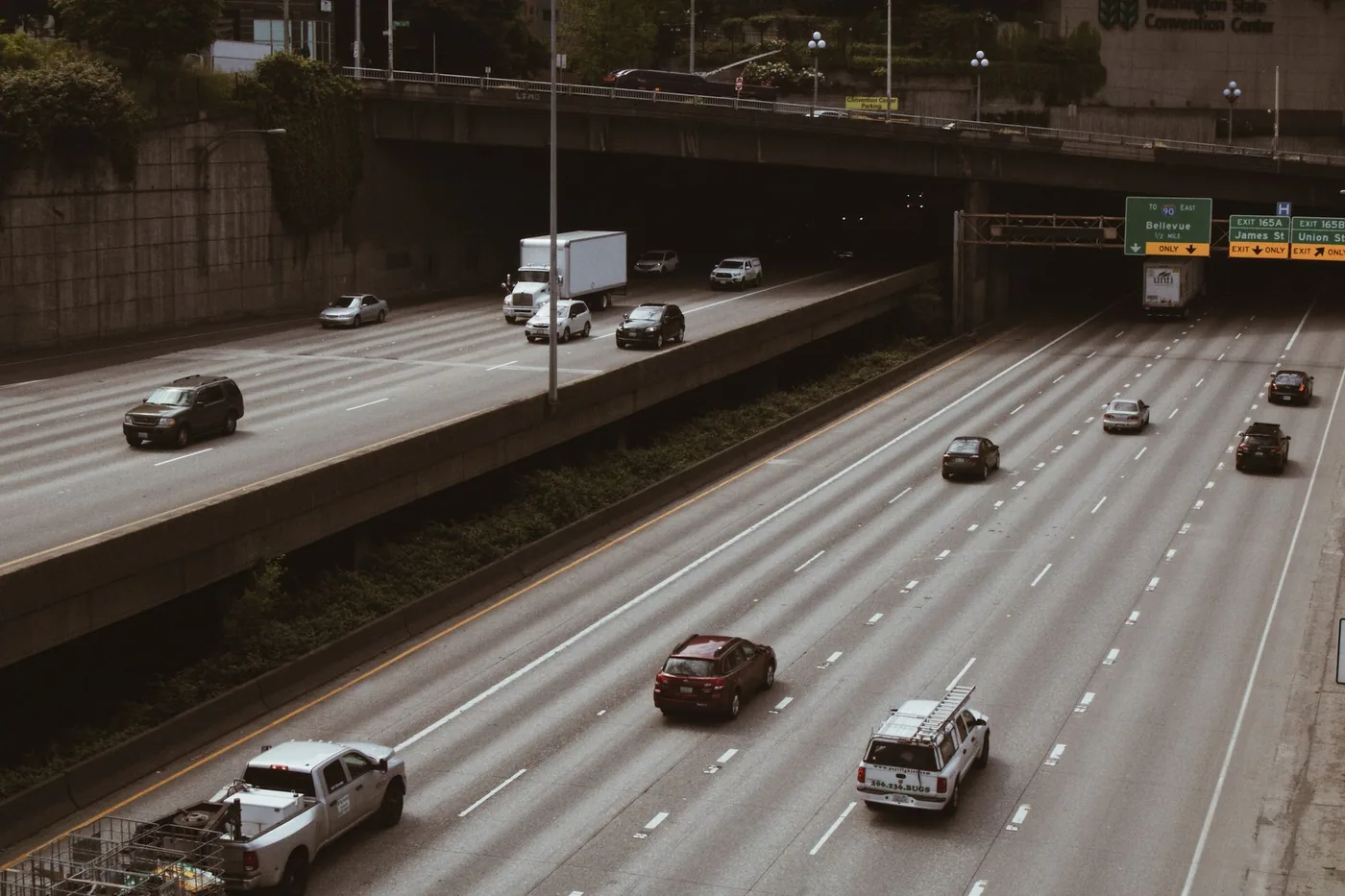
About 33 miles. Roughly 40 minutes with no traffic, and well over an hour with it.
This is a short drive on a badly congested road, which means the distance tells you almost nothing useful. The departure time tells you everything.
The numbers
| Feature | |
|---|---|
| Distance | ~33 miles downtown to downtown |
| Drive time, free-flow | ~40 min |
| Weekday peak | 1 hr – 1 hr 30 min |
| Route | I-5 south |
| Alternative | SR 167 / SR 512 via Puyallup |
Thirty-three miles taking ninety minutes is a ratio you rarely see outside the very worst US corridors. I-5 through the south Puget Sound is one of them.
The route
I-5 south through Tukwila, SeaTac, Federal Way and Fife into Tacoma. Direct, and where all the congestion is.
SR 167 south to SR 512 runs inland through Renton, Kent, Auburn and Puyallup. Longer in distance, and frequently faster when I-5 is broken — particularly if your origin or destination is on the east side.
SR 99 / East Marginal Way is a local alternative for the northern portion only. Not a serious contender for the full run, but useful for getting out of Seattle when I-5 is stopped at the start.
Where it backs up
Three specific places do most of the damage on this corridor:
The SeaTac / Tukwila stretch. Airport traffic loads onto I-5 on top of commuter traffic. This is the densest section on a normal weekday.
Federal Way to Fife. The long middle section, where volume is heavy and there are few alternatives once you are committed.
The Tacoma Dome approach. Where I-5 meets SR 16 and I-705, and where the southbound trip finishes badly.
When to go
| Departure | Typical duration | Notes |
|---|---|---|
| Before 5:30 a.m. | ~40 min | Free-flow |
| 5:30 – 6:30 a.m. | 45–55 min | Building |
| 6:30 – 9:00 a.m. | 55 min – 1 hr 15 | Morning peak — heavier northbound |
| 9:30 a.m. – 2:30 p.m. | 40–50 min | Best window |
| 3:00 – 6:30 p.m. | 1 hr – 1 hr 30 | Peak southbound. Avoid. |
| After 7:00 p.m. | ~40 min | Clear |
Direction matters as much as the hour. Employment concentrates in Seattle, so the corridor loads northbound in the morning and southbound in the evening. Driving Seattle→Tacoma means you are with the crowd in the evening and against it in the morning.
A 7:30 a.m. southbound run is far less painful than a 5:00 p.m. southbound run, even though both fall inside a named peak.
The airport factor
Sea-Tac International sits directly on this corridor at roughly the one-third mark. That has two consequences.
First, it adds a continuous stream of traffic that does not follow commuter patterns — airport volume is high at 5 a.m. and at 10 p.m.
Second, it makes this corridor genuinely useful in both directions for airport runs. seattle airport to bellevue, tacoma airport to seattle and similar queries all touch the same stretch of road.
If your trip involves Sea-Tac, budget more than the corridor numbers above suggest, and check the terminal-side traffic separately from the freeway.
Is there an alternative to driving?
Yes, and it is a real one.
Sounder commuter rail runs the Seattle–Tacoma corridor on the south line, and Sound Transit express buses run it as well. Both avoid I-5 entirely for the portion they cover.
The trade is the usual one: fixed journey time and no variance, against a schedule you have to fit and a first-and-last-mile problem at either end. For downtown-to-downtown at 5 p.m., rail is frequently the faster real-world option. Off-peak, driving wins comfortably.
Weather
Rain is the constant. Puget Sound rain is rarely heavy but it is persistent, and I-5 at capacity degrades disproportionately when the surface is wet.
Winter ice is rare and disruptive when it happens — the region has limited equipment and drivers have limited practice.
Fog in the low-lying sections near the water can be dense in autumn mornings.
The reverse trip
Tacoma to Seattle is the harder direction in the morning. The northbound peak between roughly 6:00 and 9:00 a.m. is the corridor's worst regular condition, driven by the employment concentration in Seattle.
If you commute this way daily, leave before 6:00 a.m. or after 9:15. The window between is where the time goes.
Before you leave
Thirty-three miles that can take forty minutes or ninety is the definition of a corridor where knowing today's conditions is worth more than knowing the route.
BoardSpy watches I-5 and SR 167 in real time and tells you before you leave which one is moving — with an alert when shifting your departure by fifteen minutes would save you half an hour.
Related BoardSpy guides
Frequently asked questions
How far is Seattle to Tacoma?
About 33 miles downtown to downtown. Free-flow is about 40 minutes. Weekday peaks run 1 hour to 1 hour 30 minutes on I-5 south. Pattern estimates, not live times.
When is the worst time to drive Seattle to Tacoma?
Southbound 3:00–6:30 p.m. Employment concentrates in Seattle, so evenings load southbound. Mornings southbound are easier than evenings.
Is SR 167 faster than I-5?
Sometimes. SR 167 to SR 512 via Puyallup is longer in miles and often faster when I-5 is broken, especially for east-side origins or destinations.
Can you take a train from Seattle to Tacoma?
Yes. Sounder commuter rail on the south line and Sound Transit express buses skip I-5 for the portion they cover. At 5 p.m. downtown-to-downtown, rail is often faster in the real world.
Does Sea-Tac change the drive?
Yes. The airport sits about one-third of the way down the corridor and adds traffic that does not follow commute hours, including early morning and late evening.
References
Posted signs and operator timetables override this guide. Drive-time windows are pattern estimates, not measured figures for today.
- Sound Transit — Sounder south line and ST Express buses on the Seattle–Tacoma corridor.
- WSDOT rest areas — Washington rest-area locations and typical ~8-hour limit.
- BoardSpy data sources — How leave-time recommendations use a saved route (limits disclosed).