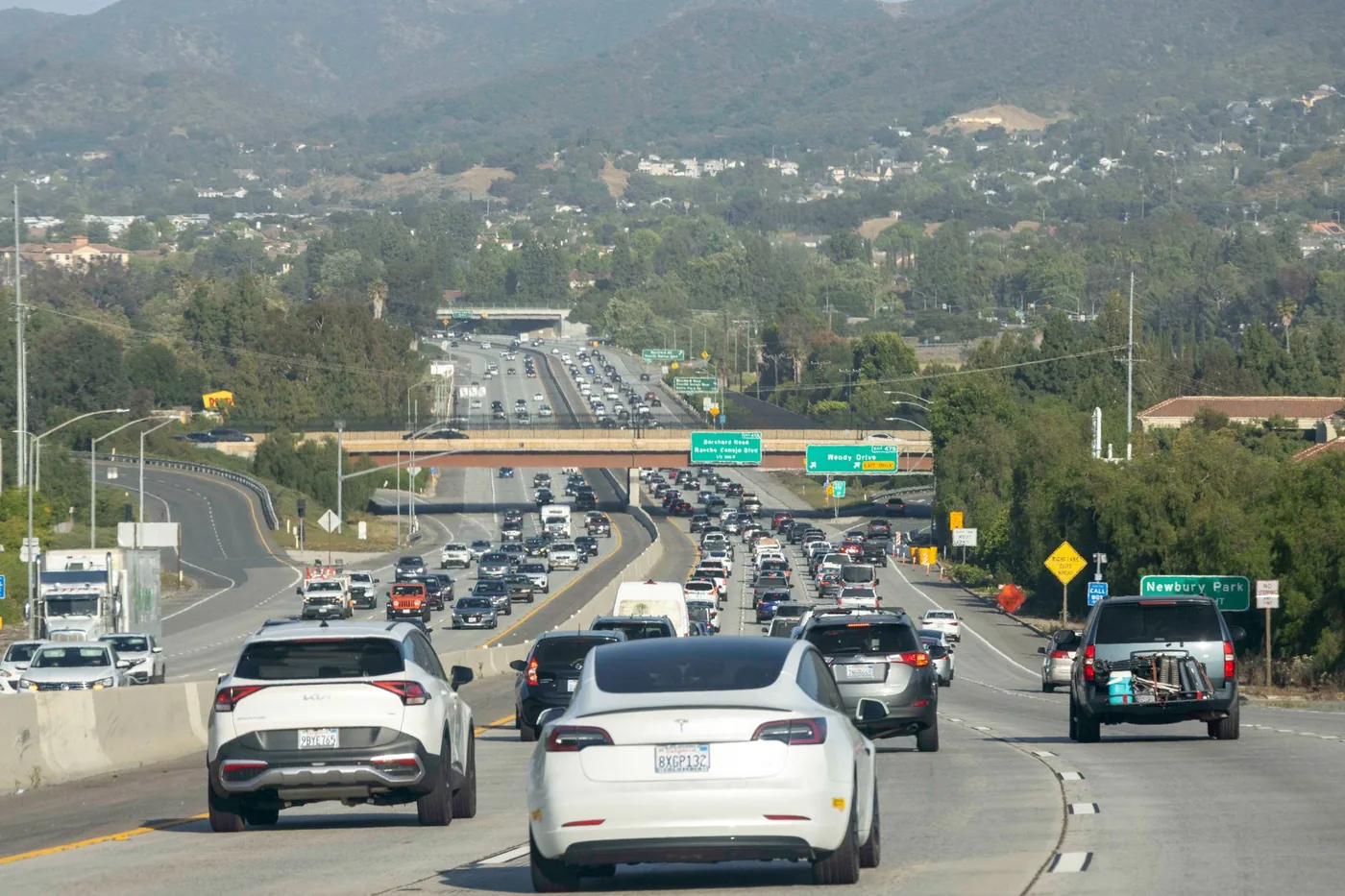
About 500 miles on I-5 and roughly eight hours. Realistically a nine-and-a-half-hour day with stops, or a comfortable two-day trip if you take the coast.
This is the full length of California, and the first two hours are the ones that decide how it goes.
The numbers
| Route | Distance | Drive time |
|---|---|---|
| I-5 (via LA and the Central Valley) | ~500 mi | ~8 hr |
| US 101 (coastal inland) | ~550 mi | ~9 hr 30 |
| Highway 1 (the coast) | ~600 mi | 12 hr+ / two days |
The Los Angeles problem
This is what separates the San Diego trip from the LA one: you have to get through Los Angeles first, and Los Angeles is 120 miles into the drive.
Getting that wrong costs you an hour before you have really started.
| Leave San Diego | Reach LA | Verdict |
|---|---|---|
| Before 5:00 a.m. | ~6:45 a.m. | Best. Through LA before the peak fully forms. |
| 5:00 – 6:00 a.m. | 7:00 – 8:00 a.m. | Poor. Straight into the LA morning peak. |
| 9:00 – 11:00 a.m. | 11:00 a.m. – 1:00 p.m. | Good. LA between peaks. |
| 1:00 – 3:00 p.m. | 3:00 – 5:00 p.m. | Worst. LA evening peak, which runs to 7. |
| After 7:00 p.m. | after 9:00 p.m. | Clear roads, night driving. |
The single most useful rule on this route: plan your arrival into Los Angeles, not your departure from San Diego. Everything else follows from it.
There is also a second congestion point most people forget — the Orange County stretch between Oceanside and Irvine, which has its own commuter peaks independent of LA's.
The route
I-5 north through Orange County and Los Angeles, over the Grapevine at Tejon Pass, down into the Central Valley, then west toward the Bay Area.
I-405 is an alternative through the LA basin. It is not usually faster and it is frequently worse; the main reason to take it is if your route touches the west side of LA.
US 101 diverges after Ventura and runs the inland-coastal route through Santa Barbara, San Luis Obispo and Salinas. An hour and a half longer and considerably more pleasant.
Where to stop
Eight hours needs three stops minimum.
Irvine / Orange County — about 90 miles. Early, but a sensible first break if you left before dawn.
Santa Clarita — about 150 miles, just before the Grapevine. Last services before the climb.
Bakersfield — about 230 miles. Full services, and the natural halfway-ish break.
Kettleman City — about 330 miles. The most substantial services on the I-5 valley run, and where most people stop.
Santa Nella / Los Banos — about 410 miles. Last good stop before the Bay Area approach.
The gaps in the valley are real. Do not pass Kettleman City low on fuel.
The two-day version
At 500 miles this is a trip that genuinely benefits from splitting, and the natural break points are good ones.
Via I-5: overnight in Bakersfield or Fresno. Efficient, not memorable.
Via US 101: overnight in San Luis Obispo or Paso Robles. Roughly the midpoint, genuinely pleasant places, and it turns a long haul into a decent trip. This is the version worth doing if you have the time.
Weather
Tule fog (November–February) on the Central Valley I-5 stretch is the serious hazard. Dense ground fog, near-zero visibility, very little warning. Worst in the early morning — which is otherwise the best departure time, so this is a real trade-off in winter.
Grapevine closures. Tejon Pass shuts several times most winters for snow and ice. Check the status before you leave; the detour when it closes is long and slow.
Summer heat in the valley is extreme and the exposed stretches are long. Carry water.
Coastal fog on the US 101 routing is common in summer mornings.
The night-driving question
Leaving San Diego after 7 p.m. gets you clear roads through LA and an empty valley. It also means driving I-5's most monotonous section in the dark, when tule fog is hardest to see and services are thinnest.
If you do it, break the trip. An overnight in Bakersfield turns a risky push into two easy halves.
Should you drive at all?
Five hundred miles is a real distance, and San Diego to San Francisco is a well-served air route with frequent short flights.
Drive when: you need the car at the other end, you are travelling as a group, you have luggage, or the trip is the point.
Fly when: it is a short trip and a rental at the far end costs less than eight hours of your day.
Before you leave
Five hundred miles where Los Angeles at mile 120 and the Grapevine at mile 160 decide the whole day. At the north end, use the best time to leave San Francisco to avoid traffic; at the south/LA stretch, see the best time to leave Los Angeles to avoid traffic.
BoardSpy models the full corridor — the Orange County build, your LA crossing time, Grapevine conditions, and valley fog — and gives you a departure window based on the whole route rather than where you are standing.
Related BoardSpy guides
- Drive time from LA to San Francisco
- How far is Los Angeles to Long Beach
- Best time to leave in Los Angeles
Frequently asked questions
How long does it take to drive from San Diego to San Francisco?
About 500 miles and roughly eight hours on I-5, or about nine and a half hours with stops. US 101 is about 550 miles / 9 hours 30. Highway 1 is a two-day trip. Pattern estimates, not live times.
When should you leave San Diego?
Plan your arrival into Los Angeles, not just your departure. Before 5:00 a.m. gets you through LA before the peak. 9:00–11:00 a.m. hits LA between peaks. 1:00–3:00 p.m. is the worst LA evening-peak arrival.
What is the Los Angeles problem on this drive?
LA is about 120 miles in. Hitting the basin at the wrong hour costs an hour before the valley even starts. Orange County between Oceanside and Irvine has its own commuter peaks.
Where should you stop?
Irvine if you left before dawn, Santa Clarita before the Grapevine, Bakersfield, Kettleman City (do not pass low on fuel), then Santa Nella / Los Banos. For two days, overnight in Bakersfield or San Luis Obispo.
Should you fly instead?
Fly when it is a short trip and a rental at the far end costs less than eight hours of your day. Drive when you need the car, are a group, have luggage, or the trip is the point.
References
Posted signs and operator timetables override this guide. Drive-time windows are pattern estimates, not measured figures for today.
- Caltrans road conditions — Live Grapevine / I-5 / Highway 1 closure status.
- Caltrans District 6 — Central Valley I-5, including tule fog and Tejon Pass.
- BoardSpy data sources — How leave-time recommendations use a saved route (limits disclosed).