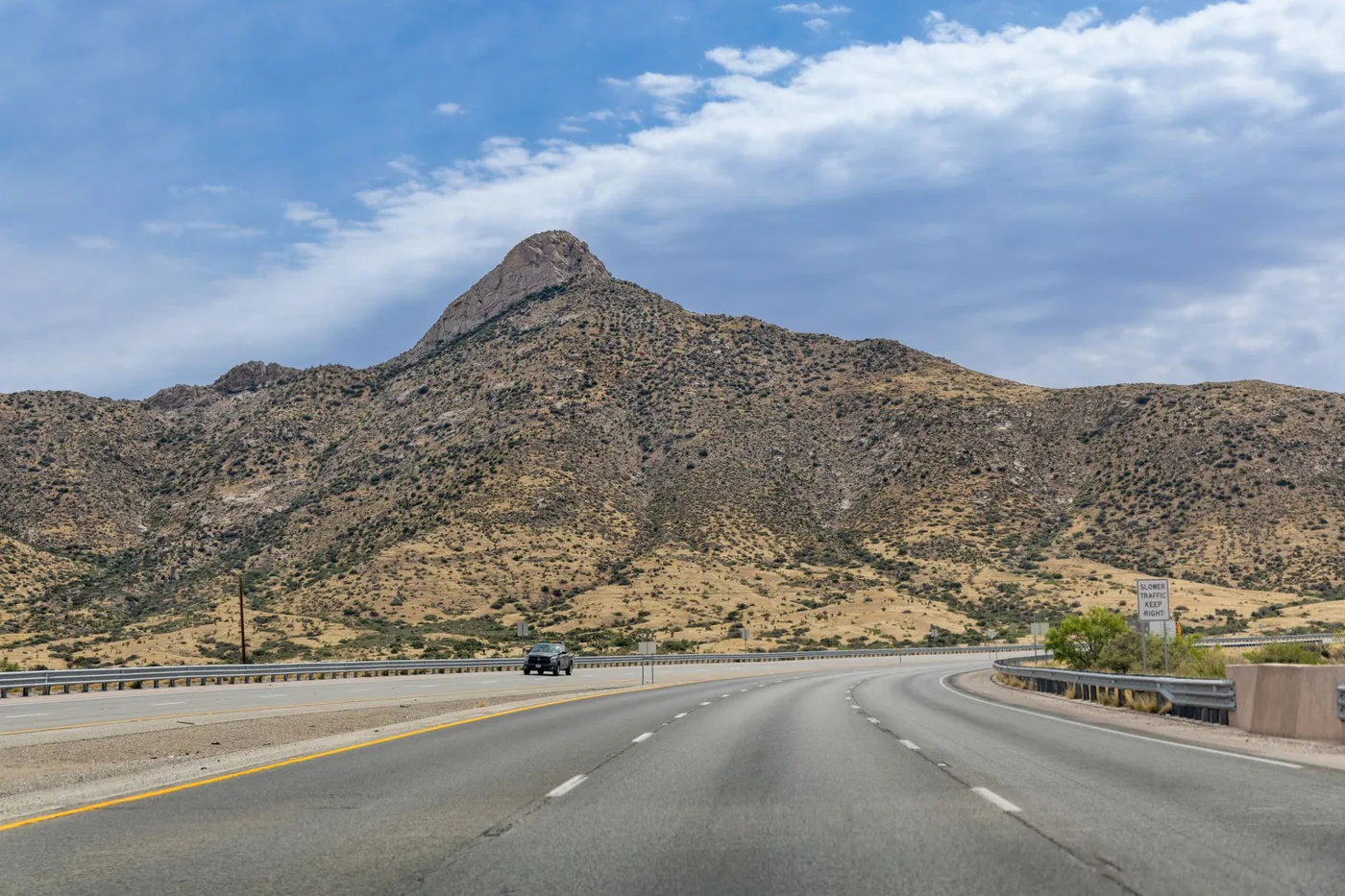
This is one of the longest single-state drives in America — roughly 635 miles across the width of Texas. It is also a drive where the planning matters more than usual, because the middle 300 miles have long gaps between services and weather that can close the road. Starting from Fort Worth instead: Fort Worth to El Paso. Clearing the Metroplex: Dallas to Fort Worth traffic guide.
The short answer
- Distance: ~635 miles
- Pure driving time: ~9 hr 30 min
- Realistic single-day time: 11 hours with stops
- Route: I-20 west to I-10 west at Monahans
- Best departure: before 6:00 a.m. from Dallas
- Time zone: El Paso is on Mountain Time — you gain an hour arriving, lose one returning
That time zone change is the most commonly forgotten detail on this drive. A 6:00 a.m. Dallas departure arriving "at 5:00 p.m." arrives at 4:00 p.m. local.
The route
I-20 west out of Dallas through Fort Worth, Abilene, Big Spring, Midland and Odessa. I-10 west from around Monahans through Van Horn to El Paso. There is no meaningful alternative. US 180 exists as a slower parallel and I-27/US 87 north is a detour, not a shortcut. This is an I-20/I-10 drive.
Timing the departure
| Leave Dallas | Clear DFW by | Verdict |
|---|---|---|
| Before 6:00 a.m. | ~6:45 a.m. | Best. Beats the DFW morning peak entirely. |
| 6:00–6:30 a.m. | ~7:30 a.m. | Good. Marginal. |
| 6:30–9:00 a.m. | 8:30–10:00 a.m. | Poor. You lose 30–45 min to DFW traffic. |
| 9:30 a.m.–noon | — | Fine, but you arrive after dark. |
| After 2:00 p.m. | — | You're driving West Texas at night. See below. |
Dallas–Fort Worth holds 41 of the state's 100 most congested road segments per the Texas A&M Transportation Institute and TxDOT — more than any other Texas metro — according to Dallas Morning News coverage of the 2025 Top 100. The I-30/I-20 corridor through Arlington is where a late start costs you. The I-30 Canyon near downtown Dallas is also an active long-term construction zone with ongoing lane shifts. Leaving before 6:00 a.m. skips all of that. Dallas-end windows: best time to leave in Dallas.
Where to stop
Nine and a half hours needs three stops minimum. The corridor supports it, but the spacing is uneven — plan around the gaps rather than assuming fuel is always nearby.
- Abilene — ~180 miles, roughly 2 hr 45 min. First proper stop. Full services, good food, easy on and off.
- Big Spring — ~275 miles. Reasonable secondary option if you didn't stop at Abilene.
- Midland / Odessa — ~350 miles, roughly the halfway mark and the natural lunch stop. The largest services between Fort Worth and El Paso. If you are splitting the drive over two days, this is the place to overnight.
- Pecos — ~450 miles. Last substantial services for a while.
- Van Horn — ~530 miles. Small, and the last stop before the final 120-mile run. Fuel here whether or not you think you need to.
The gap to know about: between Van Horn and El Paso there is very little. Do not enter that stretch on a quarter tank.
West Texas weather — the part people underestimate
Dust storms. The National Weather Service in Midland/Odessa issues Dust Storm Warnings for the I-20 corridor with visibility under a quarter mile and winds over 50 mph, describing the hazard on I-20 as life-threatening. Blowing Dust Advisories are common, with warnings that visibility can drop suddenly to near zero, especially where bare fields exist. Affected counties routinely include Ector, Midland, Martin, Howard, Ward, Crane, Reeves and Loving — the exact heart of your route. Official guidance: NWS dust storms and haboobs. Forecast office: NWS Midland/Odessa.
The official guidance if you encounter blowing dust is specific and worth memorising: pull off the road as far as possible, put the vehicle in park, turn the lights all the way off, and keep your foot off the brake pedal. The reasoning is that lit brake lights attract following drivers directly into your stationary vehicle. "Pull Aside, Stay Alive."
High wind. Wind Advisories in the Permian Basin regularly cite gusts to 45 mph, with the note that travel will be difficult especially for high-profile vehicles. Severe thunderstorm gusts in the region have been measured in the 60s.
Winter ice — rare but severe. A December 2014 event produced widespread road closures including parts of I-10 and I-20, over 350 vehicle accidents, three fatalities, and shelters set up for stranded travellers at Van Horn. West Texas has limited equipment and drivers have limited practice. An ice event here does not slow the road, it closes it.
Summer heat. Extreme heat drives tyre failures and overheating on a route where a breakdown can leave you a long way from help. Construction: TxDOT runs periodic overnight closures on I-20 between Midland and Odessa with frontage-road detours. Check before an overnight leg.
Driving it at night
Not recommended, for reasons specific to this route rather than general caution: wildlife on the open stretches, particularly deer; very long gaps between services if something goes wrong; dust and fog are far harder to detect in the dark; limited phone coverage in sections. If you must drive part of it at night, do the Dallas–Midland half in daylight and the western section early rather than the reverse.
The two-day version
If you have the time, splitting at Midland/Odessa makes this a pleasant trip rather than an endurance exercise:
- Day 1: Dallas → Midland, ~350 miles, 5 hours. Leave at 8 a.m., arrive early afternoon.
- Day 2: Midland → El Paso, ~285 miles, 4 hr 30 min. Leave at 9 a.m., arrive early afternoon Mountain Time.
This also puts the most weather-exposed section — Pecos through Van Horn — into a morning slot, before afternoon wind and dust typically peak.
Before you leave
On a nine-and-a-half-hour drive the departure decision is made once and cannot be revisited, and the weather 400 miles ahead of you is not the weather outside your window. BoardSpy models the full corridor — DFW's morning peak, the open middle, and dust and wind conditions across the Permian Basin — and gives you a departure window based on the whole route rather than just where you are standing.
Frequently asked questions
How long does it take to drive from Dallas to El Paso?
About 635 miles. Pure driving is roughly 9 hours 30 minutes; a realistic single day with stops is about 11 hours. El Paso is on Mountain Time, so you gain an hour arriving.
What is the best time to leave Dallas for El Paso?
Before 6:00 a.m., so you clear DFW before the morning peak. A 6:30–9:00 a.m. start can cost 30–45 minutes before you even reach open highway.
Where should I stop for fuel?
Abilene, Midland/Odessa, Pecos, and definitely Van Horn. Do not enter the Van Horn–El Paso stretch on a quarter tank — there is very little in between.
What do I do in a West Texas dust storm?
Pull off as far as possible, park, turn lights all the way off, and keep your foot off the brake. Lit brake lights draw following drivers into you. NWS slogan: Pull Aside, Stay Alive.
Should I split the drive over two days?
If you can. Overnight in Midland/Odessa (~350 miles). That puts Pecos–Van Horn in a morning slot before afternoon wind and dust typically peak.
References
DFW congestion rankings come from TxDOT/TTI. Dust-storm procedure is National Weather Service guidance. Timing tables are pattern estimates, not measured figures for today.
- Texas Top 100 Congested Road Segments — TxDOT / TTI annual ranking.
- These Dallas-Fort Worth roads are among the most traffic-plagued in Texas — Dallas Morning News (Dec 2025). DFW holds 41 of the Top 100.
- Dust Storms and Haboobs — National Weather Service safety page: Pull Aside, Stay Alive.
- NWS Midland/Odessa — Forecast office covering the I-20 Permian Basin stretch.
- 2025 Texas Top 100 Congested Road Segments (PDF) — Texas A&M Transportation Institute.
- Data sources and privacy — How leave-time recommendations use your saved route (limits disclosed).