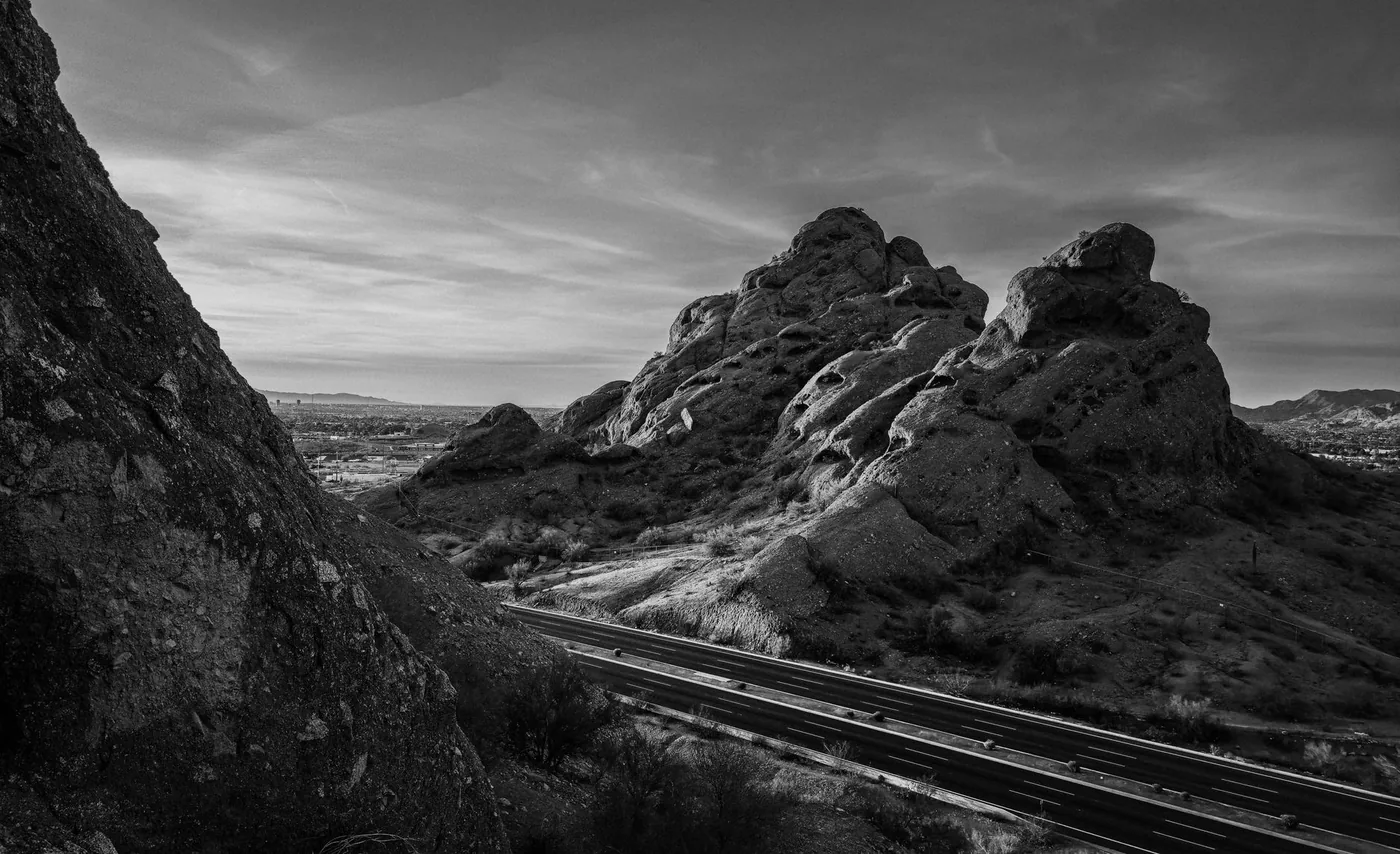
Phoenix is a straightforward crossing most of the year, and a genuinely hazardous one in summer. Both facts matter.
The routes
I-10 runs east to west — the coast-to-coast southern route, Los Angeles toward Tucson and El Paso. I-17 runs north from the city toward Flagstaff.
Loop 101 rings much of the metro. Loop 202 covers the south and east, including a southern section that lets I-10 traffic avoid the central stretch.
Neither loop is complete, so the bypass options are partial — but they are genuinely useful at peak.
Summer heat is a planning factor, not a comfort issue
Phoenix regularly exceeds 110°F (43°C) in summer, and that changes the calculation.
Vehicle risk. Cooling systems, tyres and batteries all fail more often in extreme heat. A breakdown on I-10 in the desert in July is a serious situation rather than an inconvenience — especially on the long stretches either side of the metro where services are sparse.
Practical response: in July and August, many long-haul drivers cross this stretch at night. It is cooler for the vehicle, cooler for you, and the roads are quieter.
If you drive in daytime heat: carry more water than you think you need, check tyre pressures before setting off, and do not rely on finding help quickly on the desert stretches.
Dust storms — the official procedure, in full
Arizona monsoon season officially runs 15 June to 30 September. During it, dust storms can reduce highway visibility to near zero within seconds, and they cause some of the deadliest multi-vehicle pileups in the Southwest.
ADOT runs a public campaign for this — Pull Aside, Stay Alive — jointly with the Governor's Office of Highway Safety, the Arizona Department of Public Safety and the National Weather Service. The NWS uses the same wording in its Dust Storm Wireless Emergency Alert templates.
These are ADOT's steps. They are worth reading before you need them.
1. Do not drive into a dust storm. This is the primary instruction. If you can see a dust wall ahead, exiting the highway before it reaches you is the safest decision available.
2. If it engulfs you, check traffic around your vehicle immediately — front, back and sides — and begin slowing down. Do not wait until visibility makes it difficult to pull off safely. Do it as soon as possible.
3. Completely exit the highway if you can.
4. If you cannot, pull completely off the paved portion of the roadway. Do not stop in a travel lane. Do not stop in the emergency lane either — a stationary vehicle in the shoulder is still in the path of drivers who cannot see.
5. Put the vehicle in park and set the parking brake.
6. Turn off all your lights — including hazard flashers.
7. Keep your foot off the brake pedal.
Steps 6 and 7 are the counterintuitive ones, and they are the ones that save lives. Drivers in zero visibility instinctively steer toward the tail lights ahead of them, believing they are following a moving vehicle. Lights on while you are stationary invites a rear-end collision at speed.
8. Stay in the vehicle with your seatbelt buckled and wait for the storm to pass. Most haboobs blow through in 10 to 30 minutes.
The smaller storms are the more dangerous ones
ADOT makes a point worth repeating: fast-moving dust channels that whip up alongside highways without warning can be more dangerous than a 3,000-foot haboob, because drivers often get no chance to avoid them.
You can see a haboob coming. You cannot see a dust channel coming.
High-profile vehicles
ADOT specifically advises drivers of high-profile vehicles to be especially aware of changing conditions and to travel at reduced speeds. Crosswinds during these events are significant.
Checking conditions
ADOT operates a dust detection system on I-10, which has been recognised as a significant safety innovation. Real-time highway conditions are published at az511.gov, through the AZ511 app, or by calling 511. Further guidance is at pullasidestayalive.org.
Timing
| Crossing time | What to expect |
|---|---|
| Before 5:30 a.m. | Clear |
| 6:00 – 9:00 a.m. | Morning peak |
| 10:00 a.m. – 3:00 p.m. | Best window for traffic, worst for heat in summer |
| 3:30 – 6:30 p.m. | Worst window |
| After 7:00 p.m. | Clearing, and cooler |
Winter is Phoenix's busy season. Seasonal residents and visitors add substantial traffic between November and March, and the metro feels considerably busier than in summer.
Weather beyond the heat
Monsoon thunderstorms, June to September, produce sudden heavy rain, flash flooding in washes, and the dust storms above.
Flash flooding. Desert ground absorbs little, so rainfall runs straight off. Never drive through a flooded wash, and never drive around a "road closed" sign — that is explicit ADOT guidance. Arizona also has a law under which drivers who need rescuing after ignoring barricades can be billed for the cost.
ADOT's broader monsoon advice: expect the unexpected in heavy rain, do not tailgate, leave extra braking room, and carry an emergency kit with extra water, snacks, sun protection, any prescription medication and a fully charged phone.
Winter is mild in the valley, but I-17 north toward Flagstaff climbs significantly and gets genuine snow. If you are continuing north, that is a different trip and needs checking separately.
If you are stopping
Services are plentiful throughout the metro and on the loops.
Fuel and water before the desert stretches in either direction. Westbound toward California and eastbound toward Tucson both involve long gaps, and in summer that gap is a safety matter rather than a convenience one.
Arizona operates rest areas along the interstates, with posted signs governing stays.
Continuing on?
West on I-10: the desert run toward Los Angeles — long, hot, and sparse. East on I-10: Tucson, about 115 miles, then Las Cruces and El Paso. North on I-17: Flagstaff, climbing to elevation, with winter conditions.
Commuting rather than passing through?
Different problem, different timing. See best time to leave Phoenix to avoid traffic.
Before you drive
Phoenix's traffic is the easy part. The heat and the dust are what deserve planning.
BoardSpy watches the crossing and the desert stretches either side, with live weather including dust and monsoon conditions on the road ahead.
Stopping for food? Use restaurants on my route.
Related drive-through guides
Along shared corridors: best time to leave Phoenix to avoid traffic · best time to drive through Dallas–Fort Worth · best time to drive through Houston · best time to drive through San Antonio · best time to drive through Salt Lake City.
Frequently asked questions
What is the best time to drive through Phoenix?
Between 10:00 a.m. and 3:00 p.m., or after 7:00 p.m. Avoid 6:00 to 9:00 a.m. and 3:30 to 6:30 p.m. In summer, consider crossing at night — daytime heat above 110F is a genuine vehicle risk on this stretch.
Can I bypass Phoenix?
Partly. Loop 101 rings much of the metro and Loop 202 covers the south and east, including a southern route that lets I-10 traffic avoid the central section. Neither is a complete ring, so the bypass is useful rather than total.
What is a haboob and how does it affect driving?
A haboob is a large dust storm, and Arizona monsoon season officially runs 15 June to 30 September. Visibility can drop to near zero within seconds. ADOT's Pull Aside, Stay Alive guidance is: do not drive into a dust storm; exit the highway if you can; if you cannot, pull completely off the paved roadway, put the vehicle in park, set the parking brake, turn off all lights including hazard flashers, keep your foot off the brake so trailing drivers are not drawn toward your taillights, and stay belted in until it passes.