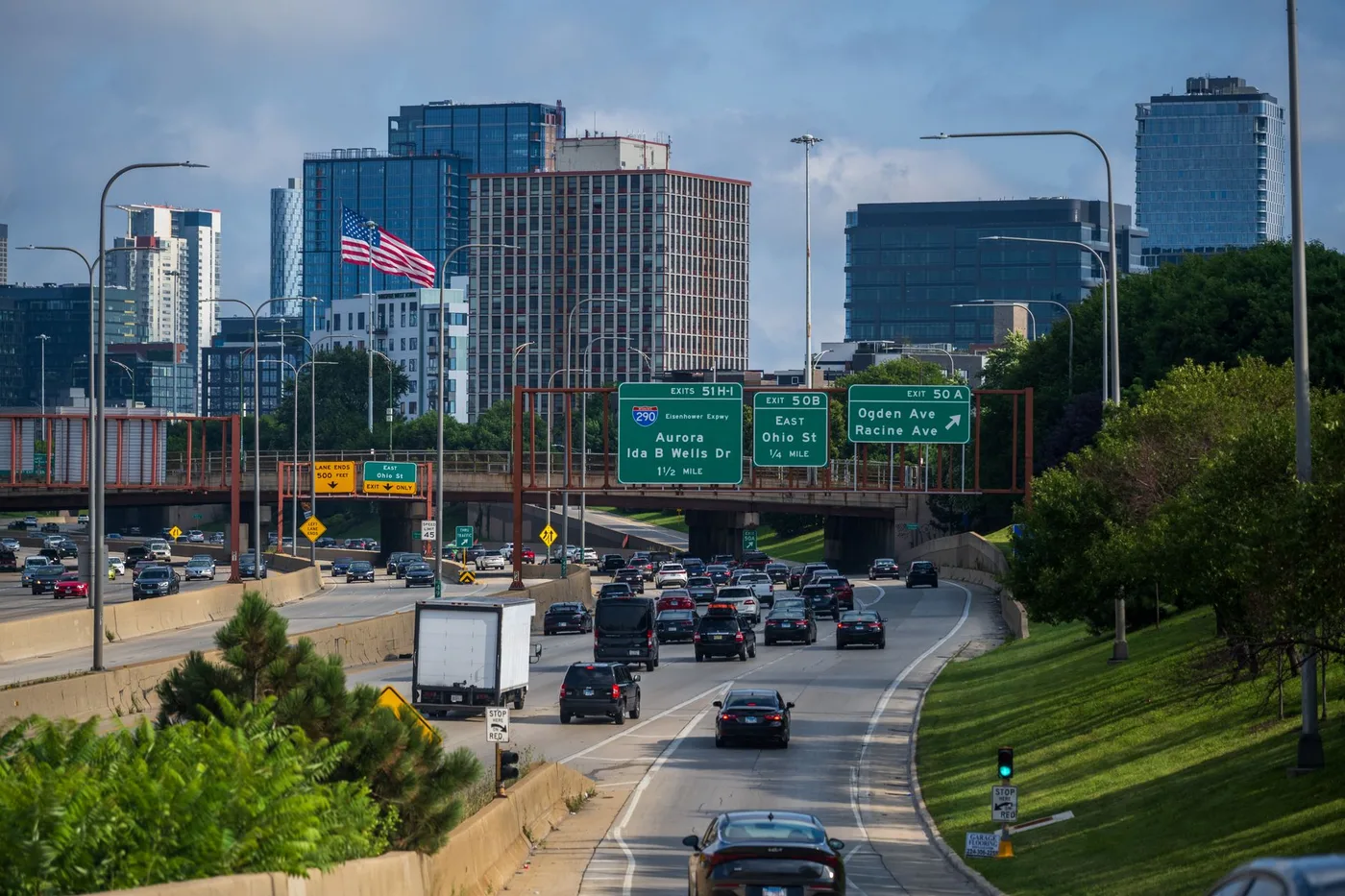
Three interstates converge on Chicago and none of them makes it easy. Here is when to cross and when to go around.
The short answer
Cross between 10:00 a.m. and 2:00 p.m., or after 7:00 p.m.
Avoid 6:30–9:30 a.m. and 3:00–6:30 p.m.
If you are going east–west and not stopping: take I-80 south of the city. That is the single most useful piece of advice on this page.
The routes through
I-90 / I-94 run together through the city as the Kennedy Expressway north of downtown and the Dan Ryan south of it. They split at the Circle Interchange near the Loop — one of the most congested interchanges in the United States.
I-55 comes in from the southwest.
I-290, the Eisenhower, runs west from the Loop.
If your route takes you through the Circle Interchange at peak, you will feel it.
The bypasses
I-80 runs east–west well south of the metro, through Joliet. For anyone crossing from Ohio/Indiana toward Iowa and not stopping in Chicago, this is the standard routing and it avoids the city entirely. Most long-haul freight uses it.
I-294, the Tri-State Tollway, arcs around the western suburbs. Tolled, and generally faster than crossing the city at peak.
I-355 extends further west for a wider berth.
The rule: if Chicago is a destination, go through. If it is an obstacle, go around — and for east–west travel that means I-80.
Timing
| Crossing time | What to expect |
|---|---|
| Before 6:00 a.m. | Clear |
| 6:30 – 9:30 a.m. | Morning peak, heaviest inbound |
| 10:00 a.m. – 2:00 p.m. | Best window |
| 3:00 – 6:30 p.m. | Worst window |
| After 7:00 p.m. | Clearing |
Friday builds earlier and lasts longer, particularly westbound out of the city in summer.
Tolls
Several of the bypass routes are on the Illinois Tollway system. Rates and payment arrangements change, so if you do not have an I-PASS transponder, check the current pay-by-plate rules before travelling rather than assuming.
The tolls are generally worth it if you are crossing at peak. Off-peak, the free routes are fine.
Weather — the thing that makes Chicago different
Lake-effect snow is the hazard that has no equivalent in most metros. It forms fast off Lake Michigan, is intensely localised, and can drop visibility to nothing on a stretch of road while the next town is clear.
Winter generally is severe enough to close interstates. If you are crossing between December and March, check road conditions before committing — Illinois and Indiana DOT both publish live status.
Summer thunderstorms produce flash flooding on the low sections of the expressway network.
Wind off the lake affects high-profile vehicles on the exposed lakefront sections.
If you are stopping
Services are plentiful on I-80 through Joliet and on the tollway system’s oases — the Illinois Tollway operates service plazas over the mainline, so you never leave the road.
Inside the city, stopping means leaving the expressway and rejoining it, which at peak costs more than the stop itself.
Which interstate are you on?
I-80 — the coast-to-coast route. Passes south of Chicago and is the recommended crossing. I-90 — Boston to Seattle. Runs through the city on the Kennedy, or around it on the tollway. I-94 — Detroit to Montana. Shares the Kennedy and Dan Ryan with I-90 through the metro. I-55 — Chicago to New Orleans. Terminates in the city. I-65 — passes to the east through Indiana; connects Indianapolis to the lakefront.
Commuting rather than passing through?
Different problem, different timing. See our best time to leave Chicago to avoid traffic.
Before you drive
The pattern holds most days. Whether there is a wreck on the Dan Ryan at 4 p.m., or a lake-effect band sitting over the Skyway, is not something a pattern can tell you.
BoardSpy watches the crossing routes in real time and tells you before you reach the metro whether to go through or around — with live weather on the road ahead.
For tools that help you avoid traffic before you leave, see best app to avoid traffic.
Related drive-through guides
Along shared corridors: best time to drive through Indianapolis · best time to drive through St Louis · best time to drive through Columbus.
Frequently asked questions
What is the best time to drive through Chicago?
Between 10:00 a.m. and 2:00 p.m., or after 7:00 p.m. Avoid 6:30 to 9:30 a.m. and 3:00 to 6:30 p.m. If you are travelling east–west and not stopping in the city, the I-80 route south of Chicago avoids the metro entirely.
Should I take I-80 around Chicago?
For east–west through-traffic, usually yes. I-80 runs south of the metro and avoids the city's worst congestion entirely. It is the standard long-haul routing and it is what most freight uses.
Are Chicago tolls unavoidable?
No, but the tolled routes are often the faster ones. The Illinois Tollway system covers several of the bypass options. If you do not have an I-PASS transponder, check the current pay-by-plate arrangements before you travel.