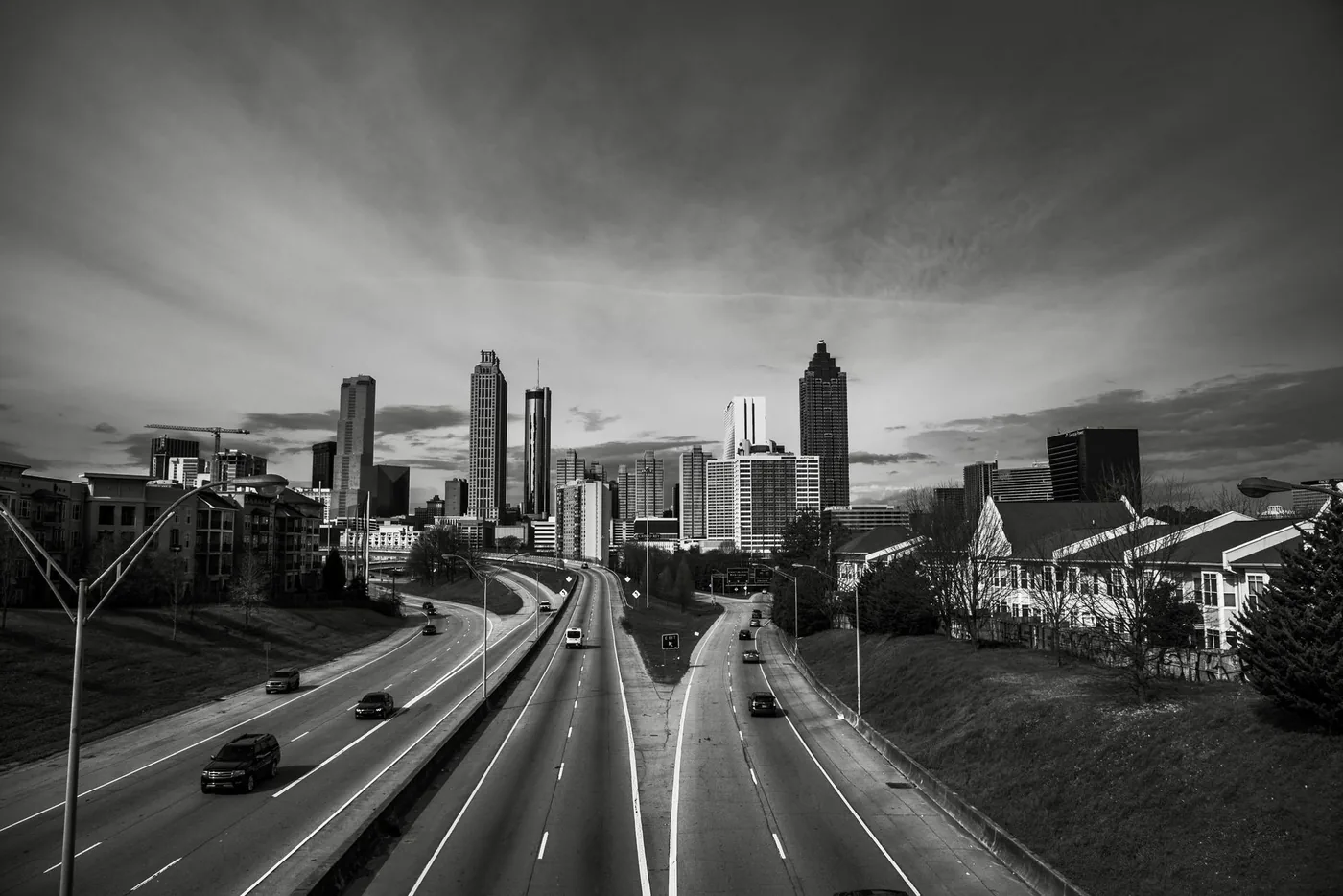
About 20 miles. Twenty-five minutes clear, an hour at peak.
Twenty miles northwest of downtown Atlanta, straight down I-75, on one of the most congested urban interstates in the southeastern United States.
The numbers
| Feature | |
|---|---|
| Distance | ~20 miles downtown to downtown |
| Drive time, free-flow | 25–30 min |
| Weekday peak | 50 min – 1 hr 10 |
| Main route | I-75 south |
| Alternative | US 41 / Cobb Parkway, I-285 |
The route
I-75 south is the direct line, through Cumberland and Vinings into the Downtown Connector — the shared I-75/I-85 section through central Atlanta.
The Connector is where the delay concentrates. It carries the combined load of two interstates through the middle of the city, and it is consistently among the worst-performing urban freeway segments in the region.
US 41 / Cobb Parkway runs parallel as a surface alternative. Slower in free-flow conditions, but a genuine option when I-75 is broken, and useful for destinations along the corridor rather than downtown.
I-285, the Perimeter, is the bypass. Not useful for a downtown trip, but the right answer if your destination is on the east or south side of the metro — including the airport.
When to go
| Departure | Typical duration | Notes |
|---|---|---|
| Before 6:00 a.m. | 25–30 min | Free-flow |
| 6:30 – 9:30 a.m. | 50 min – 1 hr 10 | Peak southbound into Atlanta |
| 10:00 a.m. – 2:30 p.m. | 30–40 min | Best window |
| 3:00 – 7:00 p.m. | 45 min – 1 hr | Peak northbound toward Marietta |
| After 7:30 p.m. | 25–30 min | Clear |
Atlanta's peaks run long. The evening build starts around 3 p.m. and does not properly clear until after 7 — a four-hour window rather than the two-hour one most people plan for.
Direction matters. Employment concentrates in and around central Atlanta, so mornings load southbound and evenings northbound. A reverse commuter — living in the city, working in Cobb County — travels against the dominant flow both ways and has a materially easier time of it.
The Cumberland factor
The Cumberland / Galleria area sits directly on this corridor at roughly the midpoint, and it is a major employment and retail centre in its own right — not just a place you drive past.
Truist Park is also there. Braves game days generate substantial I-75 traffic in a two-to-three-hour window before first pitch, and the exits serving the stadium area back up badly.
If you are making this trip on a game day, check the schedule first. It is thirty seconds and it is the difference between twenty-five minutes and ninety.
MARTA and the Cobb County gap
This is the thing that shapes transit on this corridor.
MARTA rail does not serve Marietta. Cobb County is outside the MARTA rail network, and there is no train between the two cities.
CobbLinc operates bus service connecting parts of Cobb County to MARTA stations. It works, it is cheap, and journey times are long with limited schedules. Check carefully before relying on it.
The practical hybrid: drive or get dropped at a northern MARTA rail station, then take the train into the city. That removes the Connector — the part of the trip with all the traffic risk — and converts an unpredictable hour into a predictable one.
For a downtown Atlanta destination during peak, that hybrid is frequently the best version of this trip.
Where to stop
Twenty miles does not need a stop, but Cumberland and Vinings sit near the midpoint with substantial services just off I-75, and both are easy on and off.
Weather
Summer thunderstorms are frequent and intense in north Georgia, and they arrive fast. The Connector at capacity degrades disproportionately when wet.
Winter ice is rare and severe. Atlanta has limited equipment and drivers have limited practice — an ice event closes the metro rather than slowing it. Elevated sections and the bridges over the Chattahoochee freeze first.
Fog in the Chattahoochee river valley is common on autumn mornings, and the corridor crosses it.
Pollen season in spring is not a driving hazard but it is a genuine visibility and comfort issue in this region, and it is worth knowing about if you are new to Atlanta.
The airport version
A large share of Marietta–Atlanta trips are really airport trips, and Hartsfield-Jackson is on the far side of the city — south, when Marietta is northwest. That is a 30-mile crossing rather than a 20-mile one, and the route decision changes.
We cover the airport version separately.
The reverse trip
Atlanta to Marietta is the evening problem — northbound between 3 and 7 p.m., with the Connector at its worst.
If you have any flexibility, leaving before 2:30 p.m. or after 7:30 p.m. is worth roughly half an hour.
Before you leave
Twenty miles through the Downtown Connector is a trip where the road decides your day, not the distance. See the best time to leave Atlanta to avoid traffic. Airport: Marietta to Atlanta Airport.
BoardSpy tells you before you leave what I-75 and the Connector actually look like right now — with event-day alerts for Truist Park and live weather on the route.
Related BoardSpy guides
Frequently asked questions
How far is Marietta to Atlanta?
About 20 miles downtown to downtown. Free-flow is 25–30 minutes. Weekday peaks run 50 minutes to 1 hour 10 on I-75 into the Downtown Connector. Pattern estimates, not live times.
When is the worst time to drive Marietta to Atlanta?
Southbound into Atlanta 6:30–9:30 a.m. and northbound toward Marietta 3:00–7:00 p.m. Atlanta’s evening peak starts around 3 p.m. and does not clear until after 7.
Does MARTA go to Marietta?
No. Cobb County is outside the MARTA rail network. CobbLinc buses connect parts of Cobb to MARTA stations. A common hybrid is drive to a northern MARTA station, then ride into downtown.
Does a Braves game change the drive?
Yes. Truist Park at Cumberland sits on this corridor. Game days generate substantial I-75 traffic in a two-to-three-hour window before first pitch.
Is this the same as Marietta to the airport?
No. Hartsfield-Jackson is south of downtown; Marietta is northwest. That is about a 30-mile crossing, not this 20-mile downtown run, and I-285 often enters the decision.
References
Posted signs and operator timetables override this guide. Drive-time windows are pattern estimates, not measured figures for today.
- Georgia DOT — I-75 / Downtown Connector operations in metro Atlanta.
- MARTA — Rail network coverage; Marietta is outside the rail system.
- CobbLinc — Cobb County bus connections to MARTA stations.
- BoardSpy data sources — How leave-time recommendations use a saved route (limits disclosed).