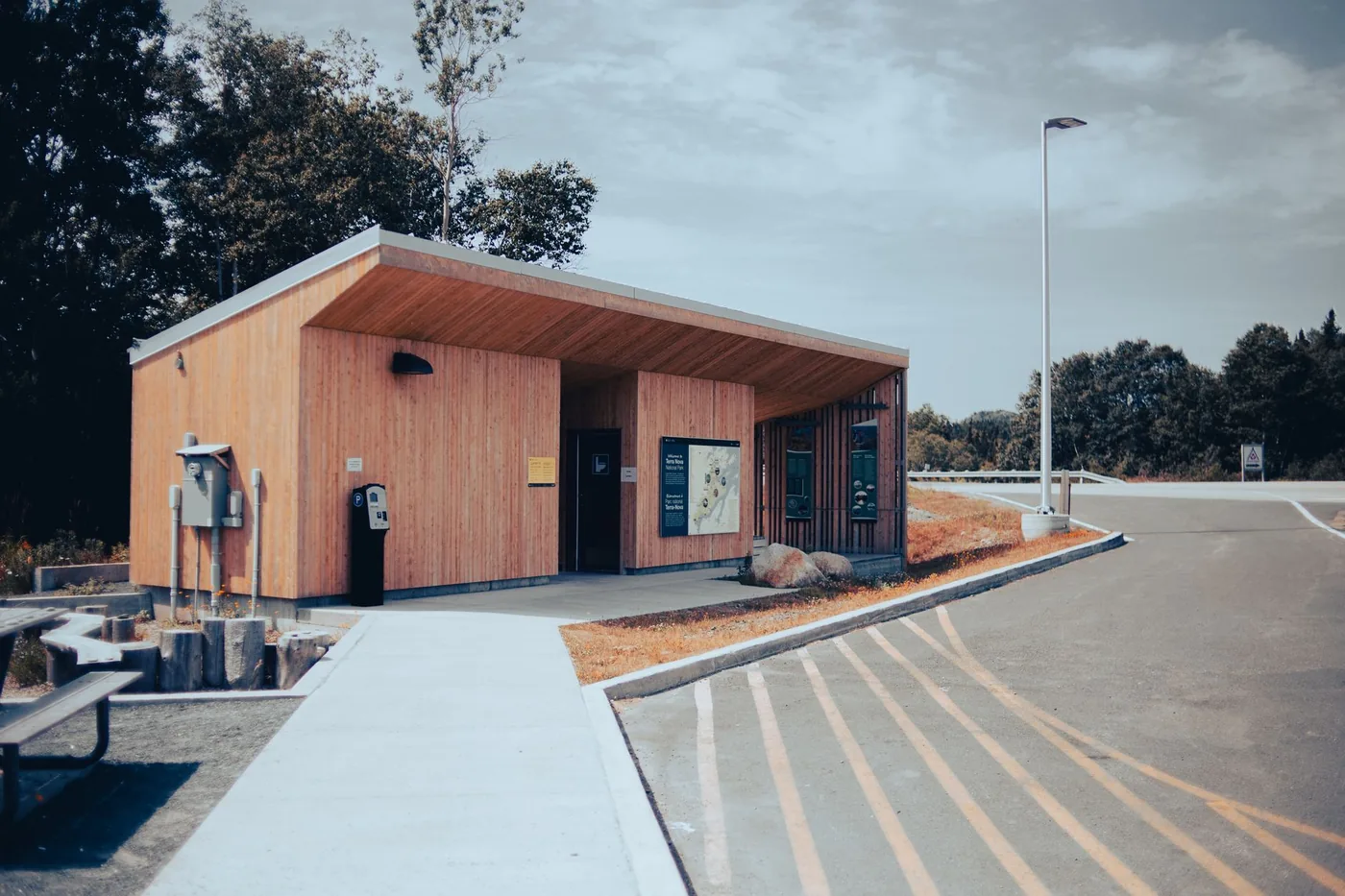
"Freeway rest stop" and "interstate rest area" usually mean the same facility. The word changes by region — freeway is the western term, particularly in California — but the rules are set by the state, not by what the road is called.
Here is what applies, and what to expect. Full state-by-state limits: interstate rest stops.
What a freeway rest stop is
A facility built and maintained by a state Department of Transportation, accessible directly from the mainline, free to enter, and governed by that state's administrative code.
Standard facilities:
- Restrooms
- Vending machines
- Picnic areas and shade structures
- Pet-walking areas
- Separated car and truck parking
- Sometimes: WiFi, dump stations, water, local information
What they are not: they are not campgrounds, not truck stops, and not service plazas. All three of those are different things with different rules, and confusing them is how people end up being moved on at 3 a.m.
How long you can stay
This is the part that varies, and it varies a lot.
The permissive end:
Arizona has no rules against overnight parking and no restriction on length of stay. Arkansas likewise allows overnight with no limitation. Georgia has no defined time limit — state law expressly protects resting, sleeping and eating at rest areas and welcome centers.
Texas allows roughly 24 hours. Iowa allows up to 24 hours for reasonable justification including rest. New Mexico allows up to 24 hours in any 3-day period. Nevada allows 18 hours within a 2-week period.
The western freeway states specifically:
California — roughly 8 hours. Enforced more consistently than in neighbouring states.
Washington — roughly 8 hours.
Oregon — overnight generally permitted; posted signs govern.
Idaho — 10 consecutive hours on interstate rest areas, 16 on other state highways, under IDAPA 39.03.50.
The restrictive end:
Tennessee does not allow overnight truck parking at all — around two hours, enforced, with officers able to check logs. New Jersey and Pennsylvania cap at roughly two hours. Illinois caps at three under Ill. Admin. Code Title 92 § 533.20, and notes the limit may be reduced further when capacity is approached.
The rule that never changes
No state allows camping at a rest area. Not one.
Sleeping inside your vehicle is a different legal category and is what most of the permissions above cover. Camping means anything outside the vehicle — slides out, awnings, chairs, gear, cooking, campfires. Banned everywhere, including in the states with no time limit at all.
Arizona and Idaho both specifically prohibit campfires alongside camping.
Truck spaces
Spaces marked for commercial trucks are for commercial trucks.
When passenger vehicles and RVs occupy them, drivers with legally mandated rest requirements end up parking on highway shoulders instead. That is a genuine safety issue produced by a small discourtesy.
If you are in a car or an RV, use the car and RV spaces. They are always there. Overnight truck rules: truck rest stops.
Why stopping is worth it
Drowsy driving causes roughly 100,000 crashes a year, concentrated between midnight and 6 a.m.
The arithmetic is straightforward. A rest stop you did not need costs you twenty minutes. A rest stop you needed and skipped costs considerably more.
Freeway rest areas exist specifically to reduce that number, and in the western states they tend to be spaced around the long empty stretches where skipping one is worst. West Coast example: rest stops on I-5.
Finding them
Most state DOTs publish rest area locations, and several publish interactive maps showing which specific sites have truck parking, dump stations, WiFi or propane.
Arkansas does this particularly well. Georgia and Idaho publish similar tools.
Checking before a long run beats arriving at a facility closed for maintenance.
Safety
Rest areas are public facilities on busy roads, and traffic proximity provides some natural visibility. That said:
- Rural facilities are generally quieter than urban ones
- Park where there is lighting and other vehicles
- Keep doors locked when sleeping
- Do not leave valuables visible
Massachusetts has a specific rule worth knowing: you cannot leave a vehicle unattended for more than 30 minutes.
When a rest stop is the wrong choice
When you need more time than the state allows. In California and Washington the cap is eight hours; in Tennessee it is two. A truck stop is a private business setting its own rules and is the correct answer.
When you need fuel. Rest areas almost never have it. Service plazas on toll roads usually do; ordinary rest areas do not. See toll road rest stops.
When you need a proper meal. Vending machines are the norm.
When the weather is severe enough that you might be there for a day. Check the state's limit before you settle in.
Rules change
Posted signs at the facility override this or any other guide, and state DOT websites are the authority. Rules change without notice.
Before you leave
The facility ahead may be open, closed for maintenance, or full at the hour you arrive — and it may not permit what you need.
BoardSpy shows the rest stops, fuel and food actually along your route as you drive it, filtered by real detour distance, so the next stop is one you can reach and use.
Related BoardSpy guides
- Interstate rest stops: US overnight rules
- Truck rest stops overnight parking
- Toll road rest stops and service plazas
- Rest stops on I-5
Frequently asked questions
Are freeway rest stops the same as interstate rest areas?
Usually yes. “Freeway” is the western term, particularly in California. The rules are set by the state, not by what the road is called.
How long can you stay at a freeway rest stop in California?
About eight hours, enforced more consistently than in neighbouring states. Washington is also about eight hours. Oregon generally permits overnight; check posted signs.
Can you camp at a freeway rest area?
No. No state allows camping at a rest area. Sleeping inside the vehicle is a different legal category. Awnings, chairs, cooking and campfires are camping.
Do freeway rest stops have fuel or restaurants?
Almost never. Expect restrooms, vending, picnic areas and pet walking. For fuel or a proper meal, use a truck stop or a toll-road service plaza.
When should you skip a freeway rest stop?
When you need more time than the state allows, when you need fuel or a real meal, or when severe weather might keep you there for a day. A truck stop is a private business with its own rules.
References
Posted signs and operator timetables override this guide. Stay limits are pattern summaries of state DOT rules, not a substitute for the sign at the facility.
- NHTSA: Drowsy Driving — NHTSA estimates drowsy driving is involved in about 100,000 crashes a year, concentrated overnight.
- 23 CFR § 752.5 — Safety rest areas — Federal rule defining Interstate safety rest areas; petroleum sales are not allowed at those Interstate sites.
- Caltrans rest areas — California Safety Roadside Rest Area program; typical ~8-hour stays.
- IDAPA 39.03.50 — Idaho rest-area stay limits (10 hours interstate / 16 hours other state highways).
- Arizona DOT rest areas — Arizona rest-area information; no statewide overnight time cap.
- Georgia DOT rest areas — Georgia rest-area locations and the statutory rest/sleep/eat protection.
- BoardSpy data sources — How leave-time recommendations use a saved route (limits disclosed).