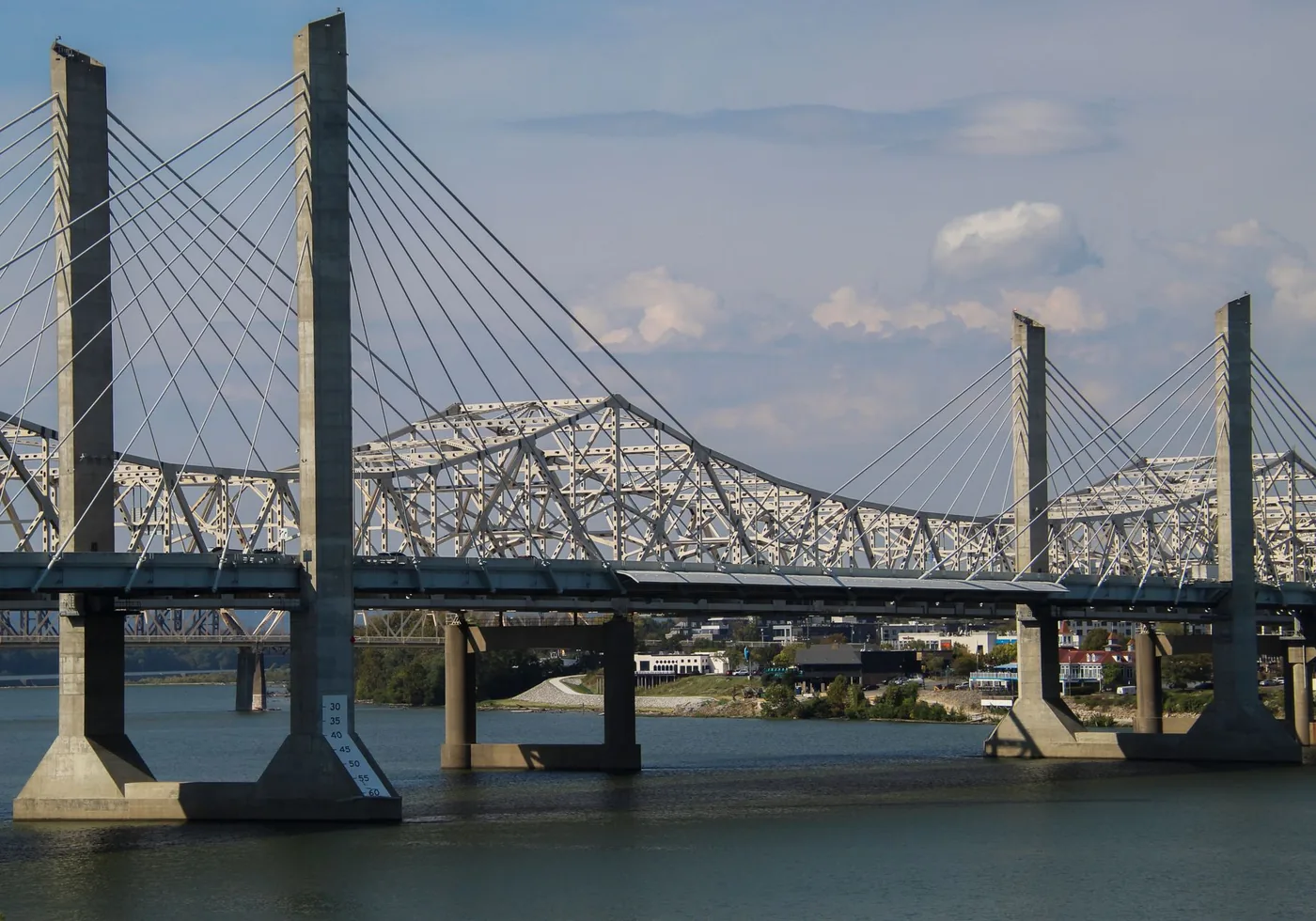
Louisville's commute is defined by a river and a price list. Here is what the agency data says, when the crossings actually peak, and how to find the best time to leave for your route.
Three bridges cost money, two don't
Louisville has five vehicle crossings of the Ohio River, and the split is the single most important thing to know about driving here.
Tolled, per RiverLink, the tolling authority:
- Abraham Lincoln Bridge — I-65 northbound
- John F. Kennedy Memorial Bridge — I-65 southbound
- Lewis and Clark Bridge — I-265 / KY 841, Prospect to Utica
Free, in RiverLink's own words, both "remain toll free":
- Sherman Minton Bridge — I-64, West Louisville to New Albany
- Clark Memorial Bridge — US 31, the downtown "Second Street Bridge"
Note the asymmetry: the Sherman Minton is the region's only free interstate-grade crossing. The Clark Memorial is a four-lane surface-street bridge, which makes it a very different proposition at 8 a.m.
Current rates, from RiverLink: as of 1 July 2025 tolls "range from $2.68 for passenger cars to $16.01 for trucks with five or more axles," with the standard passenger rate at $5.36 per crossing and a 50% discount for drivers with a transponder and prepaid account. As of July 2026 the prepaid-transponder passenger rate is $2.79. Rates rise annually by inflation or 2.5%, whichever is greater.
The states predicted the price would move the traffic
Tolling began 30 December 2016 — more than 52,000 vehicles crossed the three toll bridges in the first twelve hours.
What makes this a genuinely unusual commute market is that Indiana and Kentucky forecast the behavioural shift before it happened, in the official Louisville–Southern Indiana Ohio River Bridges Traffic & Revenue Study. From the study:
"In 2030, I-65's share of traffic falls from 42% to 31% when tolls are added... In 2030, the East End Crossing's share of traffic falls from 20% to 16% when tolls are added, with similar reductions seen in the other years."
The same study expected the tolled I-65 crossing to capture "roughly 70% of its non-tolled level," and the east-end crossing around 80%.
For scale, the study's 2012 baseline counts: the I-65 Kennedy Bridge carried 122,000 vehicles a day, the I-64 Sherman Minton 78,200, and the US-31 Clark Memorial 24,100. RiverLink's 2024 annual report records 37.1 million crossings across all three tolled bridges, up 2% on 2023, of which 4.6 million were five-or-more-axle trucks.
That works out to roughly 101,600 crossings a day across all three tolled bridges combined — fewer than the single Kennedy Bridge alone carried before the project. Louisville added a second I-65 span and an entirely new east-end bridge, and the tolled system still moves less traffic per day than the old bridge did. (Those two figures are not strictly like-for-like — one is a bridge count, the other is toll transactions — but the direction is unambiguous.)
The practical conclusion: in Louisville, price is a routing variable, not just a cost. Which bridge is busy at 8 a.m. depends partly on who decided $2.79 was worth saving.
When is Louisville traffic worst?
The state's river-crossing counts give unusually precise peaks. From Table ES-4 of the Traffic & Revenue Study, total daily crossings by period:
| Hour | Crossings |
|---|---|
| 6–7 a.m. | 12,161 |
| 7–8 a.m. | 16,857 — morning peak |
| 8–9 a.m. | 14,429 |
| 10 a.m.–3 p.m. | ~13,870 per hour |
| 3–4 p.m. | 15,858 |
| 4–5 p.m. | 18,225 |
| 5–6 p.m. | 18,255 — evening peak |
| 6–7 p.m. | 12,923 |
| 7 p.m.–6 a.m. | ~4,202 per hour |
Three things fall out of that table:
- The evening peak is worse than the morning — 18,255 against 16,857, about 8% higher.
- The 4–5 p.m. and 5–6 p.m. hours are effectively tied, 30 crossings apart. There is no "leave at 4 to beat it."
- The 6–7 a.m. hour is lighter than lunchtime — 12,161 crossings against a midday average of about 13,870. Leaving before 7 a.m. puts you in genuinely quieter traffic than noon does.
These are river-crossing counts from a 2012 base year rather than whole-network figures, so treat them as the shape of the day rather than today's volumes. The Texas A&M Transportation Institute's 2025 Urban Mobility Report puts the Louisville area at 54 hours of delay per commuter a year and $1,219 in annual congestion cost, using 2024 data.
By corridor:
- I-65 and the twin tolled bridges — the north–south spine, six lanes each way across the river. Southbound inbound from Southern Indiana in the morning.
- I-64, the Riverfront Expressway — east–west through downtown on an elevated viaduct, three lanes each way, crossing on the free Sherman Minton.
- I-71 — begins at the Kennedy Interchange and runs northeast; the Oldham County commuter radial.
- I-264, the Watterson Expressway — a 22.93-mile partial inner loop, not a full beltway. Around 70,000 vehicles a day near US-31W.
- I-265, the Gene Snyder Freeway — the outer partial beltway, carrying the tolled Lewis and Clark Bridge, which opened 18 December 2016.
- Dixie Highway / US-31W — the surface arterial paralleling I-65 southwest, feeding downtown and the Clark Memorial Bridge.
Prefer a leave-by time to a set of windows? Put your arrival time into the departure time calculator and it will work out when to go.
Spaghetti Junction: three interstates in one interchange
I-64, I-65 and I-71 all meet at the Kennedy Interchange, a few hundred yards from the river crossings. I-71 has no other southern end — its entire 345-mile run to Cleveland starts here.
Before the $1.1 billion redesign, I-64 squeezed through the junction on a single funneled lane in each direction, now two, with shoulders widened to 12 feet. The 1996 Ohio River Major Investment Study measured 261 crashes per 100 million vehicle-miles travelled from 1996 to 1998 — 172% above the Kentucky state average.
Rebuilt or not, the geometry is still the geometry: an incident here propagates onto three interstates and the bridge approaches simultaneously.
Louisville has lost its free interstate crossing before
In September 2011, cracks were found in main load-bearing elements of the Sherman Minton Bridge and it was closed by emergency order. Engineers later concluded the initiating crack dated back to the bridge's original 1960s construction but had not been discovered until that summer, in a type of steel now known to be susceptible to cracking. An initial 2.5-inch crack was repaired within a fortnight, after which five to seven more were found.
The bridge reopened on 17 February 2012 — closed for about five months and eight days. The repair cost roughly $20 million and used about 1,200 short tons of reinforcing steel plating.
Worth holding onto as context: the crossing that absorbed that traffic, I-65, is the tolled one now.
Three Louisville-specific things that move the peak
- The toll is a routing decision. Three of five crossings cost $2.79 with a transponder, $5.36 standard, and up to $16.01 for heavy trucks. Two are free, and only one of those is interstate-grade. The states' own forecast had I-65's share of all river crossings dropping from 42% to 31% on price alone.
- Thunder Over Louisville takes a free bridge out for three and a half days. The Derby Festival's opening event launches fireworks from the Clark Memorial Bridge itself. For the 2026 event, Louisville Metro Police announced the Clark Memorial Bridge closed from 9:30 a.m. Thursday 16 April to 3 p.m. Sunday 19 April, with I-65 both directions, I-64 both directions and I-71 southbound closed entirely from 8:30 to 11:30 p.m. on Saturday 18 April. One of the city's two free crossings is gone for most of four days.
- Derby week. The 2025 Kentucky Derby drew an official Churchill Downs attendance of 147,406 on a single afternoon, at the end of a festival fortnight that has already reshaped downtown traffic.
Why your best time is route-specific
A tolled I-65 crossing does not peak like the free Sherman Minton, an inbound trip is not an outbound one, and a commute over the Clark Memorial in April is a different problem entirely. Citywide advice smooths over exactly the differences that decide your drive. Nationally, the worst day of the week varies by city too.
Driving the I-65 corridor? See the best time to leave Indianapolis to the north and Nashville to the south.
Find the best time to leave for your Louisville route
Google Maps and Waze show live traffic and turn-by-turn once you are already on the road. BoardSpy is the leave-time app: it checks your saved Louisville route before you leave, recommends when to go, sends traffic and weather alerts, and tracks delay and on-time stats including your best and worst days. When you set off, it opens your map app for turn-by-turn. For how routing apps differ from departure-timing tools, see best app to avoid traffic and Google Maps commute alternatives.
Just passing through?
This page is for commuters driving in and around Louisville. If you are crossing the metro on the interstate rather than commuting within it, the timing question is different — see the best time to drive through Louisville.
Nearby cities
- Best time to leave Indianapolis
- Best time to leave Nashville
- Best time to leave Columbus
- Best time to leave Memphis
Every metro is listed on Best time to leave by city.
Frequently asked questions
What is the best time to leave to avoid traffic in Louisville?
Before 7:00 a.m. is the strongest single move. Indiana and Kentucky's river-crossing counts show the 6–7 a.m. hour carrying 12,161 crossings against a midday average of about 13,870 — so leaving before 7 is quieter than leaving at lunchtime. The peak hours are 7–8 a.m. and 5–6 p.m., and in the evening the 4–5 p.m. hour is effectively just as busy as 5–6, so leaving an hour early does not help.
When is Louisville rush hour?
The morning peak hour is 7–8 a.m. and the evening peak hour is 5–6 p.m., per the states' Ohio River crossing counts. The evening is about 8% heavier than the morning. The forecasting model in the same study treats the broader peak periods as 6–9 a.m. and 3–7 p.m.
Which Louisville bridges are tolled and which are free?
Tolled: the Abraham Lincoln Bridge (I-65 northbound), the John F. Kennedy Memorial Bridge (I-65 southbound), and the Lewis and Clark Bridge (I-265). Free: the Sherman Minton Bridge (I-64) and the Clark Memorial Bridge (US 31). The Sherman Minton is the only free interstate-grade crossing; the Clark Memorial is a four-lane surface-street bridge.
How much are the Louisville bridge tolls?
RiverLink's rates effective 1 July 2025 range from $2.68 for passenger cars to $16.01 for trucks with five or more axles. The standard passenger-car rate is $5.36 per crossing, halved for drivers with a transponder and a prepaid account; as of July 2026 that prepaid passenger rate is $2.79. Rates increase annually by inflation or 2.5%, whichever is greater.
Did tolling change which bridges people use in Louisville?
Kentucky and Indiana forecast that it would, in their own official traffic and revenue study. That study projected I-65's share of all river crossings falling from 42% to 31% once tolls were applied, and the East End crossing's share falling from 20% to 16%, with the tolled I-65 crossing capturing roughly 70% of its untolled traffic level. Published post-2016 counts for the two free bridges are not available, so the shift is best described as the states' forecast rather than a measured outcome.
How do I find the best time to leave for my Louisville commute?
Use a leave-time commute app that reads your actual route rather than only a live map. BoardSpy recommends when to leave for your Louisville route, sends pre-departure traffic and weather alerts, and tracks on-time performance and your best and worst traffic days. Download it here.