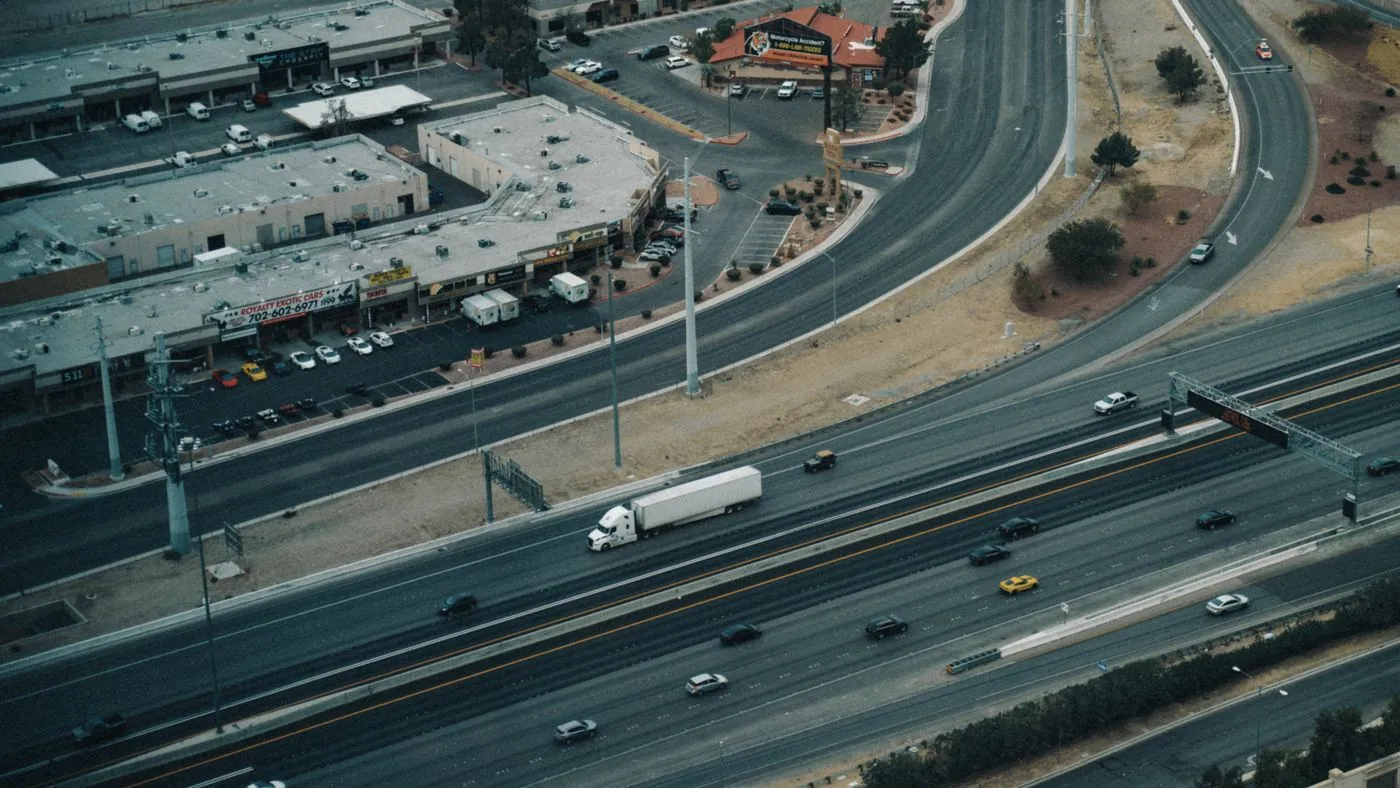
Las Vegas is the one US metro where the standard two-peak model genuinely doesn't fit. Here is what the agency data says, when things actually load up, and how to find the best time to leave for your route.
Four miles of road, 300,000 vehicles a day
NDOT's own account of Project Neon is unusually quotable. It describes the work as "the state of Nevada's largest and most expensive public works job ever undertaken" in the state's 155-year history: $1 billion total, $603 million in construction, covering nearly four miles of I-15 between Sahara Avenue and the Spaghetti Bowl interchange.
The numbers NDOT gives for that stretch:
| Daily traffic | 300,000 vehicles — "currently the busiest stretch of highway in Nevada" |
| Share of state population | about one tenth, passing through daily |
| Lane changes | 25,000 per hour |
| Crashes | an average of 3 per day |
| Expected growth | traffic to nearly double over the next 20 years |
Construction ran April 2016 to May 2019 and finished nearly a year early. NDOT's phase names — "Car-nado," "The Big Squeeze," "The Main Event" — tell you how the agency itself thought about it.
Twenty-five thousand lane changes an hour is the figure worth holding onto. That is what a road looks like when it is simultaneously a commute route, a resort-corridor artery and the only interstate to Southern California.
FHWA found three peaks, not two
This is the finding that should change how you plan your day here.
In a near-road monitoring study on I-15, FHWA recorded a "tri-modal traffic distribution as opposed to a bi-modal distribution". Most volume occurs during midday, and volume peaks around 4:00 p.m. The hourly patterns were similar across months.
FHWA's quarterly congestion data says the same thing a different way. For April–June 2026:
| measure | Las Vegas | all-cities average |
|---|---|---|
| Congested hours per weekday | 2:34 | 2:33 |
| Travel Time Index | 1.15 | 1.23 |
| Planning Time Index | 1.53 | 1.75 |
Las Vegas has the same amount of congested time as the average American city but noticeably milder peaks. The delay is spread thin across the day rather than concentrated into two spikes. The Texas A&M Transportation Institute separately names Las Vegas one of four US cities with "relatively flat geography and well-built freeway networks," which fits.
So the practical advice inverts the usual rule: the safest departure windows here are early morning and evening, not midday. Lunchtime is not the gap it is in most cities.
Thirty-eight million visitors on a 2.4-million-person road network
Clark County has 2,407,226 residents. The Las Vegas Convention and Visitors Authority recorded 38,545,700 visitors in 2025 — down from 41,676,300 in 2024 — plus 5,988,200 convention attendees.
That is roughly sixteen visitors per resident per year, on roads built and funded for the residents.
Some of it is measurable at the single-event level. CES 2026, held 6–9 January, posted audited total attendance of 148,392 with over 4,100 exhibitors, 55,841 of them international. One four-day event adds a city's worth of people to the same freeways.
And a verified share arrives by car: in a joint announcement with California, Nevada's governor stated that "more than 11 million Las Vegas visitors drive in and out of town on I-15 each year."
When is Las Vegas traffic worst?
Neither NDOT nor the RTC publishes a plain "rush hour" definition. NDOT's HOV lane hours are the closest official answer: 6:00–8:00 a.m. and 4:00–6:00 p.m., Monday to Friday, set in 2023. Combine that with FHWA's 4:00 p.m. peak and the late afternoon is clearly the pinch.
By corridor:
- I-15 — the north–south spine and the only route to Southern California. NDOT calls the Sahara-to-Spaghetti-Bowl stretch the busiest highway in Nevada at 300,000 a day. HOV lanes run from the Spaghetti Bowl to Silverado Ranch.
- US-95 / I-515 — the northwest-to-southeast spine through the Spaghetti Bowl toward Henderson, carrying over 20 miles of continuous HOV lanes from the Elk Horn connector to the interchange.
- The 215 Beltway (Bruce Woodbury Beltway) — roughly 50 miles of orbital, split between I-215 under NDOT and CC-215 under Clark County. Full freeway build-out completed December 2023 with the Centennial Bowl, whose US-95-to-CC-215 flyover is 2,635 feet long, the second-longest structure in Nevada.
- Summerlin Parkway (SR-613) — the Summerlin-to-US-95 connector, and a genuine commuter route: NDOT applies HOV restrictions to it.
- Charleston Boulevard (SR-159) — the cross-valley east–west arterial, 19.2 miles under NDOT, signed as Fremont Street at its eastern end.
- Las Vegas Boulevard, the Strip — about 4.2 miles, and worth being precise: it is not a state route and not a commuter corridor. It is the visitor corridor that pushes commuters onto I-15 and the arterials instead.
Prefer a leave-by time to a set of windows? Put your arrival time into the departure time calculator and it will work out when to go.
Three Las Vegas-specific things that move the peak
- I-15 southbound on Sundays and Mondays is its own event. Per that joint California–Nevada announcement, southbound travel times on Sundays and Mondays run three to five hours for the 113 miles from the state line to Barstow. Most of the congestion is in a five-mile stretch where I-15 drops from three lanes to two and back. California added a $12 million part-time shoulder lane used primarily on Sundays and Mondays — and called it a temporary fix. If your week involves leaving or returning on a Sunday, that is the constraint, not rush hour.
- A quarter of the workforce is in hospitality. Bureau of Labor Statistics figures for August 2026 put leisure and hospitality employment at 302,500 of 1,184,600 total nonfarm jobs — about 25.5%. That is roughly double the national share. A workforce that size on round-the-clock shifts is the most plausible reason FHWA sees three peaks rather than two, though no agency states the causal link.
- Heat is a schedule, not a season. NWS Las Vegas 1991–2020 normals: 78.2 days a year at or above 100°F, 40.5 days at or above 105°F, and 9.4 days at or above 110°F. Annual precipitation is 4.18 inches, with June the driest month at 0.04 inches. NWS also warns of gusty winds of 45–55 mph, higher in the passes, with blowing dust. On a 110-degree afternoon, when you leave is a vehicle-reliability question as much as a traffic one.
Why your best time is route-specific
I-15 through the Spaghetti Bowl behaves nothing like Summerlin Parkway, the Beltway loads suburb-to-suburb rather than inbound, and a Sunday run toward California is a completely separate problem from a Tuesday commute. Citywide advice smooths over exactly the differences that decide your drive. Nationally, the worst day of the week varies by city too.
Driving I-15 southwest? See the best time to leave Los Angeles, or the best time to drive through Los Angeles if you are transiting. North on I-15, Salt Lake City is the next metro.
Find the best time to leave for your Las Vegas route
Google Maps and Waze show live traffic and turn-by-turn once you are already on the road. BoardSpy is the leave-time app: it checks your saved Las Vegas route before you leave, recommends when to go, sends traffic and weather alerts, and tracks delay and on-time stats including your best and worst days. When you set off, it opens your map app for turn-by-turn. For how routing apps differ from departure-timing tools, see best app to avoid traffic.
Nearby cities
Every metro is listed on Best time to leave by city.
Frequently asked questions
What is the best time to leave to avoid traffic in Las Vegas?
Early morning or evening — and specifically not midday, which is the opposite of most cities. FHWA's monitoring of I-15 found a tri-modal traffic distribution with most volume occurring at midday and the day peaking around 4:00 p.m. NDOT's HOV lanes operate 6:00–8:00 a.m. and 4:00–6:00 p.m., which is the closest thing to an official peak definition the agencies publish.
When is Las Vegas rush hour?
There isn't a clean one. Neither NDOT nor the RTC publishes a rush-hour definition, and FHWA found three peaks rather than two on I-15, with midday carrying the most volume and a peak around 4:00 p.m. NDOT's HOV restrictions run 6:00–8:00 a.m. and 4:00–6:00 p.m. on weekdays. FHWA's congestion data shows Las Vegas with the same congested hours as the national average but a lower Travel Time Index — flatter, wider congestion rather than sharp spikes.
What is the busiest road in Las Vegas?
I-15 between Sahara Avenue and the Spaghetti Bowl interchange. NDOT calls it "currently the busiest stretch of highway in Nevada," carrying 300,000 vehicles a day across roughly four miles, with 25,000 lane changes an hour and an average of three crashes a day. Rebuilding it as Project Neon cost $1 billion and was the largest public works project in Nevada's 155-year history.
How bad is I-15 to Los Angeles on a Sunday?
Bad enough that both states intervened. A joint California–Nevada announcement put average southbound travel times on Sundays and Mondays at three to five hours for the 113 miles from the state line to Barstow, with most congestion in a five-mile stretch where the freeway drops from three lanes to two and back. California added a $12 million part-time shoulder lane used primarily on Sundays and Mondays, describing it as a temporary solution. More than 11 million Las Vegas visitors drive in and out on I-15 each year.
Does the heat affect driving in Las Vegas?
It is a routine condition rather than an occasional one. National Weather Service normals for 1991–2020 give Las Vegas 78.2 days a year at or above 100°F, 40.5 days at or above 105°F, and 9.4 days at or above 110°F, with just 4.18 inches of annual rainfall. The NWS also warns of gusty winds of 45–55 mph — higher in the passes — with blowing dust. Choosing a departure time in summer is partly a vehicle decision.
How do I find the best time to leave for my Las Vegas commute?
Use a leave-time commute app that reads your actual route rather than only a live map. BoardSpy recommends when to leave for your Las Vegas route, sends pre-departure traffic and weather alerts, and tracks on-time performance and your best and worst traffic days. Download it here.