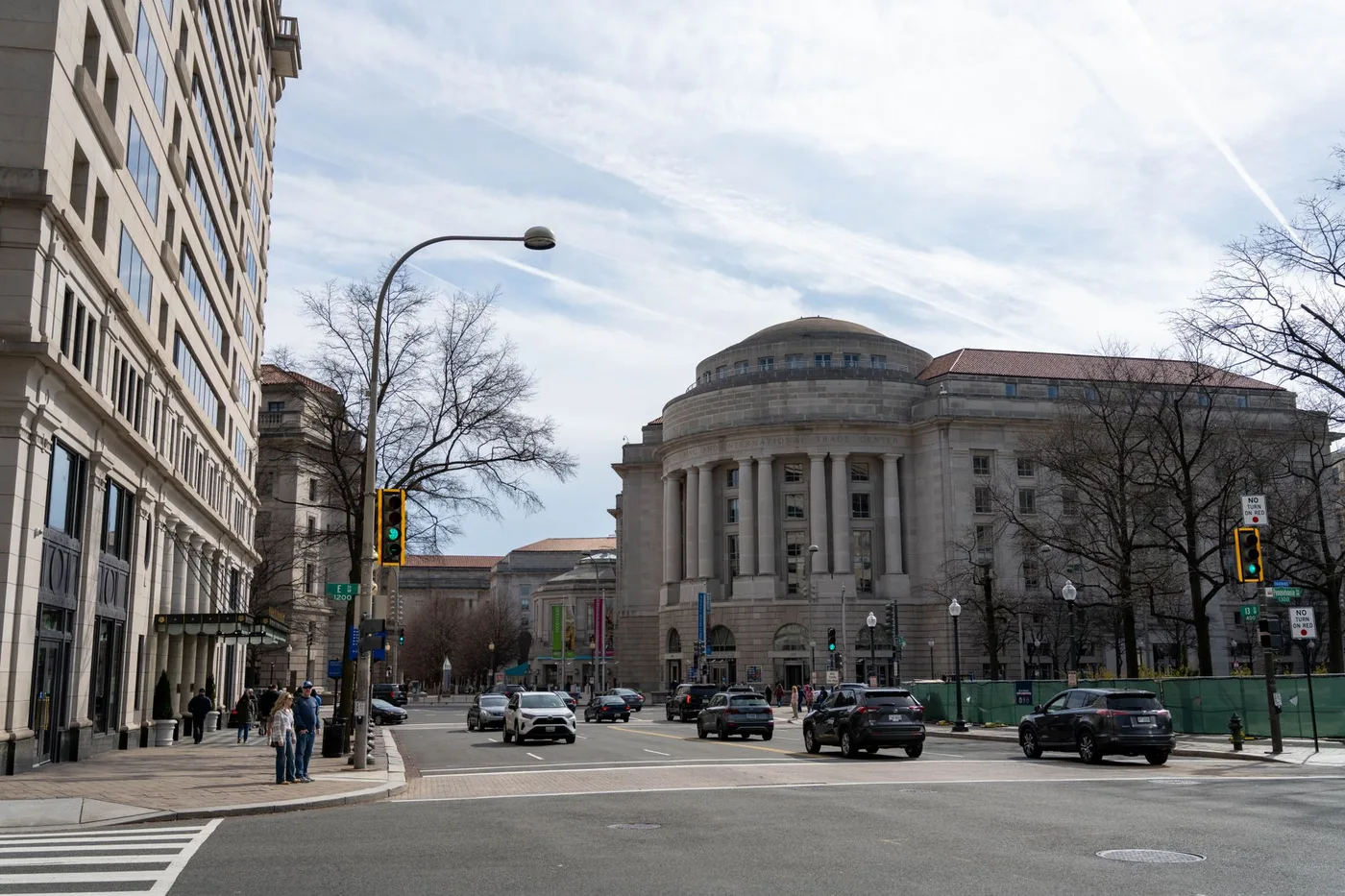
I-95 is the east coast’s spine, and Washington is the worst thing on it. Here is how to get past.
The short answer
Cross between 10:00 a.m. and 2:00 p.m., or after 7:30 p.m.
Avoid 6:00–9:30 a.m. and 3:00–7:00 p.m. The DC region consistently ranks among the most congested in the United States, and the evening peak runs four hours.
The geography
I-95 does not go through central Washington. It joins the Capital Beltway (I-495) and runs around the eastern side through Maryland, then rejoins itself south of the city in Virginia.
That means your through-route is the Beltway, and the Beltway is the problem.
Two pressure points:
The Springfield Interchange in Virginia, where I-95, I-395 and I-495 meet. Locally known as the Mixing Bowl for good reason.
The Woodrow Wilson Bridge carries the Beltway across the Potomac on the eastern side — a chokepoint with no alternative for anyone on the I-95 through-route.
East side or west side?
Eastern Beltway (through Maryland) is where I-95 actually runs. It is the through-route and usually correct.
Western Beltway (through Virginia) is longer for pure north–south travel, but it is the alternative when something breaks on the east side. Worth knowing before you need it.
The express lanes
Virginia operates dynamically priced express lanes on I-95 and I-495 south and west of the city.
Two things to know:
Pricing changes with demand, sometimes substantially, and it is displayed before you commit.
The I-95 express lanes reverse direction depending on time of day — northbound in the morning, southbound in the afternoon. Check which way they are running before you plan on them.
Occupancy requirements may apply for free use. Rules and pricing change, so check current Virginia DOT guidance rather than relying on a page you read months ago.
For a through-trip with a schedule, the express lanes are frequently worth the money. For a relaxed drive, the general lanes off-peak are fine.
Timing
| Crossing time | What to expect |
|---|---|
| Before 5:30 a.m. | Clear |
| 6:00 – 9:30 a.m. | Morning peak |
| 10:00 a.m. – 2:00 p.m. | Best window |
| 3:00 – 7:00 p.m. | Worst window |
| After 7:30 p.m. | Clearing |
Friday afternoon is the worst regular slot on the corridor. The peak starts earlier and stacks weekend traffic heading toward the Chesapeake and the beaches.
Sunday evening northbound is the return version of the same problem.
Weather
Winter snow and ice are the main disruption, and the DC region handles snow poorly relative to how often it gets it. A moderate snowfall can gridlock the Beltway.
Summer thunderstorms are intense and produce flash flooding on the low sections.
Fog in the Potomac valley areas is common on autumn mornings.
If you are stopping
Maryland House on I-95 northeast of Baltimore, and the Delaware Welcome Center further north, are the substantial service areas on the corridor. South of DC, Virginia has service areas at intervals along I-95.
Stopping inside the Beltway means leaving and rejoining a congested road, which at peak costs more than the stop.
Continuing north or south?
North: Baltimore is next, roughly 40 miles, with its own tunnel bottleneck at Fort McHenry. Then Delaware, Philadelphia and the New Jersey Turnpike.
South: Richmond, then the long run through the Carolinas.
If you are doing the full I-95 corridor, DC and Baltimore are two of the four hard crossings — the others being Philadelphia and the New York approaches.
Commuting rather than passing through?
Different problem entirely. See our best time to leave Washington DC to avoid traffic.
Before you drive
The Beltway pattern is stable. Whether there is an incident at the Springfield Interchange when you arrive is not.
BoardSpy watches the crossing in real time and tells you before you reach the region which side of the Beltway is moving — with live weather and express lane direction.
For tools that help you avoid traffic before you leave, see best app to avoid traffic.
Related drive-through guides
Along shared corridors: best time to drive through Richmond.
Frequently asked questions
What is the best time to drive through Washington DC on I-95?
Between 10:00 a.m. and 2:00 p.m., or after 7:30 p.m. The DC region has some of the worst congestion in the country and its peaks are long — roughly 6:00 to 9:30 a.m. and 3:00 to 7:00 p.m.
Should I take the east or west side of the Capital Beltway?
I-95 runs on the eastern side of the Beltway through Maryland, which is the through-route and usually the right choice. The western side via I-495 through Virginia is longer for pure north-south travel but can be better when there is an incident on the eastern side.
What are the I-95 express lanes near DC?
Virginia operates dynamically priced express lanes on I-95 and I-495 south and west of the city. Pricing changes with demand and the lanes reverse direction on the I-95 segment depending on time of day. Check the current direction and price before committing, and note that occupancy requirements may apply for free use.