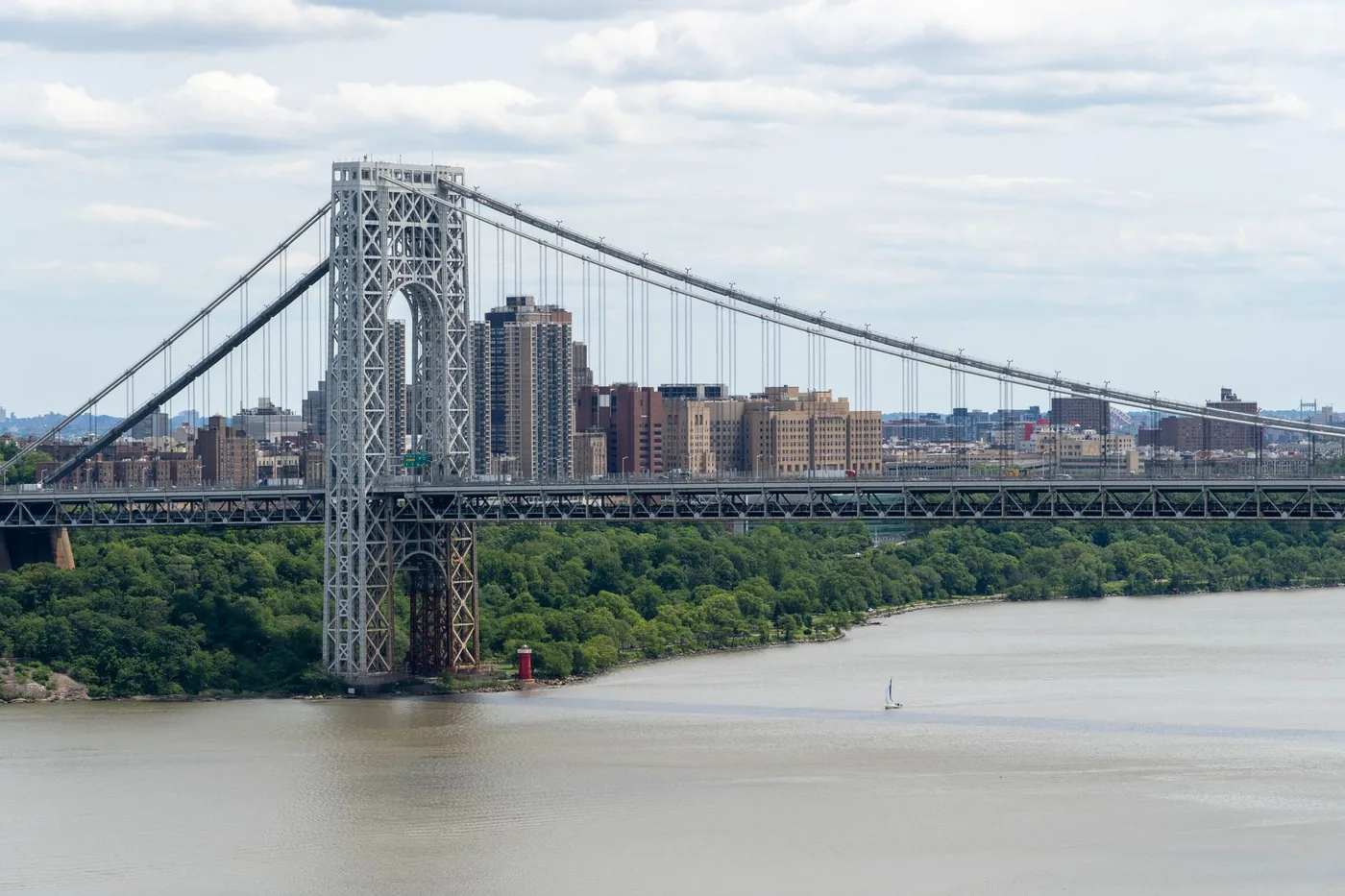
This page is for drivers crossing New York — I-95 from Philadelphia toward Connecticut, say — not for people commuting within it. Here is what the agency data says, which crossing actually works, and what the tolls really cost.
Tolls and congestion-pricing rules below were verified 8 October 2026. Both change — the Port Authority and the MTA adjust in early January.
America's worst truck bottleneck is the GWB approach
ATRI publishes an annual Top 100 Truck Bottlenecks list from freight-truck GPS data across more than 325 monitored locations. In the 2026 edition, built on 2025 data:
| Fort Lee, NJ — I-95 at SR 4 | national rank 2 |
| Average truck speed | 28.2 mph |
| Peak average | 22.1 mph |
| Non-peak average | 30.7 mph |
| National average, all monitored locations | 33.2 mph |
"I-95 at SR 4, Fort Lee" is the George Washington Bridge approach. New Jersey Route 4's eastern terminus is that interchange, and eastbound exit 72A — the ramp all trucks are directed to — feeds the GWB upper level.
That 8.6 mph gap between peak and off-peak is the whole argument of this page, and it comes from a primary source rather than an estimate. If you can shift your crossing out of the peak, you are moving from 22 mph to 31 mph through the worst freight chokepoint in the country.
Worth knowing what is not on that list: the Cross Bronx Expressway does not appear anywhere in ATRI's 2026 Top 100. If you read otherwise, the source is citing an older edition. The only New York State entries are Brooklyn's I-278 at the Belt Parkway (rank 73, 31.7 mph peak), and two I-495 locations in Queens and Manhasset.
Congestion pricing doesn't apply to you — until you take an exit
This is the most misunderstood thing about driving through New York now, and getting it right saves a lot of needless rerouting.
Manhattan's Congestion Relief Zone covers local streets and avenues south of and including 60th Street. The George Washington Bridge lands at 178th Street and I-95 continues over the Alexander Hamilton Bridge onto the Cross Bronx — entirely north of the zone. A through-driver on I-95 pays nothing.
The MTA also excludes the FDR Drive, the West Side Highway / Route 9A, and the Hugh L. Carey Tunnel connections to West Street. Its own FAQ states that drivers staying on the West Side Highway or FDR Drive to travel through the zone, from one entry point to a different exit point, are not tolled.
The catch is in the same FAQ: "The system will charge a toll only if a vehicle is no longer detected on the excluded roadways." Leave the FDR or the West Side Highway for a local street — for fuel, food, or a hotel — and you are charged.
Current rates, passenger vehicles, once per day:
| E-ZPass | Non-E-ZPass | |
|---|---|---|
| Peak (5 a.m.–9 p.m. weekdays, 9 a.m.–9 p.m. weekends) | $9.00 | $13.50 |
| Overnight (9 p.m.–5 a.m. weekdays, 9 p.m.–9 a.m. weekends) | $2.25 | $3.30 |
Crossing credits apply to peak entries only, with E-ZPass: $3.00 via the Lincoln or Holland Tunnel, $1.50 via the Queens-Midtown or Hugh L. Carey. No credits overnight. Towing a trailer bumps you up a toll class.
One trap: the old congestionreliefzone.mta.info page still serves the superseded pre-launch figures of $15 peak and $3.75 overnight. Use mta.info.
What the crossings actually cost
Port Authority — George Washington Bridge, Lincoln Tunnel, Holland Tunnel. Tolls are collected only when entering New York. Nothing is charged entering New Jersey. All crossings are cashless.
Peak is weekdays 6–10 a.m. and 4–8 p.m., plus Saturday and Sunday 11 a.m.–9 p.m. The off-peak discount for a passenger car is $2.00 — and it is being phased out, falling to $1.50 in 2027, $1.00 in 2028, $0.50 in 2029 and nothing from January 2030. Within a few years there will be no off-peak saving on a Port Authority crossing at all.
MTA Bridges and Tunnels charge $7.46 with a New York Customer Service Center E-ZPass at the Verrazzano-Narrows, Throgs Neck, Bronx-Whitestone and Robert F. Kennedy bridges and the Queens Midtown and Hugh L. Carey tunnels. Tolls by Mail is $12.03 — a $4.57 premium per crossing, 61% more. That is the one that hits out-of-state through-drivers hardest, and on a Verrazzano round trip it is over nine dollars extra.
MTA crossings have no time-of-day variation whatsoever. $7.46 at 3 a.m. is $7.46 at 5 p.m.
The Governor Mario M. Cuomo Bridge on I-287 charges a round-trip toll southbound only — nothing is collected northbound. New York E-ZPass is $7.25, with peak rates weekdays 6–10 a.m.
The asymmetry is worth planning around: a northbound I-95 run past New York via the GWB pays nothing on the Hudson crossing, because Port Authority tolls are eastbound only.
Three ways through, and the one that doesn't exist for trailers
Straight through — GWB, Trans-Manhattan Expressway, Alexander Hamilton Bridge, Cross Bronx. Shortest. One toll, eastbound only. No congestion pricing. Trucks permitted but must use the upper level; 13'6" clearance on both levels, 10'0" width limit, and propane is banned from the lower level. Then the Cross Bronx — 6.83 miles, six 12-foot lanes, carrying up to 150,000 vehicles a day in places per NYSDOT, with large stretches having no shoulders at all, so a single breakdown blocks a travel lane.
Around the south — Goethals or Outerbridge, Staten Island Expressway, Verrazzano, then Brooklyn. Two tolls. And a hard limit: the Belt Parkway is closed to all commercial vehicles, trucks and tractor-trailers. The "Verrazzano and then the Belt" shortcut does not exist for anyone towing anything — you stay on I-278 through the Gowanus and the BQE, which is ATRI's rank-73 bottleneck at 31.7 mph peak.
The Holland Tunnel is not an escape valve either: tractor-trailers, three-axle dual-unit trucks and anything with four or more axles are prohibited in both directions, with the tightest clearances of any Port Authority crossing at 12'6" high and 8'0" wide.
The western bypass — I-287 and the Governor Mario M. Cuomo Bridge. A three-mile twin span, the longest in New York State. Trucks permitted. Toll southbound only. The real risk here is the GPS trap below.
The parkway trap
This is the most expensive mistake a through-driver can make in New York, and NYSDOT warns about it explicitly.
Commercial vehicles, trucks and tractor-trailers are banned from the Belt, Bronx River, Cross Island, Cross County, FDR Drive, Grand Central, Harlem River Drive, Henry Hudson, Hutchinson River, Jackie Robinson, Mosholu, Palisades Interstate, Pelham, Saw Mill River, Sprain Brook and Taconic State parkways, plus the Long Island parkways.
Some parkway bridges have posted clearances as low as 6 feet 11 inches. NYSDOT states directly that GPS and online mapping may route you onto a parkway incorrectly, and that signs govern. The consequences it lists include fines, licence points, vehicle and bridge damage, towing fees over $10,000, and reimbursing the State and City for bridge repairs.
If you do enter one near a low clearance: pull onto the shoulder, hazards on, call 911.
Separately, under §4-13 of the Rules of the City of New York, a truck with neither an origin nor a destination in a borough must use the Through Truck Route Network while passing through, and must carry a bill of lading showing origin and destination.
Five chokepoints on the way through
- The GWB New Jersey approach — ATRI's number two bottleneck in America. 22.1 mph at peak.
- The GWB upper/lower split — fourteen lanes, eight above and six below, decided before the toll plaza and effectively irreversible. All trucks upper.
- The Cross Bronx Expressway — 6.83 miles, no shoulders in long stretches, up to 150,000 vehicles a day.
- The Bruckner Interchange — where I-95 leaves the Cross Bronx and turns north while the Cross Bronx continues east as I-295 to the tolled Throgs Neck Bridge. A mandatory lane change, or you pay a toll you didn't plan for.
- The Lincoln Tunnel helix — 74 turns through three-quarters of a circle over about 4,000 feet, descending the Palisades to the portal. Three tubes, two lanes each, no trucks in the centre tube.
Find the best time to cross New York
Google Maps and Waze show live traffic once you are already driving. BoardSpy is the leave-time app: it checks your saved route before you leave, recommends when to go, and sends traffic and weather alerts for the road ahead. When you set off, it opens your map app for turn-by-turn. For how routing apps differ from departure-timing tools, see best app to avoid traffic.
Commuting in New York rather than crossing it?
This page is for through-traffic. If you drive in and around the city daily, the timing question is different — see the best time to leave New York. On the I-95 corridor, Philadelphia and Baltimore are the next stops south.
Frequently asked questions
What is the best time to drive through New York City?
Outside the Port Authority's peak hours, which are weekdays 6–10 a.m. and 4–8 p.m. plus weekends 11 a.m.–9 p.m. The weekend window surprises people: a Saturday midday crossing is both priced and loaded like a weekday rush hour. ATRI's data on the New Jersey approach to the George Washington Bridge shows trucks averaging 22.1 mph at peak against 30.7 mph off-peak, so shifting out of the peak is worth roughly 9 mph through the worst of it.
Do I pay congestion pricing driving through NYC on I-95?
No. The Congestion Relief Zone covers local streets south of and including 60th Street. The George Washington Bridge lands at 178th Street and I-95 continues over the Alexander Hamilton Bridge onto the Cross Bronx, entirely north of the zone. The MTA also excludes the FDR Drive and the West Side Highway. You are charged only if you leave an excluded roadway for a local street inside the zone — which means an exit for fuel or food south of 60th Street triggers the $9 peak toll.
How much is the George Washington Bridge toll?
Port Authority tolls are collected only when entering New York, with nothing charged entering New Jersey, and all crossings are cashless. Peak hours are weekdays 6–10 a.m. and 4–8 p.m. plus weekends 11 a.m.–9 p.m. The off-peak discount for a passenger car is currently $2.00 and is being phased out, reaching zero in January 2030. Rates change each January, so check panynj.gov for the current figure.
Can trucks use the Belt Parkway through Brooklyn?
No. The Belt Parkway is closed to all commercial vehicles, trucks and tractor-trailers, so the Verrazzano-then-Belt-Parkway route does not exist for anyone towing a trailer. Commercial traffic stays on I-278 through the Gowanus Expressway and the BQE instead. NYSDOT bans commercial vehicles from roughly sixteen New York-area parkways, some with clearances as low as 6 feet 11 inches, and warns that GPS may route you onto one incorrectly.
Is the Cross Bronx Expressway the worst bottleneck in New York?
It is the most notorious, but it does not appear in ATRI's 2026 Top 100 Truck Bottlenecks at all. The worst documented bottleneck on a New York crossing is actually on the New Jersey side — I-95 at SR 4 in Fort Lee, ranked second nationally. The Cross Bronx's real problem is structural rather than statistical: 6.83 miles of six 12-foot lanes with long stretches having no shoulders, carrying up to 150,000 vehicles a day.
Which NYC crossing is cheapest for through-traffic?
A northbound I-95 run via the George Washington Bridge pays nothing on the Hudson crossing, because Port Authority tolls are collected eastbound only. Southbound, you pay once. If you use an MTA crossing instead, get an E-ZPass first — Tolls by Mail costs $12.03 against $7.46, a 61% premium per crossing, and MTA crossings have no off-peak discount at any hour.